11. PROPER USE
Primary medical evaluations must be carried out before the patient is moved, lifted or transported. Once the diagnosis has been made, it is
preferable to advise the patient to actively contribute to the transition from bed to stretcher/chair, while at the same time informing them of
the risks they may be running. Before loading the patient, bring the device as close as possible to the patient.
11.1 Emergency vehicle requirements
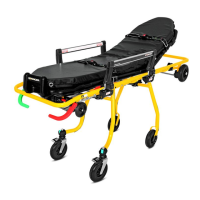
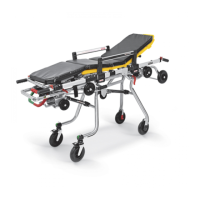
The stretcher is designed to enter and exit the medical compartment of an ambulance. The vehicle requirements should be:
• Level stretcher floor
• Stretcher floor that is wide and long enough to accommodate the stretcher without becoming an obstacle
The wheels of the front legs must be at a safe distance of at least 5 cm from the ground during loading/unloading or when the loading trolley
is still on the vehicle, to allow the front leg to open safely
Failure to take the above measure will preclude safe use of the device, resulting in risk of damage to the patient, operators and the device
itself.
11.2 Parking brakes (Image P20)
To engage the parking brakes, simply press on the strips on the rear wheel brackets with your foot. To disengage the parking brakes, simply
press down on the opposite side of the parking brake pedal and they will return to their original position with a slight click.
Never leave the patient unattended, even if the parking brakes have been engaged.
11.3 Sidebars - Image P21
The stretcher is equipped with sidebars, which are necessary for restraining the patient on the stretcher.
NEVER MOVE THE PATIENT AND NEVER LEAVE THE PATIENT ON THE STRETCHER WITHOUT FIRST RAISING THE SIDEBARS. Failure to heed
this warning could cause serious damage.
To lower the sidebars, pull the levers located on the lower part of the machine, identified by the word PULL (letter G par.10), towards you
simultaneously. The sidebar will open automatically. To close the sidebar, lift it back to its original position and check that it is correctly
hooked by making a few repeated pulling movements. Make sure that nothing interferes with the locking systems when closing. Sheets, for
example, could prevent proper closure.
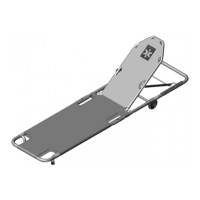
11.4 Activating the twist system (if present) - Images P22 and P23
This system allows the front wheels to pivot. This rotation is unlocked by turning the lever on the patient foot side outwards. On the Cross Up
8409 and Cross Chair trolleys, if present, the system is unlocked by turning the handle L indicated in the functional specifications in the
previous paragraph.
When unlocking the rotation is no longer necessary, reposition the control and push the stretcher forward firmly; the wheels will then be
locked again.
When using the twist system, at least one additional operator must be present to steer the head end of the stretcher, as the stretcher is
much more difficult to manoeuvre with all four wheels unlocked.
Be sure to carefully assess the ground conditions before operating the twist system, as the stretcher may move in an unexpected and
uncontrolled manner.


 To Next Page