12
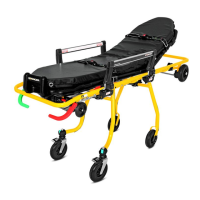
11.5 Lowering the stretcher - Image P24
To facilitate patient transfer, it is advisable to move the stretcher to the intermediate height position or to the lowered position if there is no
patient present.
Procedure for loading/unloading immobilized or hospitalized patients onto the stretcher at intermediate height:
• Engage the rear leg unlocking lever, hold it in place and lift the stretcher slightly to unlock the rear leg moving mechanism. Lower the
stretcher about 10 cm, release the unlocking lever and support the stretcher until the intermediate height position is reached. Make sure
that the stretcher has reached a stable position. Engage the brakes on the rear wheels.
To lower the front part of the stretcher, engage the red lever between the sidebars and the loading trolley, pushing the front leg slightly
towards the loading trolley - Image P25. The weight of the stretcher, patient and any equipment attached to the stretcher must be
supported. After starting the lowering motion, release the handle while keeping your grip on the frame until the stretcher reaches the
intermediate height position. Make sure that the position reached is stable.
When loading a non-hospitalized patient:
1 - Assist the patient as he/she climbs onto the stretcher, making sure that the first leg to be lifted rests on the footrest of the patient bed.
When correctly positioned, help him/her raise the other leg.
2 - Immobilize the patient with the straps and raise the sidebars.
3 - Once the patient is lying on the stretcher and correctly immobilized, carefully lift the stretcher to a horizontal position.
On Crossover stretchers, when the stretcher is moved to intermediate height, the TWIST system control lever automatically moves to the
UNLOCK position. DO NOT ENGAGE THE LEVER WITH THE BAR AT INTERMEDIATE HEIGHT BECAUSE THE MECHANISMS COULD BECOME
DAMAGED - Image P26
Once the stretcher has been returned to the standard height, return the lever to its original position.
Lowering the stretcher to the ground
This procedure allows the stretcher to reach the minimum distance from the ground.
• This manoeuvre cannot be carried out when a patient is on the device.
• Raise the stretcher from the side of the levers until the loading trolley wheels rest on the ground.
• With the loading trolley wheels resting on the ground and ready to bear the weight of the stretcher, engage both leg unlocking levers,
push towards the stretcher to unlock the front leg moving system and then the stretcher towards the ground. The stretcher is now in the
lowest position.
Note: The parking brakes will not perform their function when the stretcher is fully lowered. Make sure that the stretcher is held in place by
ate least one operator.
11.6 Releasing the stretcher from the trolley (Cross Up and Cross Chair) – Images P27 and P28
• Brake the trolley with the parking brakes.
• Engage the corresponding control (lever) and pull out the stretcher, sliding it about ten centimetres.
• Complete the operation by lifting the stretcher from the trolley.
• This operation requires at least two operators: one on the foot side of the stretcher to operate the controls, one on the head side to lift
the stretcher. Extra operators are needed in the event of especially heavy patients or adverse conditions.
11.7 Raising the stretcher – Image P24
To bring back the stretcher back to the standard height, starting from any of the previous configurations, the operators must coordinate
while simultaneously lifting the front and rear of the stretcher, ensuring the proper alignment of the patient bed. Do not carry out these
operations until you have checked that the patient has been properly restrained with the strap and that the sidebars are raised.
• At the rear, grab the part of the frame near the footrest of the patient bed or, in the case of a stretcher with detachable stretcher, grab
the telescopic handles after making sure that the stretcher is properly attached to the trolley.
• At the front, similarly, grab the frame above the loading trolley or, for stretchers with detachable stretchers, grab the telescopic handles
after making sure the stretcher is properly secured to the trolley.
• Raise the assembly until the locking mechanisms are properly engaged.
• Only use the frame of the stretcher or, in the case of stretchers with another stretcher, only use the telescopic handles for lifting.
• Do not use the boards or other areas that are not designed for this purpose.
11.8 Loading and unloading the stretcher from the medical vehicle - Images P30 and P31
Stretcher loading and unloading are among the most delicate steps during the use of stretchers. It is necessary to follow all the warnings in
this manual very carefully, practising under simulated conditions before putting the product into service. The patient must always be
properly immobilized.
Always ensure that the conditions of use allow the front legs to open properly before any loading and/or unloading operations.
To load the stretcher onto the vehicle:
• The operator performing the loading should align with the stretcher and the fixing system so that both devices are in front of him/her and
in the intended alignment for fixing.
• Move the wheels of the loading trolley forward into the vehicle until the front legs of the stretcher come into contact with the bodywork of
the vehicle.
• In the event of a slide/ramp, the wheel of the loading trolley should be in a horizontal position before the front legs come into contact with
the vehicle bodywork.
• Ensure that the wheels of the front legs are least 5cm from the ground. Failure to do so may result in serious damage and/or injury when
unloading the stretcher from the vehicle.


 To Next Page