14
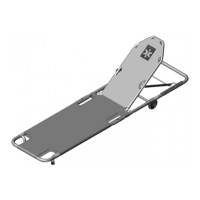
• Raise the backrest of the stretcher to a vertical position.
• Hold the loading trolley securely and unlock it by pressing down or lifting the unlocking lever as shown in the adjacent image.
• Slowly lift the loading trolley with one hand until it is locked in the loading trolley stops.
• To return the trolley to the horizontal position, unlock it using the unlocking lever, supporting it as it lowers and, again using the lever,
align the trolley with the dedicated stops.
11.13 Telescopic handle operation - Image P40 and P41
• To pull out the telescopic handles, press the red button on the top and pull the handles out slightly. After a stroke of about 2cm,
release the buttons and pull the handles until the next locked position is reached, which will lock automatically.
• When the locked position is reached, check that it is secure by trying to retract the handles without operating the release buttons.
For Cross Chair stretchers only:
• The rear handles have 3 positions that serve different functions:
Position 1: This is the position that allows the device to maintain the stretcher configuration. It is the only one that is allowed to be used in
stretcher mode.
Position 2: This is the position that unlocks the moving mechanism for configuration change and can be used when transporting the device in
chair mode on flat surfaces.
Position 3: This is the position to be used when transporting the device on stairs.
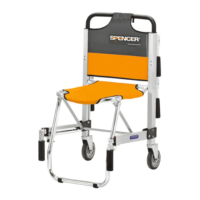
11.14 Changing the Cross Chair configuration (stretcher mode -> chair mode) – Image P42 – P43 – P44 – P45
The change from stretcher mode to chair mode is carried out in 3 steps:
• With the Cross Chair placed on the floor in stretcher mode, pull out the rear handles and bring them into Position 2. This unlocks the
moving mechanism.
• Raise the patient's feet until the locking system engages, which will be activated when the patient's seat reaches approximately 90°.
• At this point, it is possible to lift the front part of the Cross Chair using the telescopic handles until it is upright.
The seat support frame is now resting on the floor and, exerting friction on the surface, partially performs the function of a parking brake.
11.15 Changing the Cross Chair configuration (chair mode -> stretcher mode) – Image P 46
• To return the Cross Chair to stretcher mode, position it so that the 4 wheels with the largest diameter are resting on the ground.
• Pull the chair position unlocking lever by rotating it approximately 45° as shown in the figure. The locking mechanism is now
disengaged.
• Support the movable part of the frame as it moves towards the ground.
• Caution – Hazard of crushing fingers
Make sure that your hands or those of other operators or other objects are not in the area where the mobile frame joins the fixed frame,
highlighted in the figure with the warning symbol.
Return the rear telescopic handles to Position 1. The patient can only be lifted after checking that these are fully inserted and locked and that
the mobile frame is attached to the main frame of the Cross Chair.
11.16 Transporting the Cross Chair on stairs or in confined spaces – Image P47 and P48
Several operators are required, at least one at the front and at least one at the back, when transporting the device on stairs or in confined
spaces. It is advisable to use the device in chair mode to facilitate the operators during manoeuvres for this type of transport.
• Move the rear pull-out handles to Position 3.
• Pull out the rear handles.
• The siderails must be in the closed position in order to best contain the patient.
• The rescuers must coordinate their lifting to start at the same time.
• Once on a flat surface, the rescuer should consider whether to continue transport in chair mode or to change the device back to stretcher
mode. To continue transporting in chair mode on flat surfaces, return the pull-out handles to Position 2 to avoid unnecessary
encumbrances, close back up the rear handles and make sure they reach their rest position (parallel to the frame). Tilt the Cross Chair
and slide it on the rear wheels. If the rescuer deems it more efficient to transport the Cross Chair in stretcher mode, change the
configuration as described in the next paragraph.
11.17 Lifting the stretcher with patient – Image P49
• Secure the patient to the stretcher with the straps provided, adjusting the tension correctly according to the patient's clinical condition.
• Positioning the operators at the ends of the stretcher (one at the feet and one at the head)
• Using an adequate lifting technique to avoid fatigue, operators must grab firmly at both ends. Raise the stretcher.
• For easier lifting, the front handles can be pulled out as described in the previous step.
• Do not pull out the rear handles under any circumstances when lifting with Cross Chair. You must make sure that the handles are
completely inserted and locked.
11.18 Loading the Cross Chair Stretcher/chair onto the Cross Chair Trolley – Image P50
Before loading the Cross Chair onto the Cross Chair trolley, it is necessary that:
• The rear telescopic handles are in Position 1 and that the configuration change mechanism is correctly locked.
• The rear handles are folded and perfectly parallel to the stretcher frame.
For both Cross Up 8409 and Cross Chair:


 To Next Page