Tech Support: consumer.steppir.com/support | 425.453.1910 | support@steppir.com
37
The following charts can help determine what radial setup will work best for you. This is a general
overview, for more detailed information please read our complete white paper on radials which can
be found here: https://consumer.steppir.com/wp-content/uploads/2018/11/Radial-Systems-for-
Elevated-and-Ground-Mounted-Antennas-2.2-12_2018.pdf
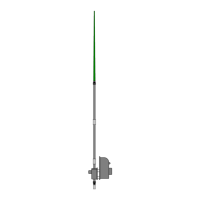
Ground mounting:
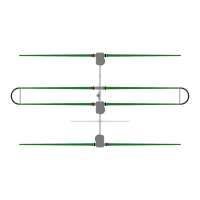
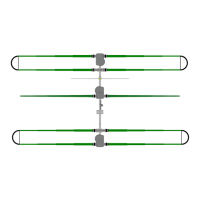
Elevated mounting:
COUNTERPOISE/RADIAL SYSTEM OVERVIEW
CONS
• Takes 120 radials to equal an elevated vertical
with 2 resonant radials (90% efficient)
• Surrounding objects can reduce signal
strength
PROS
• The radials are non-resonant so one length (.1wl
minimum at lowest frequency) works on all fre-
quencies
• Easy to mount
• Easy access
• Lower visual profile
• Sixteen 0.1 wl (wavelength) radials of lowest in-
tended frequency give 65-70% efficiency
CONS
• Requires two .25 wavelength radials (minimum)
for each band of operation (radials interact, so
spacing will affect length)
• Mounting is generally more involved
• Visually higher profile
• Must be mounted high enough that people
won’t walk into the radials
• Elevating lowers the impedance so radials
might need up to a 30° downward slope to get a
good match
PROS
• > 90% efficient with two .25 wavelength radials
• Antenna is generally more “in the clear”, so sur-
rounding objects don’t cause as much attenua-
tion
• A peaked metal roof will make a very good all-
frequency radial system
• Contrary to conventional wisdom the vertical
doesn’t have to be elevated very high, even 6”
results in much lower losses even on 80m, so 5
feet is just fine for 80m


 To Next Page