Tech Support: consumer.steppir.com/support | 425.453.1910 | support@steppir.com
11
The provided vertical mounting post (PN 10-1109-22) is a 2’ long piece of fiberglass tube which is 1.5” OD -
1/4” wall. One end of the tube has been turned down to an outer diameter of 1.48” such that it will fit into the
EHU assembly. Note that most 1.5” OD tubes/pipes will not fit in the SteppIR EHU due to the tight fiberglass
tolerances, so it is recommended to use ours. Using a metal mounting post is NOT RECOMMENDED if using
the optional loading coil as the high voltage created by loading the antenna can cause the element to arc to
the metal mounting post.
Interaction considerations: Mounting the antenna near structures may introduce interaction to the an-
tenna from nearby metal objects (gutters, electrical wiring, metal beams, etc). The further away from
the structure the better. For peak performance you may need to test different locations to find the
least amount of interaction possible. If you do decide to test multiple locations, do not concrete your
mounting post into the ground until the very end.
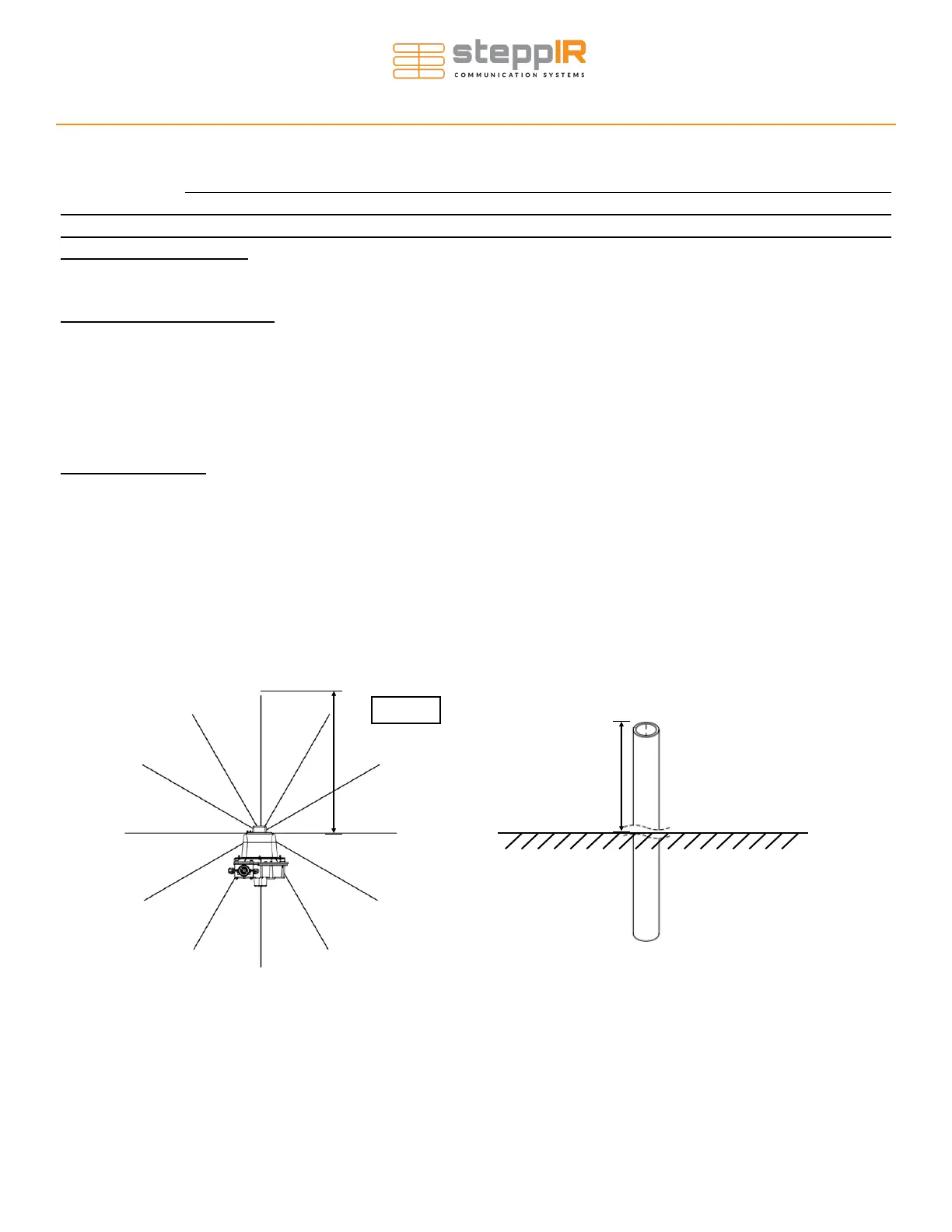
Ground mounting: Mount the fiberglass mounting post in the ground such that the top of the mounting post
is 6-10 inches above the ground. Directly burying in concrete or the use of a conduit sleeve in the ground are
common methods.
IF YOU ARE USING A RADIAL PLATE YOU MUST KEEP THE PLATE ELECTRICALLY DISCONNECTED FROM
THE VERTICAL MOUNTING POST (IF CONDUCTIVE) TO PREVENT ARCING. DO NOT USE THE COAX PASS
THROUGH ON THE PLATE.
Figure 1.01: Ground radials
1/10
N = 16+
* Top view
Ground
6-10”
Figure 1.02: Vertical mounting
* Side view
VERTICAL MOUNTING POST OVERVIEW


 To Next Page