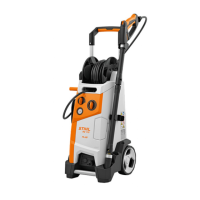
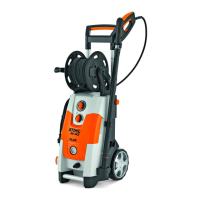
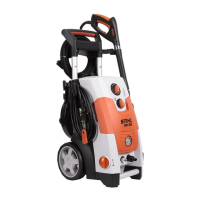
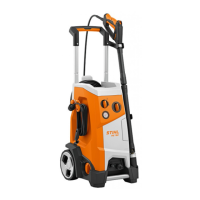
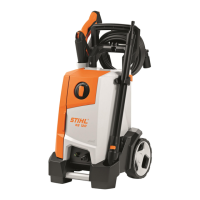
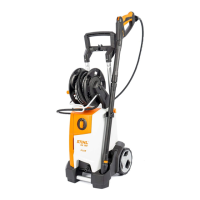
This document describes the STIHL RE 120 PLUS, 130 PLUS, and 140 PLUS high-pressure washers, providing instructions for their assembly, operation, maintenance, and safety.
The high-pressure washer is designed for cleaning vehicles, trailers, patios, paths, and facades. It is not intended for commercial use or for cleaning surfaces containing asbestos, lead paint, or those that come into contact with foodstuffs. The device should not be used in the rain.
Function Description
The high-pressure washer operates by transporting water from a water source to a spray gun via a high-pressure hose. The spray gun, when activated, releases a strong water jet through a nozzle, which can be adjusted for different cleaning tasks. The device includes a rotary switch for turning it on and off. When the spray gun trigger is released, the high-pressure pump automatically switches off, entering a stand-by mode while the machine remains switched on. Squeezing the trigger again reactivates the pump and water flow.
Usage Features
The pressure washer is equipped with several features to enhance its usability:
- Spray Attachment: The spray gun holds and controls the spray attachment, which includes a spray lance and various nozzles.
- Nozzles: The device comes with a rotary nozzle for strong, rotating water jets to remove stubborn dirt, and a fan-jet nozzle for a flat water jet, suitable for cleaning large areas. The fan-jet nozzle is adjustable to increase or reduce working pressure. A cleaning pin is provided for clearing clogged nozzles.
- Spraying Set: A dedicated spraying set is used for cleaning with detergents. Detergents can be added to a bottle that attaches to the spray nozzle, enhancing the cleaning effect.
- Hose Reel: A hose reel is integrated for rolling up the high-pressure hose, with a guide bar (on RE 130 PLUS and 140 PLUS models) to assist in guiding the hose onto the reel from the front.
- Handle and Carrying Handle: The device features a handle for carrying and moving the high-pressure washer, and a carrying handle for transport. A trigger switch lockout blocks the adjustment of the handle.
- Water Supply: The high-pressure washer can be connected to the mains water supply or draw water from alternative sources like water butts, storage tanks, or rivers/lakes, provided a STIHL suction set is used. A water filter can be connected to protect components from sand and dirt, especially when using non-mains water sources.
- Storage Compartments: The device has compartments and holders for storing supplied nozzles, the cleaning pin, the spray gun, the spray attachment, and the spraying set. A flap covers the nozzles, connecting cord, and cleaning pin.
- Connecting Cable: The connecting cable connects the high-pressure washer to the mains plug, which then connects to a socket. A clip attaches the mains plug to the coiled connecting cable, and holders allow for easy removal and storage of the cable.
- Safety Features: The spray gun includes a retaining latch to release the trigger and a locking lever to secure the connector.
Maintenance Features
Regular maintenance is crucial for the safe and efficient operation of the high-pressure washer:
- Cleaning: The pressure washer, high-pressure hose, spray gun, and accessories should be cleaned with a damp cloth. Connectors, couplings, and vents also require cleaning. Nozzles should be rinsed under running water and dried, and clogged nozzles can be cleared with the cleaning pin. The water intake screen and water filter should be regularly checked for dirt and cleaned by flushing under running water. The water filter can be disassembled for thorough cleaning.
- Lubrication: The gaskets of the connections should be greased with grease for fittings to ensure smooth operation and prevent stiffness.
- Storage: After use, the pressure washer should be stored in a clean, dry, and frost-free environment, out of reach of children. The high-pressure hose and spray attachment should be drained. If storing in a non-frost-free environment, the pressure washer should be protected with a glycol-based antifreeze. The detergent container should be emptied or secured to prevent spillage.
- Transport: Before transport, the spray gun trigger should be locked, the pressure washer switched off, and the mains plug unplugged. The spraying set should be drained or secured. The pressure washer should be secured with lashing straps, belts, or a net to prevent movement or toppling.
- Repair: Users are advised not to attempt repairs themselves. Any damaged components or malfunctions should be addressed by a STIHL servicing dealer.
- Accessory Maintenance: Accessories like the spray lance extension, surface cleaner, pipe cleaning kit, angled spray lance, and angled nozzle should be maintained according to their respective instruction manuals.



 To Next Page
 General