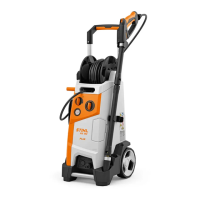
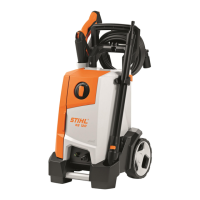
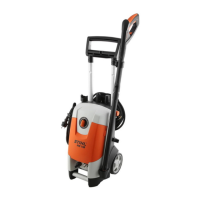
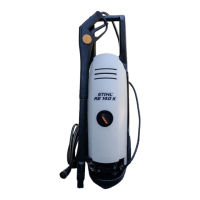
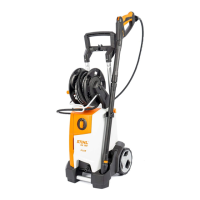
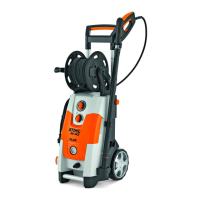
The STIHL RE 150 and RE 170 are high-pressure washers designed for cleaning various surfaces such as vehicles, trailers, patios, paths, and facades. These devices are built for reliability, even under extreme conditions, and are intended for safe and environmentally friendly use over a long service life.
Function Description
The pressure washer operates by generating a high-pressure water jet, which can be adjusted for both working pressure and water flow rate using a rotary control. The pressure gauge indicates the current pressure of the high-pressure pump. Water is supplied to the unit via a water hose, and the high-pressure hose connects the unit to the spray gun.
The spray gun is the primary interface for the user, allowing them to hold and guide the spray attachment. It features a trigger that opens and closes a valve, starting and stopping the water jet. For safety, a trigger switch lockout is present to prevent accidental operation. The spray gun also includes a locking lever to secure the spray lance connector.
The spray attachment consists of a spray lance and various nozzles. The fan-jet nozzle creates a flat water jet, suitable for cleaning large surfaces, while the rotary nozzle produces a hard, rotating water jet, ideal for removing stubborn dirt. The fan-jet nozzle's working pressure can be adjusted by turning it in either the '+' or '-' direction. A cleaning pin is provided to clear any blockages in the nozzles.
For enhanced cleaning, the pressure washer can be used with detergents. A dosing handle allows the user to set the desired dosage of cleaning agent, which is stored in a dedicated detergent container. The device can also draw detergent from a separate container if needed.
Usage Features
Before operation, the pressure washer requires proper assembly and connection. The handle needs to be pulled out until it audibly engages, and the high-pressure hose, spray gun, and spray lance with the chosen nozzle must be securely attached. The device can be connected to a standard water supply or draw water from alternative sources like water butts, cisterns, or rivers using a special suction set. If using water from non-mains sources, a water filter should be connected to protect the pump from sand and dirt.
Connecting to the power supply involves plugging the connecting cord into a properly installed, fused socket. The rotary switch is used to turn the pressure washer on and off. When operating, the spray gun should be held firmly with both hands to manage the reactive forces of the water jet.
For cleaning, users should point the nozzle at the ground before starting to ensure the surface is not damaged. The distance between the nozzle and the surface, along with the working pressure, can be adjusted to suit the cleaning task and surface type. Detergents are applied by first soaking dirty surfaces with water, then spraying the detergent from the bottom up, allowing it to work, and finally rinsing the surface.
After finishing work, the pressure washer should be switched off, unplugged, and disconnected from the water supply. The spray gun trigger should be pressed to release any remaining water pressure, and then locked. The high-pressure hose, spray gun, and nozzles should be removed and cleaned. The connecting cord can be coiled on the holder, and the detergent container should be emptied and secured.
For transport, the pressure washer can be pulled using its handle or carried by both the handle and the carrying handle. It's crucial to secure the device to prevent it from toppling or moving. If transporting or storing in a frost-prone environment, the pressure washer should be protected with a glycol-based antifreeze to prevent damage from freezing water.
Maintenance Features
Regular cleaning and maintenance are essential for the safe and long-lasting operation of the pressure washer. Before any cleaning, servicing, or repair, the device must be switched off, the spray gun trigger locked, and the mains plug unplugged from the socket.
The high-pressure washer, high-pressure hose, spray gun, and accessories should be cleaned with a damp cloth. Connectors, couplings, and vents also require cleaning. The nozzle and spray lance should be rinsed under running water and dried. If the nozzle is clogged, it can be cleaned with the provided cleaning pin.
The water intake screen and water filter, if used, need regular cleaning. This involves unscrewing the connector, removing the screen or disassembling the filter, rinsing the components under running water, greasing the gaskets with fitting grease, and then reassembling them.
The gaskets on the connections of the pressure washer, high-pressure hose, spray gun, and spray lance should be lubricated periodically to ensure smooth connection and prevent wear.
Maintenance intervals are dependent on ambient and operating conditions, but STIHL recommends monthly cleaning of the water intake screen. Users should not attempt to service or repair the high-pressure washer themselves; any faulty or damaged components, especially the connecting cable, should be replaced by a STIHL dealer. If the pressure washer requires servicing or repair, a STIHL dealer should be contacted.


 To Next Page
 General