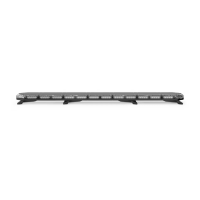
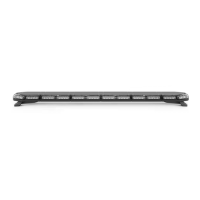
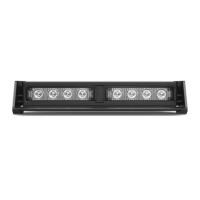
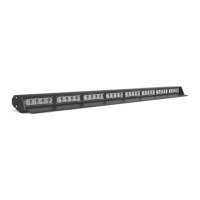
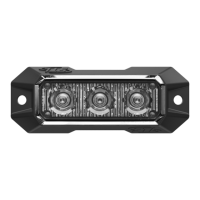
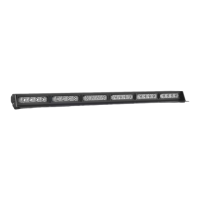
The K-FORCE® 36 FULL LIGHT BAR is a professional-grade emergency warning device designed to alert pedestrians and other operators to the presence of personnel, emergency vehicles, or an emergency site. This light bar is intended for strict use by authorized personnel only, and users are responsible for understanding and obeying all applicable city, state, and federal laws and regulations regarding its use.
Function Description:
The K-FORCE® 36 is a full light bar equipped with LED diodes and modules that provide various flash patterns for warning. It features non-volatile memory, which recalls the last selected flash pattern when the light bar is turned on. The device can be controlled via a Supreme Control Switch Box (sold separately) or through direct wiring according to the provided wiring diagram. The light bar includes functions for forward-facing lights, rear-facing lights, full 360° warning lights, take-down lights, alley lights, and cruise lights for all four corners. It also supports traffic advisor functions, including left arrow, center out arrow, and right arrow sweeps. An AUX wiring diagram is provided for additional auxiliary functions.
Usage Features:
The light bar comes with several mounting options to suit different vehicle types and installation preferences.
- Foot Brackets (Included): These adjustable brackets allow the light bar to be positioned along the aluminum track to ensure flat, even contact with the vehicle's roof.
- Universal Mounting Brackets (Included): Similar to foot brackets, these are adjustable along the aluminum track to meet the universal bracket and create even contact with the roof. They attach to the light bar foot bracket using an I-bolt and are secured to the vehicle via pre-drilled holes and user-supplied screws. The I-bolt should be tightened equally on both sides for secure attachment.
- Stud Mount (Sold Separately): For this option, the foot bracket is removed, and the main mounting bolt is placed through the stud mount. The stud mount is then attached to the light bar using the screws that originally secured the foot brackets.
- Headache Rack Mount (Sold Separately): This mount also requires removing the foot brackets. The headache rack bracket is attached to the light bar using the screws from the foot brackets, utilizing the two vertical cutaways on the bracket. It can be directly mounted or "sandwiched" to the back rack using a secondary piece and user-supplied nuts and bolts.
The Supreme Control Switch Box (sold separately) offers comprehensive control over the light bar's functions:
- Slide Switch:
- Off position: Turns off all warning functions.
- 1st position: Powers only the front of the bar and forward-facing 45° warning modules.
- 2nd position: Powers only the back of the bar and rear-facing 45° warning modules.
- 3rd position: Powers all warning functions.
- Take Down Button:
- 1st press: Steady Burn.
- 2nd press: Flashing.
- 3rd press: Flashes in the same sequence/pattern as the active warning pattern.
- Alley Button:
- 1st press: Steady Burn.
- 2nd press: Flashing.
- 3rd press: Flashes in the same sequence/pattern as the active warning pattern.
- Traffic Advisor Buttons:
- Traffic Advisor LEDs flash in sequence with the warning mode when not activated.
- Left Arrow: Right to Left Traffic Sweep.
- Center Out Arrow: Center Out Traffic Sweep.
- Right Arrow: Left to Right Traffic Sweep.
- Flash Pattern Button:
- Cycles to the next flash pattern with each press.
- Non-volatile memory recalls the last flash pattern selected.
- Hold for 3 seconds to toggle Steady Burn mode.
- Hold for 5 seconds to toggle Random pattern mode.
- Cruise Button (45° (Four Corner) Modules):
- 1st press: Steady Burn.
- 2nd press: Flashing.
- 3rd press: Flashes in the same sequence/pattern as the active warning pattern.
- AUX Button: Toggles power to AUX cables On and Off.
- Back Plate Mount: Included with the Supreme Control Switch Box.
For installations requiring extended reach, an extension cable (sold separately) can be used. Depending on the cable type, it may involve connecting corresponding ends, cutting and soldering wires, or reattaching connectors. Proper insulation and protection of connections from heat, moisture, or debris are crucial.
Maintenance Features:
To preserve the longevity and function of the light bar, certain maintenance practices are recommended:
- Cleaning: Never take the light bar through a car wash, including pressure washers, automatic car washes, or washes with brushes or chemicals that could scratch or damage the equipment. Instead, use water (H2O) with a soft cloth to clean the light bar and its lenses.
- Lens Care: Yellowing of clear lenses may occur over time. Replacement lenses can be purchased by contacting STL Customer Service.
- Daily Testing: The light bar and all its functions should be tested daily to ensure correct operation. Any malfunctions should be reported to STL Customer Service immediately.
- Wiring and Mounting Inspection: The effectiveness of the equipment relies on correct mounting and wiring. Improper wiring or mounting can reduce output and performance. Users should ensure that the projection of visual and audible signals is not blocked by vehicle components or other obstructions.
- Electromagnetic Interference: To prevent electromagnetic interference, light bars should be mounted a minimum of 12" - 34" from the radio antenna. Equipment should not be powered from the same circuit or share the same grounding circuit with radio communication equipment. After installation, all vehicle equipment should be tested together for interference-free operation.
- Airbag Deployment Areas: Equipment must not be installed in the deployment area of airbags (SRS) as it can damage or dislodge airbags and sensors, reducing their effectiveness and potentially causing serious personal injury.
- Secure Installation: All equipment must be securely attached according to the vehicle manufacturer's instructions, within zones of sufficient strength to withstand applied forces. Permanent mounting is encouraged, as non-permanent methods may lead to detachment under aggressive driving conditions.
- Wiring Protection: Grommets, cable ties, and looms should be used to anchor and protect all wiring. Fuses should be properly sized and located as close to the power take-off points as possible, and never replaced with a fuse of a higher amp rating than the initial fuse provided by STL. Insulation displacement connectors are not to be used.
- Grounding: A secure electrical connection to the battery's negative (-) post is essential for optimum efficiency. Circuit breaks should not be used.
- Control Box Placement: If a control box or remote device is used, it must be installed in a location that allows safe operation by the user without losing eye contact with the roadway.
- Wire Type: SXL type wire should be used in the engine compartment where higher heat resistance is required, in accordance with SAE J-1128. All wires must comply with minimum wire size recommendations and be protected from hot surfaces and moving parts.

 Need help?
 General

 To Next Page