8
The exchange resin charge is inside the column of the water
softener and takes up a significant part of the total volume
(between 60 and 75%, according to each model). A part of
the column must remain empty, in order to allow for a proper
regeneration of the resin bed.
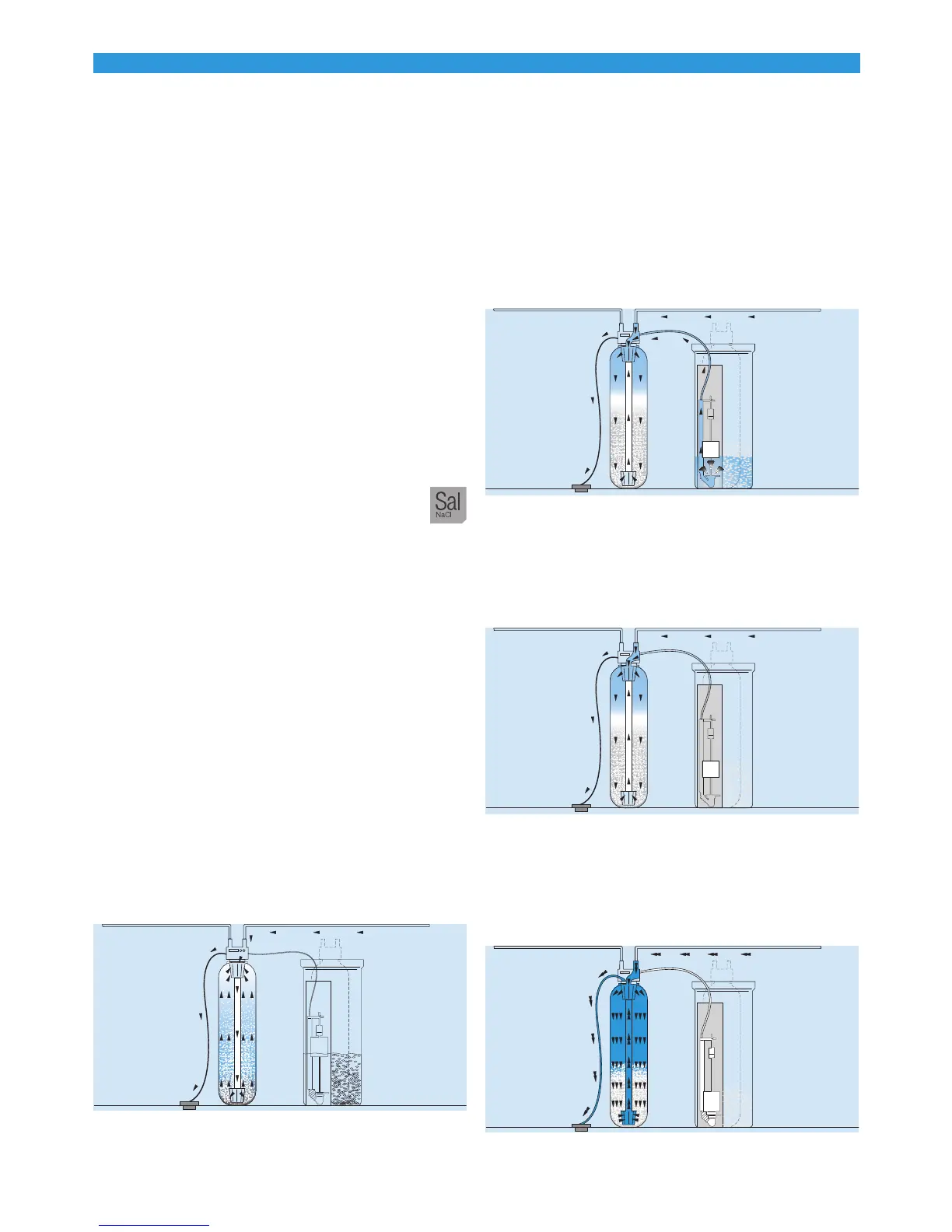
During the treatment process, water goes into the multi-way
valve through the inlet connection, flows towards the upper
part of the tank through the top nozzle and goes downwards
through the bed resin, thus producing the ion exchange.
Treated water is collected by the bottom nozzle and led to
the multi-way valve through the inner tube of the tank. Treated
water is sent for consumption using the outlet connection. At
this point, the system has a treated water meter in order to
measure the water volume.
2.3 Regeneration of the System
The quantity of calcium and magnesium ions that the resin
may retain is limited; therefore, the water volume a water sof-
tener can treat is limited as well.
The system must periodically carry out a process known as
regeneration, which allows the resin to recharge with sodium
ions, so it can continue softening water.
In STRATOS systems, the regeneration process starts auto-
matically when the configured water volume is achieved. The
programmer allows the user to set several regeneration start
modes (see ‘Section 6.3’ to obtain further information how to
operate the programmer).
The regeneration of a softener system is composed of several
stages, which are described below:
BACKWASH:
Water comes into the column through the lower manifold,
washing the suspended mater and fluffing the resin bed up,
thus facilitating the subsequent regeneration process.
BRINE ASPIRATION:
By means of an aspiration process relying on a Venturi effect,
the system sucks the brine solution, which has previously
been prepared in the regenerating tank. This brine solution is
introduced downwards in the softening column, gets in con-
tact with the ion exchange resin and regenerates it.
SLOW WASH:
In this stage the brine solution, which has been previously
sucked up, goes through the resin bed. Throughout this pro-
cess, the contact between the brine and the resin is complete,
which optimizes the regeneration.



 To Next Page