Standard user guide
V51-00-V19 eng
-6- Rights to changes reserved
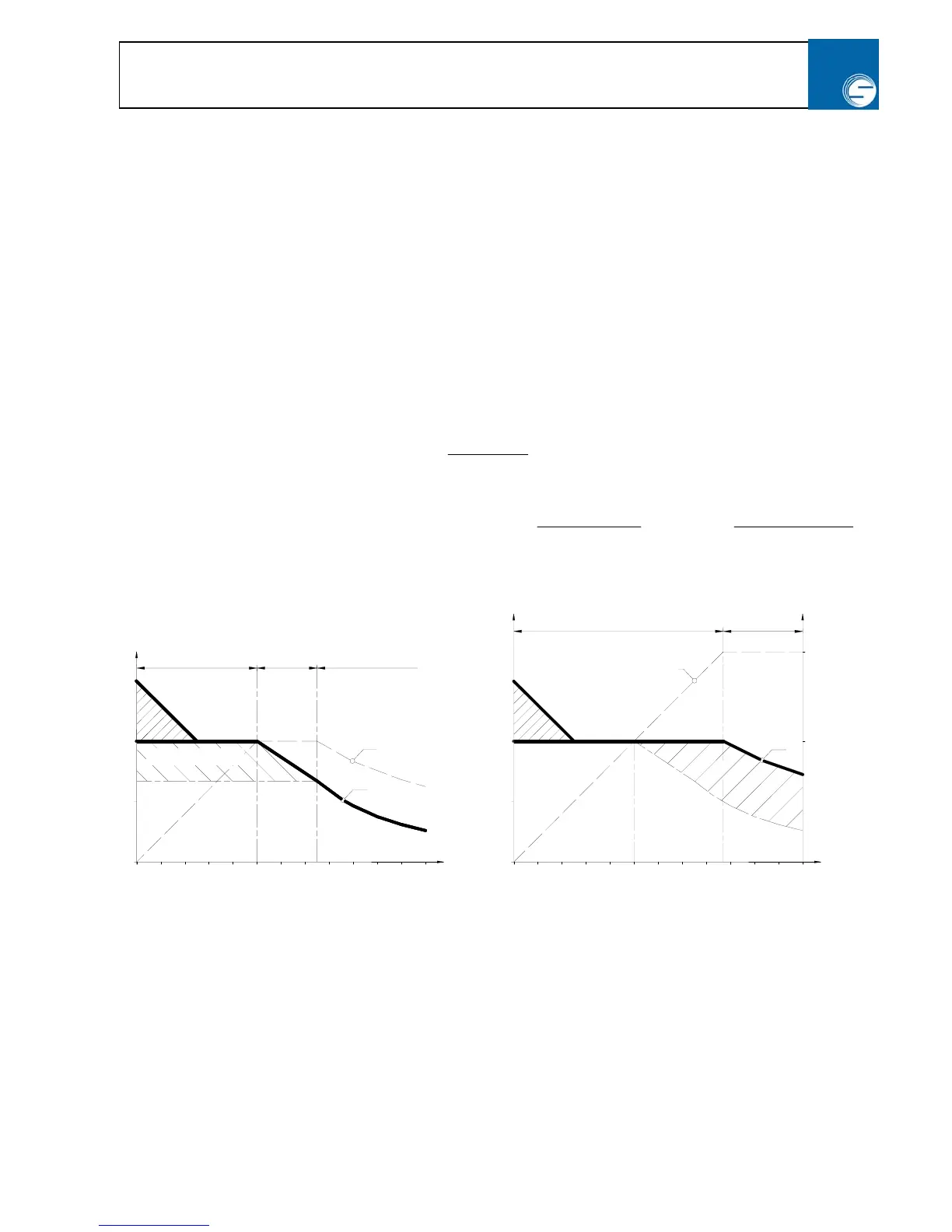
1.5 Power and torque curves
When setting up a drive the torque sequence must be considered in the wanted regulation area.
This can roughly be divided into 3 groups:
• Constantly torque in all regulation area e.g. conveyer
• Rising torque at speed acceleration e.g. Pumps or ventilation.
• Falling torque at speed acceleration e.g. drilling machines or tools machines.
Diagram below might help to choose the right function and power selection.
Power and torque curve
Zone 1: Power rises linear with frequency. Rotation torque M is constant (M
n
).
Warning: By continuous run with motor torque below 20 Hz, use a motor size larger or a motor with
ventilation.
Zone 2:
Power is constant (P
n
)
Torque falls with rising frequency
f
f
M
Knæk
=
n
P5,1
2
2
n
M5,1
f
f
M
Knæk
∗∗
=
Fig. 1 Fig. 2
Frequency / Voltage point at 50 Hz Frequency / Voltage point at 87 Hz
If you choose to set the systems max frequency to
75 Hz instead of 50. Is it possible to equalize the
smaller motor torque with a larger gearing in the
gear.
Advantages:
• 1,5 times larger regulations area
• 1,5 times larger torque below 50Hz
• Higher start torque.
• Ventilation of motor might not be needed.
Suitable for 3 phased mains supply( SC3- ) and
motor voltages at 230 / 400V by setting the motor in
delta ∆. This way you take advantage of the linear
V/F curve until 87Hz. The motor is supplied with
230V at 50 Hz and 400V at 87Hz
Advantages:
• 1,73 times larger regulations area
• 1,73 times larger motor power at 1,73 times
larger frequency inverter power.
• 100% torque from above 87 Hz.
[Hz]
50
20
10
30
40
50
60
100
70
80
90 110 120
150
[%]
P/M
P
M
50
20
10
30
50
40
60 80
70
90
[Hz]
110100 120
P/M
100
150
[%]
P
M
230
400
[V]
100
Zone 1 Zone 2 Zone 3
Zone 1 Zone 2
Motor-
voltage
Frekvens
knækpunkt
Moment overskud f < 75Hz
Kun under start
(Boost)
Kun under start
(Boost)
Frekvens knækpunkt 87 Hz
Moment forhøjelse i
forhold til Fig. 1
Moment forhøjelse i
forhold til Fig. 1


 To Next Page