pg 34
Cloud Reverb
A gorgeously big, ambient reverb that draws from techniques developed
in the late ‘70s� Using processing power not dreamed of in those days,
the Cloud reverb obscures the distinction between reality and fantasy�
CHAMBER
HALL
ROOM
PLATE
SPRING
IMPULSE
CHORALE
MAGNETO
NONLINEAR
BLOOM
SHIMMER
CLOUD
push (param)
hold (back)
hold 3s (global)
VALUE
push (dual 1 2)
hold (save)
TYPE
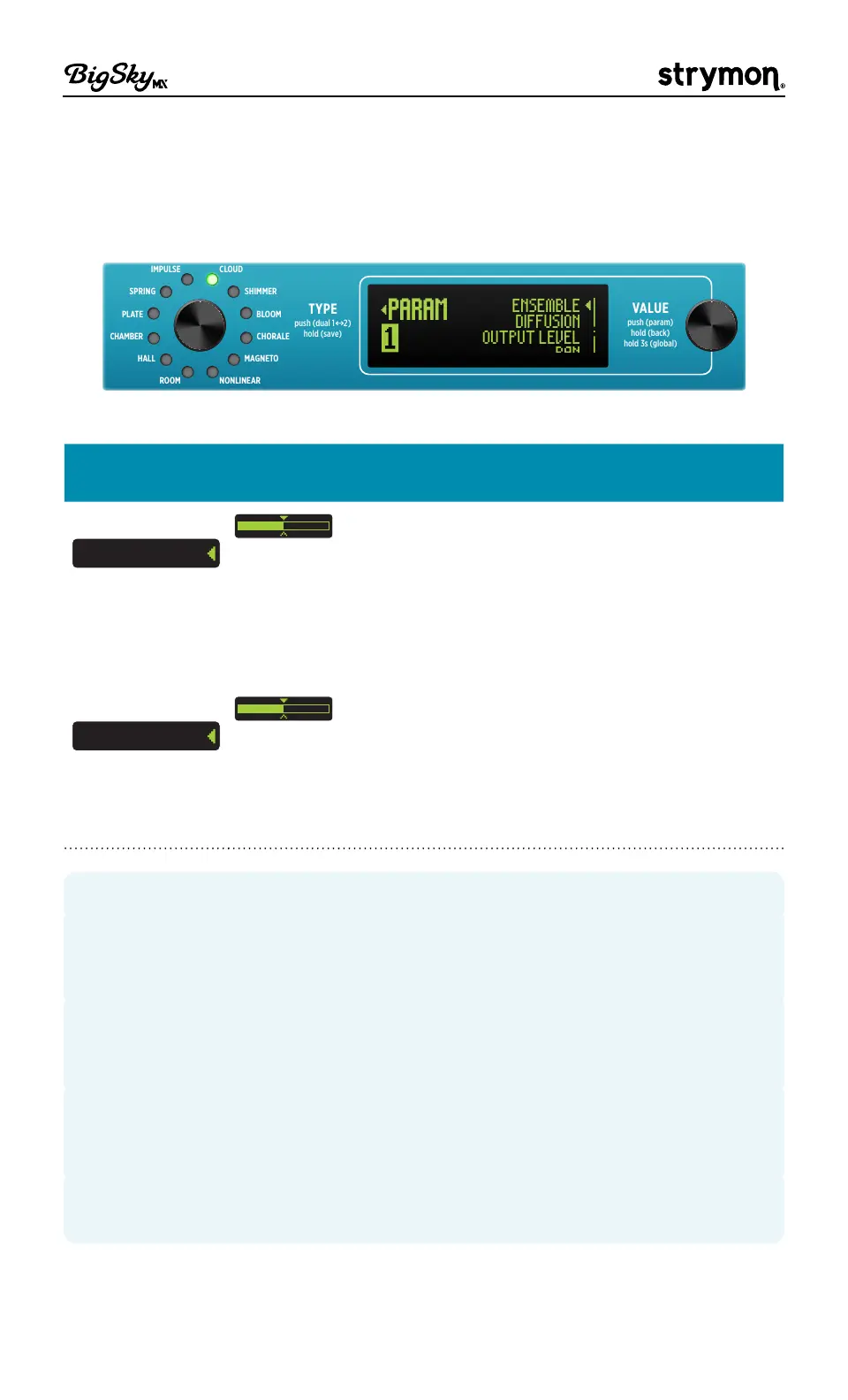
PARAM
ENSEMBLE
DIFFUSION
OUTPUT LEVEL
PAN
The Parameters menu (Cloud reverb type is selected)
CLOUD
Parameter
Values Description
Ensemble
ENSEMBLE
Analyzes the input signal and generates a
harmonically rich pad reminiscent of a string
section� Increasing the value from minimum to
mid values adds a light to medium ensemble
for subtle enhancement, and higher values
produce a pronounced ensemble effect for
creating lush soundscapes�
Diffusion
DIFFUSION
Adds diffusors in front of and within the reverb
generator� At minimum there is no diffusion
effect, and the Cloud reverb is “grainier,” yet
mesmerizing, on transient attacks�
As Diffusion is increased, the reverb is
smoothed and softened�
Using the Cloud Reverb...
The cascaded input diffusion blocks create an expanded “early” reverb�
This results in a longer overall reverb time than the displayed tank decay
time, most noticeable when the Decay knob is set to low values�
From minimum to 2 o’clock, the Modulation knob adjusts the amount of
modulation (developed by a quadrature oscillator at a frequency harmonious
to the Cloud generator) that is applied to the input diffusor sections�
Past 2 o’clock, the frequency of the quadrature oscillators is increased� The
modulation scheme was developed to allow for high degrees of modulation
without muddying up the sustaining reverberation tail�
The Cloud reverb can take any modest guitar or synth sound and turn it into
a gorgeous ensemble�


 To Next Page