EasyManua.ls Logo

Sun Microsystems VAT-60 - Circuit

Sun Microsystems VAT-60
22 pages
Print Icon
To Next Page IconTo Next Page
To Previous Page IconTo Previous Page
Loading...
C.
Set VOLT
SELECTOR
to
EXT.
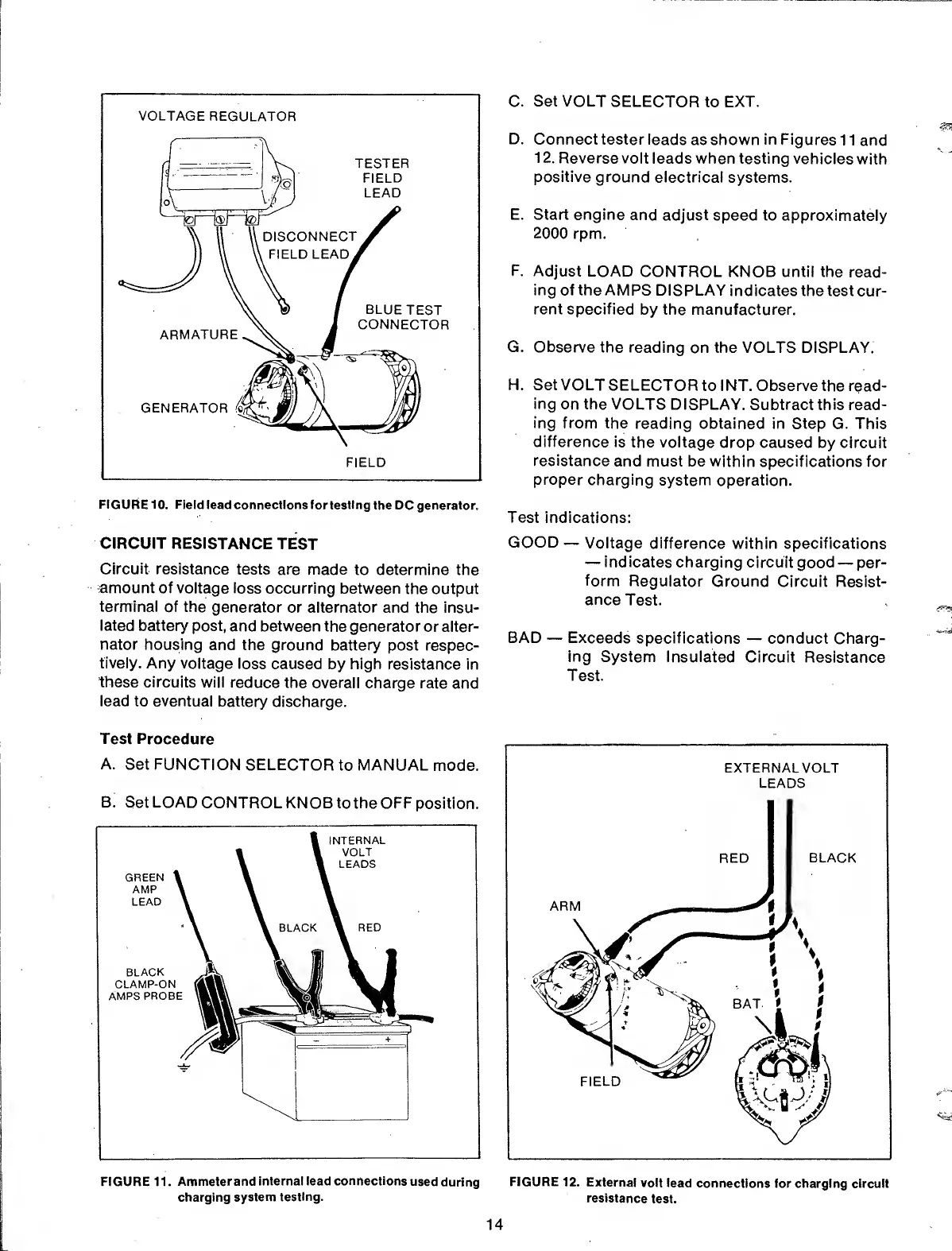
VOLTAGE
REGULATOR
FIGURE 10.
Field lead connections for testing
the DC generator.
CIRCUIT RESISTANCE
TEST
Circuit
resistance
tests are
made to determine the
amount
of
voltage loss
occurring between
the output
terminal
of the
generator
or
alternator
and the insu-
lated battery
post,
and between the generator
or alter-
nator
housing
and the ground
battery post respec-
tively.
Any voltage
loss
caused by high
resistance in
these circuits
will
reduce the overall
charge rate
and
lead to eventual
battery
discharge.
Test
Procedure
A.
Set FUNCTION
SELECTOR
to MANUAL
mode.
B.
Set
LOAD
CONTROL
KNOB to the
OFF position.
FIGURE 11.
Ammeter and
internal lead
connections
used
during
charging
system
testing.
D.
Connect tester leads
as shown
in
Figures
1
1
and
1
2. Reverse volt
leads when testing
vehicles
with
positive
ground electrical
systems.
E. Start engine
and adjust
speed to approximately
2000
rpm.
F. Adjust
LOAD
CONTROL KNOB until the
read-
ing of the AMPS
DISPLAY
indicates the test
cur-
rent specified
by the manufacturer.
G. Observe
the reading
on the VOLTS DISPLAY.
H. Set VOLT
SELECTOR
to INT. Observe the read-
ing
on the VOLTS
DISPLAY. Subtract this
read-
ing from
the reading
obtained in Step
G.
This
difference is
the voltage
drop caused by circuit
resistance
and
must be within specifications
for
proper charging
system
operation.
Test indications:
GOOD
Voltage
difference within specifications
indicates charging
circuit good
per-
form
Regulator
Ground Circuit Resist-
ance
Test.
BAD
Exceeds
specifications
conduct
Charg-
ing
System Insulated
Circuit Resistance
Test.
FIGURE
12.
External
volt lead
connections
for charging circuit
resistance
test.
14