TESTING MODES
Two different
testing modes and OFF can be chosen
with
the FUNCTION
SELECTOR
to
perform
a var-
iety of starting,
charging, and battery tests.
AUTOMATIC
CAPTURE
MODE:
Three
different types
of system
tests can be per-
formed
in the
automatic
capture mode.
BATTERY
LOAD
The
BATTERY
LOAD test
measures the
battery’s
state-of-charge.
The
GOOD/BAD
indications
represent the
battery’s
state-of-charge
condition.
By
first determining
the
PRE-TEST condition of
the
battery
and
then utilizing a
specific
time test
sequence, a
GOOD/BAD
determination of the bat-
tery
state-of-charge
can be made.
NOTE: Occasionally
battery
discharge can be
the
result of
current draw
when the
vehicle is
unattended.
This
could result
from an acces-
sory
that has not
turned off
(trunk light,
glove
box
light,
etc.) or a
short in a
circuit that
has
power even
with the
ignition switch
OFF.
Determining
PRE-TEST
condition of
battery:
NOTE: Before
conducting
open circuit
voltage
test
(PRE-TEST)
of battery, it is
recommended
that the
surface charge
on the battery be
reduced
by
applying at least a
50 amp
load
to
the battery
in the
MANUAL mode.
1.
Be sure LOAD
CONTROL
KNOB is fully
counter-
clockwise to
OFF and
FUNCTION
SELECTOR is
in the OFF
position.
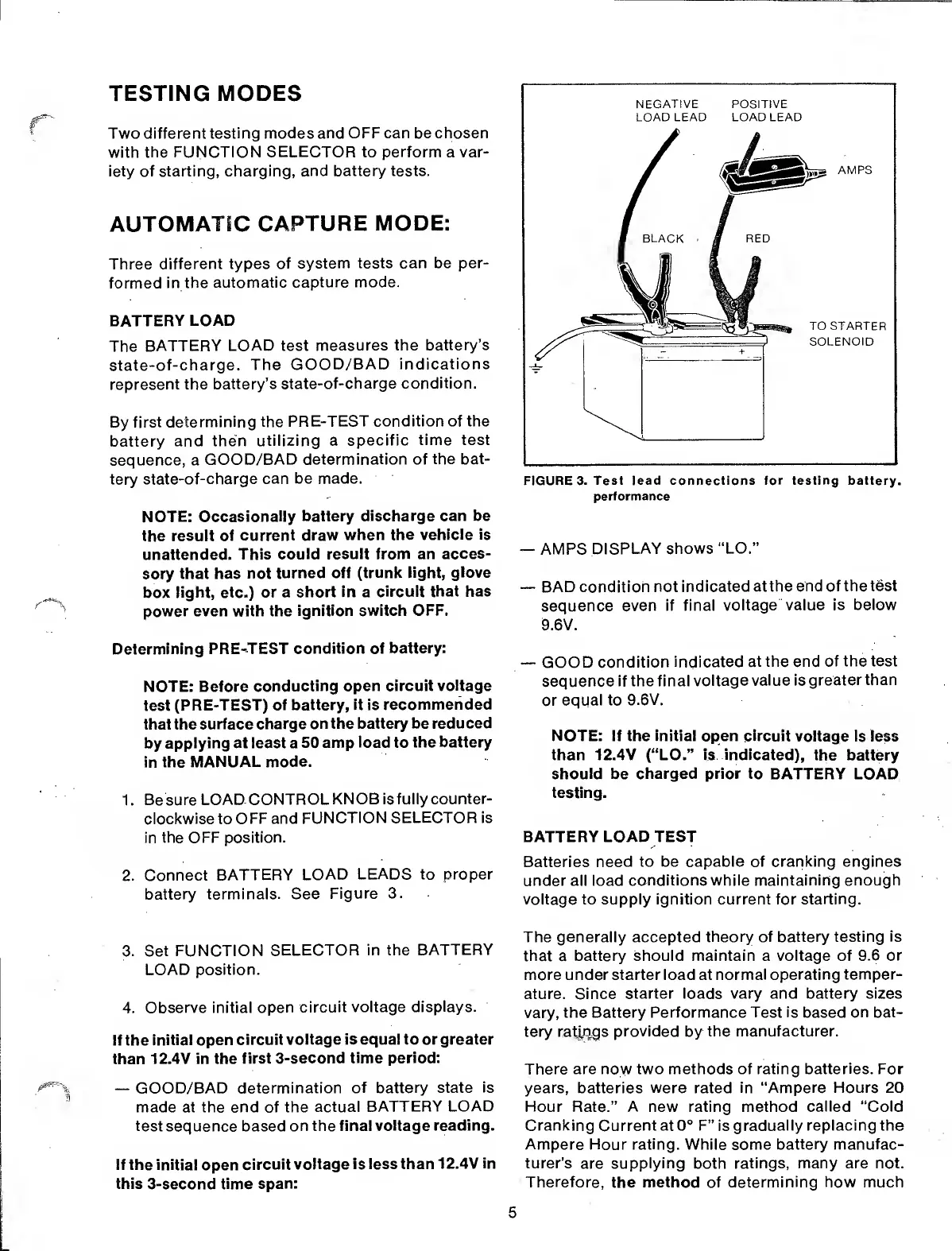
2. Connect
BATTERY
LOAD
LEADS to proper
battery terminals. See
Figure
3.
3. Set FUNCTION
SELECTOR in the
BATTERY
LOAD
position.
4.
Observe initial
open
circuit voltage
displays.
If the
initial open
circuit
voltage is equal to or greater
than
12.4V in the
first
3-second
time period:
—
GOOD/BAD
determination
of battery state
is
made at the end of the
actual
BATTERY LOAD
test
seq uence based
on the final
voltage reading.
If the initial
open
circuit voltage
is less than
12.4V
in
this
3-second
time
span:
NEGATIVE POSITIVE
LOAD LEAD LOAD LEAD
FIGURE
3. Test lead connections for testing battery,
performance
—
AMPS
DISPLAY
shows “LO.”
—
BAD condition
not indicated
at the end
of
the
t§st
sequence even
if final voltage
value is
below
9.6V.
—
GOOD
condition
indicated
at the end
of the test
sequence
if the final
voltage
value is
greater than
or
equal to
9.6V.
NOTE: If the initial open circuit
voltage is less
than 12.4V (“LO.” is indicated), the
battery
should
be
charged prior to
BATTERY LOAD
testing.
BATTERY LOAD TEST
Batteries
need to be capable of cranking engines
under all load
conditions while maintaining enough
voltage to supply ignition current for
starting.
The generally accepted
theory of battery testing
is
that
a
battery should maintain a voltage of
9.6 or
more under starter load at
normal operating temper-
ature. Since
starter loads vary and battery sizes
vary, the
Battery Performance
Test is
based
on bat-
tery ratings
provided
by
the manufacturer.
There are now two methods of rating
batteries.
For
years,
batteries
were
rated
in “Ampere Hours 20
Hour Rate.” A new rating method
called “Cold
Cranking
Current
at
0°
F”
is
gradually replacing the
Ampere Hour
rating.
While some
battery manufac-
turer’s
are
supplying
both
ratings, many are not.
Therefore,
the
method of determining how much
5


 To Next Page
 Loading...