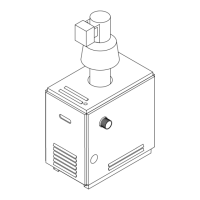
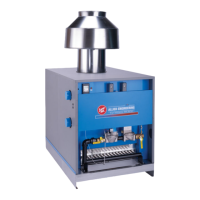
SG Series Boilers – Installation and Service Manual
24
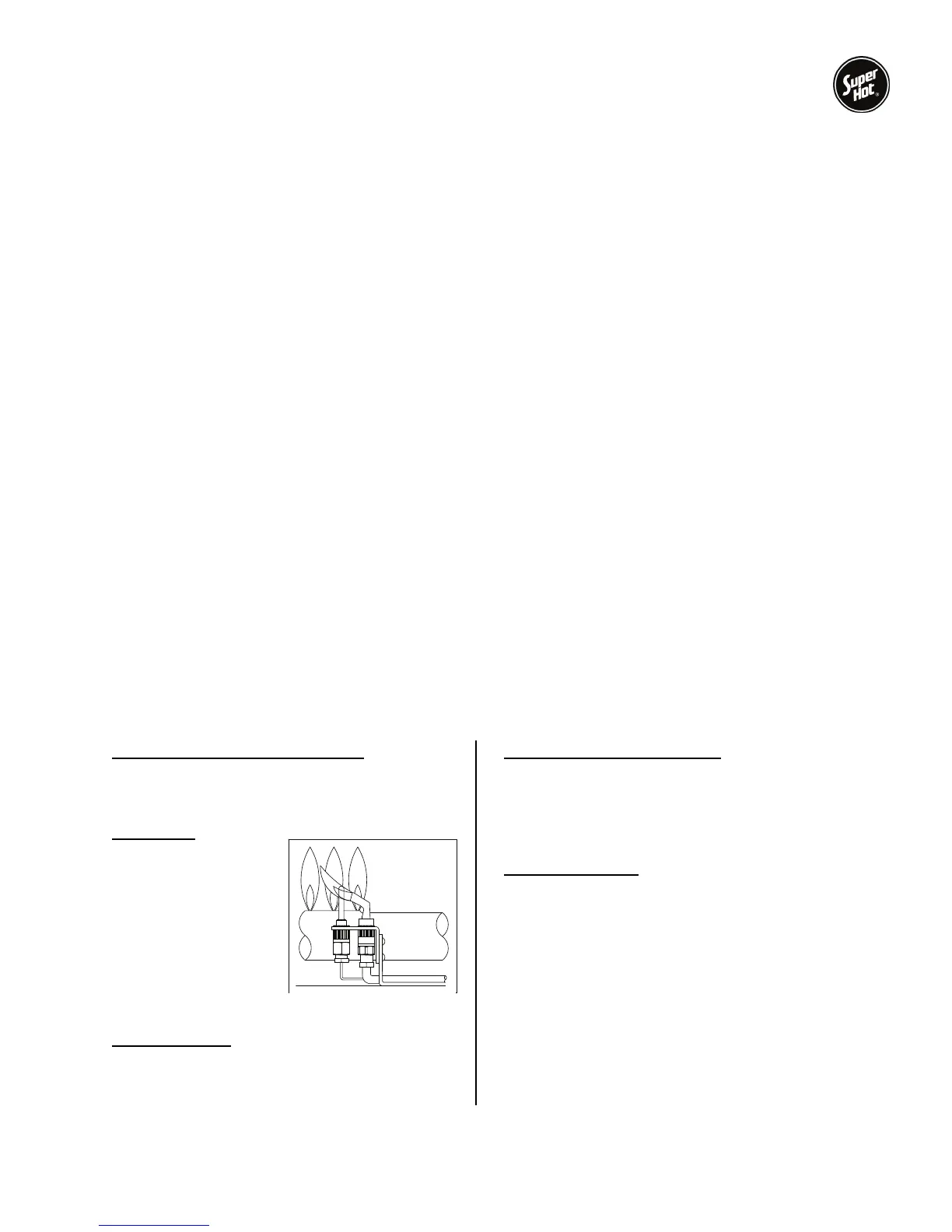
FIGURE 7 - PILOT FLAME
ADJUSTMENT
8) Check manifold pressure reading on the manometer and make necessary adjustments. Check
that burner input matches rating plate input.
9) Return thermostat and controls to normal operation settings.
b. Intermittent pilot with non-combination gas valve
This boiler does not have a continuous pilot flame. It is equipped with an ignition device which
automatically lights the pilot. Do not try to light the pilot by hand.
In the event of failure of any component, either the system will not operate or it will go into safety lockout.
1) Make sure the Main and Pilot Gas Valve and all electrical power to the boiler are "OFF".
2) Set room thermostat to the lowest setting.
4) Connect a manometer at pressure tapping on downstream section of gas valve.
4) Wait five minutes to clear out any gas. If you smell gas, STOP! Follow the safety instructions
provided in Section 1.1 under WHAT TO DO IF YOU SMELL GAS. Remember that propane does
not vent upward naturally.
5) Check the ignition control module as follows:
a) Set thermostat above room temperature to call for heat and turn power on for the boiler.
b) Watch for spark at pilot burner on units equipped with spark ignition. All models will
automatically lockout if no pilot flame is detected within 15 seconds. Automatic retry will
occur in 5 minutes.
6) Turn Pilot and Main Gas Valve to ON. Pilot burner should ignite, followed by main burners. Check
main and pilot burners and adjust pilot, if necessary, as described in Section 3.3.
7) Assure that all other gas appliances are turned off, including their pilot flames.
8) Check manifold pressure reading on the manometer and make necessary adjustments. Check
burner input to match rating plate input.
9) Return thermostat and controls to normal operation settings.
3.3 CHECK BURNER SYSTEM
To maintain safe and efficient operation, examine the burner system regularly through the inspection hole
near the pilot tube.
Check condition of burner system
It is possible for parts of the burners system to
become plugged, cracked, eroded and/or
dislodged resulting in unsafe operation.
Pilot Flame
Remove cap screw
cover on gas or pilot
valve, and then adjust
gas flow to the point
where sensor rod is
completely enveloped
by the flame (Figure 7),
but not necessarily
glowing red. Replace
and tighten cap.
Check for lifting
Flames should not lift excessively from the
burner ports. The flames may lift slightly during
ignition or when the burners are cold.
Check ignition and extinction
Ignition should flow quickly and smoothly across
all the burners. Popping noises or explosions
from the burners during ignition, extinction or
normal burner operation indicates the need for
service.
Check flame color
An extremely yellow flame, as seen on a burning
candle or match, is an indication of incomplete
combustion and is usually accompanied by the
formation of soot and carbon monoxide (carbon
monoxide is a lethal, colorless and odorless
gas). If soot is allowed to accumulate, it will
partially restrict free passage of products of
combustion to the flue. Under typical operating
conditions, the flame should have a distinct
bright blue inner cone and a blue/orange outer
cone.
If any of the above problems are observed or the burner system does not operate properly,
immediately take corrective measures.


 To Next Page