Emergencies
5-7
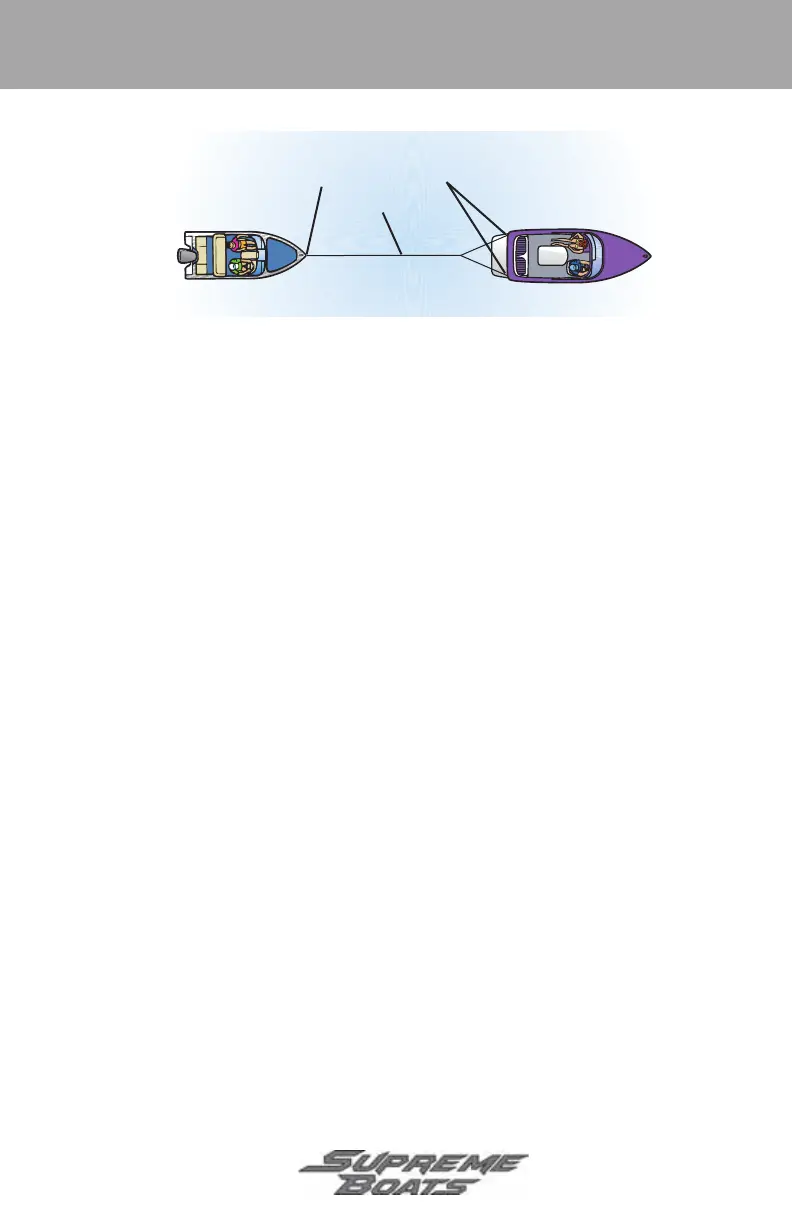
Figure 2
Figure 5-2
WARNING! Use extreme caution when using tow lines and when connecting
tow lines to cleats. Death or serious injury could occur if lines and/or cleats
fail while they are under extreme tension.
Follow these guidelines when towing or being towed:
• Use extreme caution when throwing weighted lines to a boat in distress. When
in rough seas, use a light throwing line with a weight secured on the throwing
end and a heavier towing line secured to the other end.
• Never attempt to tow a boat larger or heavier than your own.
• Never attempt to tow a grounded, damaged or capsized boat.
• Use a tow line that is rated at least four times the gross weight of the boat being
towed.
• Make sure tow lines are in good condition and are free of damage, cuts or
abrasions.
• Attach a tow line to the bow eye on the disabled boat. Never attach a tow line to
any point on the disabled boat other than the bow eye.
• Attach the tow line to the stern eyes of the tow boat. Wrap the tow line with
chafing gear where it rubs against the boat or any corners.
• Leave at least two boat lengths between the boats for adequate movement.
• Never allow anyone to be in line with the tow line. If the line breaks or pulls free,
dangerous recoil could occur, resulting in severe injury or death to anyone in its
path.
• Adjust the tow line to match wave action. Keep the boats on the crest or in the
trough of the waves at the same time. In protected, calm waters, shorten the
line for better handling.
• Tow at moderate speed, allowing for adverse wind and wave conditions.
• Have the operator of the towed boat steer with you if possible.
• Have a person on the tow boat watch the disabled vehicle and, if necessary, be
available to signal the operator of the disabled boat.
Check with local and state authorities prior to towing for additional regulations and
restrictions on towing other boats or equipment.
KC-0202C-A
TOW LINE
BOW
EYE
STERN EYES
Supreme_2018.book Page 7 Wednesday, January 31, 2018 9:30 AM



 To Next Page