Need help?
Do you have a question about the Synesso Sabre and is the answer not in the manual?
Essential safety guidelines for operating the espresso machine, emphasizing hot surfaces and electrical hazards.
Location of the label on the electrical box for safety information.
Location of the label on the end of the electrical cord.
Location of the label on the inside edge of the frame.
Instructions to have the serial number ready for service or technical support.
Specification of temperature offsets for different zones on the machine.
Requirements for placing the machine, including surface, clearance, and water supply.
Specifications for the counter surface where the machine will be placed.
Details on cold water supply line, shut-off valve, and filtration system needs.
Guidelines for connecting and routing the drain hose.
Location and dimensions of the pump and motor assembly.
Specific water quality standards required to maintain machine warranty.
Diagram showing the physical dimensions and space requirements of the machine.
Instructions for connecting water lines using compression fittings and ensuring a snug fit.
Explanation of wire color conventions for North American and European power cords.
Guidance on when to install a transformer for lower voltage receptacles.
Steps to turn on water, electronics, and heating elements.
Procedure to remove air from brew groups using the override button.
Instruction to turn the heating element breaker to the ON position.
Steps to set the pump pressure to 9 Bar using the adjusting screw.
Recommendation for a warm-up period before initial use.
Diagram and explanation of terminal assignments for the 2-group model.
Detailed explanation of each terminal's function for the 2-group model.
Detailed explanation of each terminal's function for the 3-group model.
Procedure for setting the delay time between probe response and valve opening.
How to program the pump to activate with the main valve for pressure control.
Method for setting individual volumes for multiple groups simultaneously.
Procedure for setting volumes for each group individually.
How to program the multi-function Stop/Continuous 5 button for dispensing.
Procedure to reprogram the 5th button for unlimited (continuous) flow dispensing.
Method for setting the timer for proportioning hot water for tea.
Common reasons for machine malfunctions, such as water supply or flowmeter issues.
Details on the DigiZone control system for 2 & 3 group models.
Details on the DigiZone control system for 1 group models.
Information about the location and precautions for the electronics box.
How to switch the temperature display between Celsius and Fahrenheit.
Relationship between steam tank pressure (Bar/PSI) and temperature (°F).
Steps for removing the panel and adjusting specific components like the expansion valve.
Tips on grinding fresh coffee and understanding roast properties for brewing.
Information on single and double portafilters and their respective basket capacities.
Explains the critical role of grind, dose, and tamp for satisfactory espresso shots.
Steps for engaging the portafilter and initiating the brewing process.
Steps for preparing milk and pitcher before steaming.
Guidance on inserting the wand, managing foam, and heating milk to the correct temperature.
Instructions for cleaning the steam wand after each use.
Information about the steam wand's double-walled construction.
Steps for performing daily back-flushing on brew groups.
Guidance on cleaning the machine's surfaces, steam wands, and drip trays.
Daily cleaning and back-flushing tasks for the machine.
Weekly cleaning and soaking procedures for components.
Monthly checks for water filtration system and cartridge replacement.
Quarterly checks of gaskets, screens, and internal cleaning of the electronics box.
Details on what the warranty covers and what conditions or damages are excluded.
Procedure for returning defective parts or products for repair or replacement.
Notes on varying local codes and regulations governing product use.
Disclaimer regarding Synesso's liability for damages extending beyond the product price.
Steps to reset the DigiZone electronics to factory parameters or adjust settings.
Procedure for performing a complete system reboot of the DigiZone electronics.
Table showing factory default temperature set points for different zones and groups.
Instructions on how to activate and deactivate the scroll mode for temperature settings.
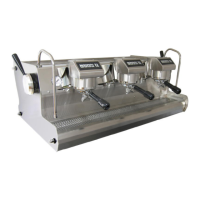
The Synesso Sabre Espresso Machine is a sophisticated piece of equipment designed for professional use, embodying artistry, ingenuity, and understanding in its construction and operation. It is built to deliver high-quality espresso and steamed milk, with a focus on precision and durability.
The Sabre Espresso Machine is primarily used for brewing espresso and steaming milk for various coffee beverages. It features multiple brew groups, allowing for simultaneous preparation of several espresso shots. Each brew group is equipped with volumetric dosing electronics, enabling precise control over the water dispensed for each shot. The machine also includes a dedicated steam tank for powerful and consistent milk steaming. A hot water mix valve provides hot water for tea or other purposes, with adjustable temperature settings. The machine's internal system includes a pump/motor combination to deliver water to the brew groups and steam tank, and a water filtration system is essential for its proper functioning and longevity.
Operating the Synesso Sabre involves several key steps and features designed for ease of use and consistent results.
Before initial use, the machine requires proper installation by an authorized service representative to maintain warranty validity. This includes connecting to a cold water supply line with a shut-off valve and a suitable water filtration system. An electrical receptacle with matching voltage and amperage is also required. To begin, the water supply is turned ON, and the electronics On/Off switch is set to ON. This activates the auto-fill feature for the steam tank and electronics, but not the heating elements. The water level in the steam tank sight glass on the right side of the machine will rise to a preset level. Air must be bled from each brew group by activating the electronics override button until water flows steadily. Once the steam tank is at least half full, the heating element breaker is turned ON. Pump pressure is adjusted to 9 Bar by activating a volume button on the keypad and using a screwdriver to turn the pump adjusting screw on the right side of the brass pump housing. Clockwise increases pressure, and counterclockwise decreases it. A warm-up time of at least 1.5 hours is recommended before brewing or steaming.
The Sabre comes with single and double portafilters, which should be warmed in the brew group before use. Filter basket sizes are typically 7 grams for a single, 14 grams for a double, and 18-21 grams for triples. For optimal espresso, fresh coffee, proper grind, dose, and tamp are crucial. The portafilter basket is filled with ground espresso, tamped firmly and evenly, and then engaged into the brew group. The desired volume button on the keypad is pressed to initiate brewing. A well-prepared double shot should take 20-25 seconds to brew 2 oz. Common issues like slow pouring can be due to a fine grind, too much coffee, firm tamp, clogged diffusion screens, or low pump pressure. Fast pouring can result from a coarse grind, insufficient coffee, light tamp, worn baskets, or cold water temperature.
The machine features a custom PID Electronics System with a 5-Zone Control System for 2 & 3 group models (and a 2-Zone system for 1 group models). This system allows for precise temperature control of different zones, including brew tanks and steam tank elements. To adjust temperatures, the ZONE button is pressed to select the desired zone. Holding the SET button checks the current set point. To change the temperature, the ZONE button is used to cycle to the desired zone, then the SET button is held while using the ARROW keys to adjust the temperature up or down. The heating element has two separate coils: Zone 4 is the primary coil, recommended to be set to achieve 1.2-1.4 Bar (250-255°F) on the steam gauge. Zone 5, the secondary coil, should be set 5-8°F lower and activates only when needed. The display can toggle between Celsius and Fahrenheit by pressing and holding the Down Arrow and Zone Button simultaneously until a beep is heard.
The Sabre's volumetric dosing system allows for programming specific water volumes for each brew group.
To set all groups together, the "Set / Operation" switch is moved to "Set." The "Stop/Continuous 5" keys of all groups to be set are pressed, and the LEDs of volumes 1-4 light up. A volume is selected from a chosen group, and water is dispensed. Pressing the same key again stops the flow, and the volume is set. The "Set / Operation" switch is then returned to "Operation." Individual groups can be set similarly by pressing the "Stop/Continuous 5" key of the specific group. The 5th button, "Stop/Continuous 5," can dispense a set portion or provide continuous flow. To program a set portion, the "Set / Operation" switch is in "Operation," the "Stop/Continuous 5" key is pressed (green LED lights up, water flows), then the "Set / Operation" switch is moved to "Set" (green LED turns off, water stops). Pressing "Stop / Continuous 5" again dispenses water until the desired volume is reached, then pressing it again stops the flow and sets the portion after a 15-second flash. To set continuous flow, the "Set / Operation" switch is in "Operation," the "Stop/Continuous 5" key is pressed (green LED lights up, water flows), then the "Set / Operation" switch is moved to "Set" (green LED turns off, water stops). This reprograms the key for unlimited dispensing.
The hot water timer for tea is set by moving the "Set / Operation" switch to "Set." Pressing the tea key starts water flow, and pressing it again stops the flow and sets the quantity.
Fresh, cold milk is poured into a steaming pitcher, filling it to about 1/2 full. The steam wand tip is inserted deep into the milk. The steam valve is fully opened by pulling the handle. As the milk heats and agitates, the pitcher is lowered to keep the wand tip closer to the surface for foam creation. Once sufficient foam is achieved, the pitcher is raised to submerge the tip deeper, minimizing further foaming. Milk should be heated to 150-170°F (65-76°C). After each use, the steam wand should be wiped clean and purged immediately. The Sabre's double-walled steam wands help keep the outer wall cooler, but the tip and base can still become very hot.
The machine continuously checks flowmeters. If no pulses are registered for 3 seconds during dispensing, it enters malfunction mode, indicated by alternating flashing LEDs of the selected line and the red "Stop / Continuous 5" key. In this mode, water dispensing must be manually interrupted, the portion is not recorded, and the pump switches off after 90 seconds to prevent damage. Common causes include interrupted water supply, fine coffee grounds blocking water flow, calcified or blocked flowmeters, or interrupted flowmeter input.
Regular cleaning and maintenance are critical for the Sabre's performance and longevity.
 General
| Type | Espresso Machine |
|---|---|
| Group Heads | 2 or 3 |
| Pressure Profiling | Yes |
| Water Source | Plumbed |
| Power | 220V/240V |

 To Next Page