This document is the Installation and Operating Instructions for Systemair roof fans, specifically models DVN(I), DVS(I), DVC(I), and DHS. It provides comprehensive information for the safe and correct handling, installation, operation, and maintenance of these ventilation devices.
Function Description:
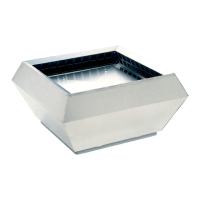
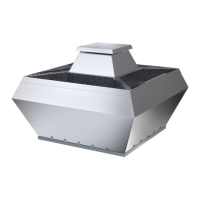
Systemair roof fans are designed for integration into ventilation systems, primarily for extract air applications. They can be installed in duct systems or with free suction via an inlet cone and a suction-side contact protection grille. To prevent cold air intake when the fan is not operating, Systemair recommends using a Back Draft Damper (VKS).
The different models are tailored for specific applications:
- DVN, DVNI: These fans are suitable for conveying contaminated air, such as dust or kitchen exhaust. The 'I' suffix indicates an insulated version, designed for high-temperature applications.
- DVS, DVSI, DVC, DVCI, DHS: These models are designed for conveying clean air. The 'I' suffix again denotes an insulated version.
- DVC, DVCI: These models are equipped with EC motors. The DVC-S version offers stepless control via a 0-10 V signal, with the operating point adjustable via an integrated potentiometer. The DVC-POC version includes integrated pressure and temperature sensors for outdoor temperature compensation, allowing for programmed constant pressure operation. The DVC-P version also features integrated pressure sensors and is programmed for constant pressure operation, and can be ordered as a Constant Air Volume (CAV) unit.
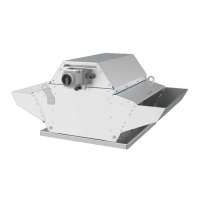
- DHS: These fans are equipped with AC motors and are designed for horizontal discharge.
Important Technical Specifications:
The technical specifications, including maximum ambient temperature, maximum transported air temperature, sound pressure, voltage, current, frequency, enclosure class, and weight, are detailed on the fan's name plate and in the online catalogue data sheets. Motor-specific data can be found on the motor's name plate or in the manufacturer's technical documents. All data on the fan's name plate adhere to "standard air" according to ISO 5801.
Key dimensions for each model (DVN, DVNI, DVS, DVSI, DVC, DVCI, DHS) are provided in detailed tables, including measurements for height, width, depth, mounting hole patterns, and connection sizes. For DVC-P models, K-factors (measured values) are also provided, which are relevant for pressure-controlled applications.
Usage Features:
- Personnel Qualification: Installation, operation, transport, cleaning, disposal, electrical connection, commissioning, and maintenance must only be performed by qualified, instructed, and trained personnel who are aware of relevant safety directives. Specific qualifications are outlined for each activity, ranging from trained personnel for storage and operation to electrical experts for electrical connections and maintenance. Smoke extraction and EX fans require agreement with Systemair for repair.
- Safety: The manual emphasizes reading the operating instructions thoroughly, adhering to local regulations, and ensuring all safety elements are intact. Protective devices (electrical and mechanical) must be in place.
- Transport and Storage: Fans should be transported in their original packaging to prevent damage, using appropriate hoisting equipment. Storage should be in a dry, dust-free location, protected from extreme temperatures. Long-term storage (over 1 year) should be avoided to prevent motor bearing issues.
- Installation: Proper installation is crucial to prevent issues like roof leaks (by correctly sealing the roof fan's base plate) and duct system leaks (by ensuring all mounting surfaces are air-tight). Thermal bridging should be avoided by insulating the fan and accessories. Duct bends should not be placed directly before or after the fan to ensure smooth and constant airflow.
- Electrical Connection: Electrical connections must match the nameplate data and circuit diagrams. EC motors are controlled via a control input. A circuit breaker with a contact opening of at least 3 mm at each pole is required. All-current-sensitive residual current circuit breakers are mandatory for systems with electronic devices like EC motors or frequency converters.
- Motor Protection: EC motors have integrated motor protection. For other motors, lead-out temperature monitors should be integrated into the control circuit to prevent automatic restart after a fault. Motor lines and temperature monitor lines should be laid separately. A motor protection switch is required if thermal protection is absent.
- Variable-Speed Fans: When using variable-speed fans, it's critical to operate them outside resonant frequency ranges to prevent vibrations and component damage. The fan and frequency converter should be installed close to each other, using shielded cables, and all components must be grounded. Operation below 10 Hz should be avoided, and an all-pole sine filter is mandatory for DVS, DVSI, and DHS models when operated with a frequency converter.
- Commissioning: Proper commissioning is essential for warranty claims. This includes verifying correct installation and electrical connection, checking for visible damage, ensuring protective equipment functions, and confirming free inlet/outlet and tight cable glands. A commissioning report must be completed.
Maintenance Features:
- Maintenance Plan: A comprehensive maintenance plan, created by the operator, is a prerequisite for warranty claims. Regular maintenance intervals are recommended to ensure continuous operation, with increased frequency under "extreme" operating conditions (e.g., kitchen exhaust, extreme temperatures).
- Activities: Maintenance activities include:
- Checking for visible damage, corrosion, and contamination of the fan and components (every six months/quarterly).
- Inspecting the impeller for damage and imbalance (annually/every six months).
- Verifying correct condensate drain function (annually/every six months).
- Cleaning the fan/ventilation system (annually/every six months).
- Checking screwed connections for damage/defects and tightness (annually).
- Ensuring the fan intake is free from contamination (annually).
- Confirming correct usage of the fan and components (annually).
- Checking current consumption against rated data (annually/every six months).
- Inspecting vibration dampers for correct function, damage, and corrosion (annually).
- Verifying electrical and mechanical protective equipment (annually).
- Ensuring the fan's rating plate is legible (annually).
- Checking connection clamps and cable connections for damage/defects and tightness (annually).
- Inspecting flexible connectors for damage (every six months).
- Cleaning: Keeping the fan clean extends its service life. This involves installing a filter monitor and regularly changing ventilation system filters. When cleaning, avoid steel brushes, sharp objects, high-pressure cleaners, and bending fan blades. Pay attention to balance weights on the impeller.
- Spare Parts: Only original Systemair spare parts should be used. When ordering, the fan's serial number (found on the name plate) must be provided.
- Troubleshooting: A detailed troubleshooting guide is provided, linking common problems (e.g., fan not reaching nominal speed, not running smoothly, low air output, grinding sounds, motor overheating) to possible causes and recommended remedies. These remedies range from contacting Systemair to correcting settings, removing blockages, rebalancing impellers, cleaning, checking wiring, and improving cooling.

 Need help?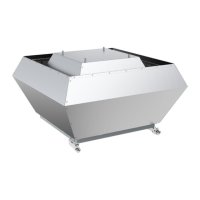

 To Next Page
 General