RISCHIO DI URTO
Do vu to alle par ti del sol le va to re o del vei co lo po si zio na te ad al tez
-
za d’uo mo.
Quan do, per ra gio ni di la vo ro, il sol le va to -
re vie ne fer ma to a quo te re la ti va men te
bas se (in fe rio ri a 1,75 m dal suo lo) vi è il
ri schio di ur ta re con tro le par ti non evi den
-
zia te da par ti co la ri co lo ra zio ni (Fig.28).
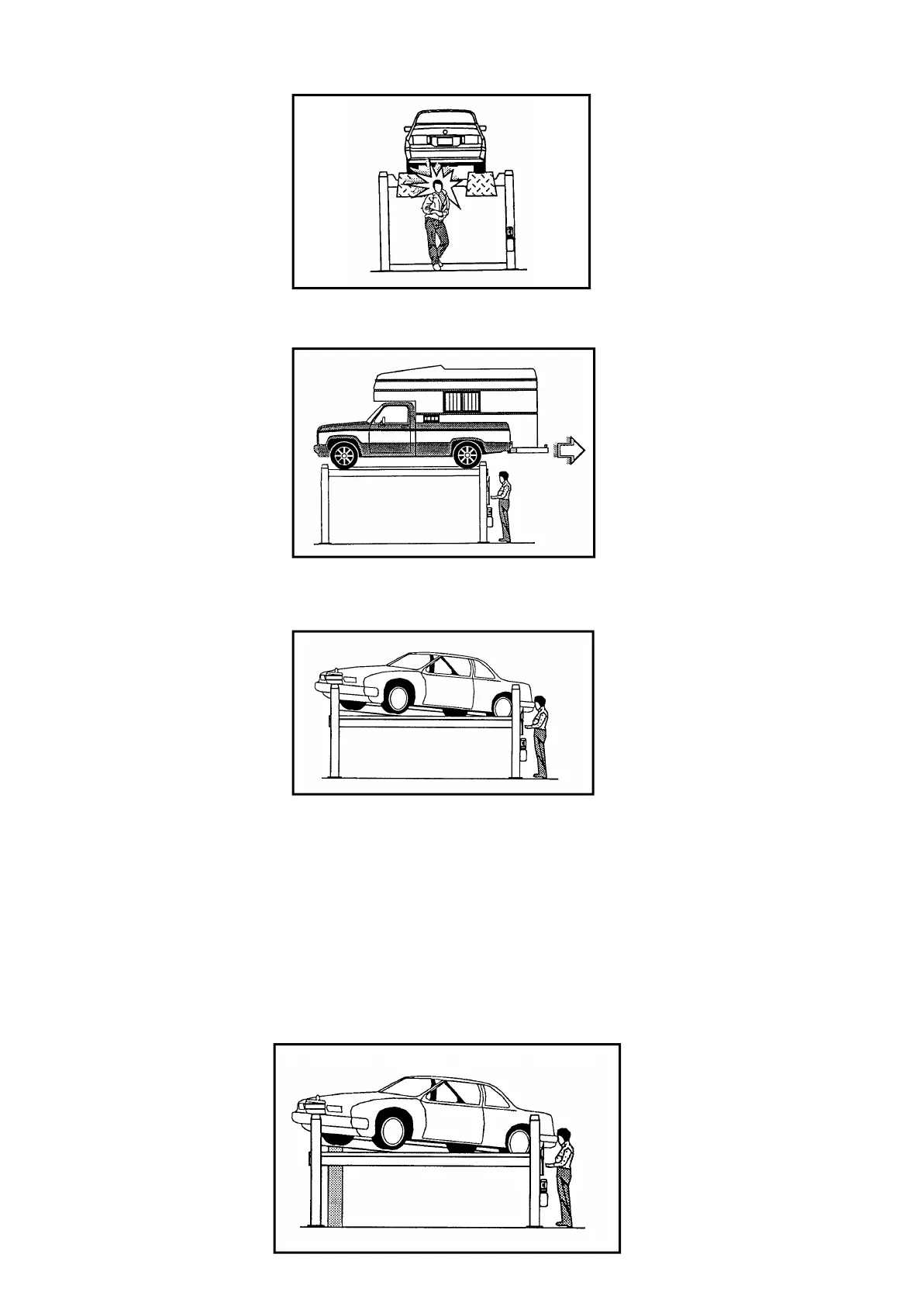
Fig.28 Ri schio d’ur to
RISCHIO DI SPOSTAMENTO DEL VEICOLO
Do vu to ad ope ra zio ni da com pie re che
ge ne ra no spin te sul vei co lo.
Se il vei co lo é di di men sio ni o pesi rag-
guar de vo li uno spo sta men to può rap pre
-
sen ta re una si tua zio ne di so vrac ca ri co o
sbi lan cia men to non pre vi sto per tan to, pri
-
ma del sol le va men to e du ran te tut te le fasi
di la vo ro,OC COR RE CHE IL VEI CO LO
SIA BLOC CA TO ME DIAN TE IL FRE NO A
MANO.
Fig.29 Ri schio di spo sta men to
RISCHIO DI CADUTA DEL VEICOLO DAL PONTE
SOLLEVATORE
Che può es se re cau sa to dal po si zio na men to non cor ret to del vei-
co lo sul le pe da ne,da un cat ti vo fis sag gio
del vei co lo,o da di men sio ni del vei co lo
non com pa ti bi li col sol le va to re.
Fig.30 Ri schio di ca du ta del vei co lo
NON COM PIE RE MAI PRO VE COL VEI CO LO IN
MOTO SUL LE PE DA NE (es. re tro mar ce ecc.).
RI SCHIO DI AL LEN TA MEN TO DEL LE FUNI
Do vu to ad og get ti ap pog gia ti alle co lon ne o la scia ti in di re zio ne
del le pe da ne (Fig.31).
NON LA SCIA RE OG GET TI AP POG GIA TI ALLE
CO LON NE O NEL LA ZONA DI DI SCE SA DEL LE
PAR TI MO BI LI.
Se ven go no la scia ti og get ti che in ter fe
-
ri sco no con la di sce sa del le pe da ne si
ha il bloc co del la di sce sa.
Fig.31
Ri schio di al len ta men to del le funi
RISK OF IMPACT
Caused by the parts of the lift or the vehicle that are positioned at
head height.
When, due to operational reasons, the lift
is stopped at relatively low elevations (less
than 1.75 m from the ground) personnel
must be careful to avoid impact with parts
of the machine not marked with special
colours (Fig.28).
Fig.28
Risk of impact
RISK OF VEHICLE MOVING
Caused by operations involving the appli-
cation of force sufficient to displace the
vehic le.
In the case of large or particularly heavy
vehicles, sudden movement could create
an unacceptable overload or uneven load
sharing. Therefore, before lifting the
vehicle and during all operations on the
vehic le
MAKE SURE THAT IT IS PROPERLY
STOPPED BY THE HAND BRAKE.
Fig.29
Risk of vehicle moving
RISK OF VEHICLE FALLING FROM
LIFT
This hazard may arise in the case of incorrect
positioning of the vehicle on the platforms,
incorrect stopping of the vehicle, or in the case
of vehicles of dimensions that are not
compatible with the capacity of the lift.
Fig.30
Risk of vehicle falling
NEVER ATTEMPT TO PERFORM TESTS BY DRIVING
THE VEHICLE WHILE IT IS ON THE PLATFORMS
(e.g. reversing, etc.).
RISK OF SLACKENING OF LIFT CABLES
Caused by objects left leaning against the posts or on the platforms
(fig.31).
NEVER LEAN OBJECTS AGAINST THE POSTS OR
LEAVE THEM IN THE LOWERING AREA OF THE
MOVEABLE PARTS OF THE LIFT.
If you leave objects that interfere with
the free lowering of the platforms the
lowering movement will be interrupted.
Fig.31
Risk of slackening of lift cables
20


 To Next Page
 Loading...