C
Copyright Technolog Ltd. 2017. All rights reserved.
Information contained in this document subject to
change without prior notice.
Sheet 31 of 43
Technolog Limited,
Ravenstor Road,
Wirksworth,
DE4 4FY,
United Kingdom
T: +44 (0) 1629 823611
E: techsupport@technolog.com
www.technolog.com
DMR No.: 7504
2099PM9000 Rev. B
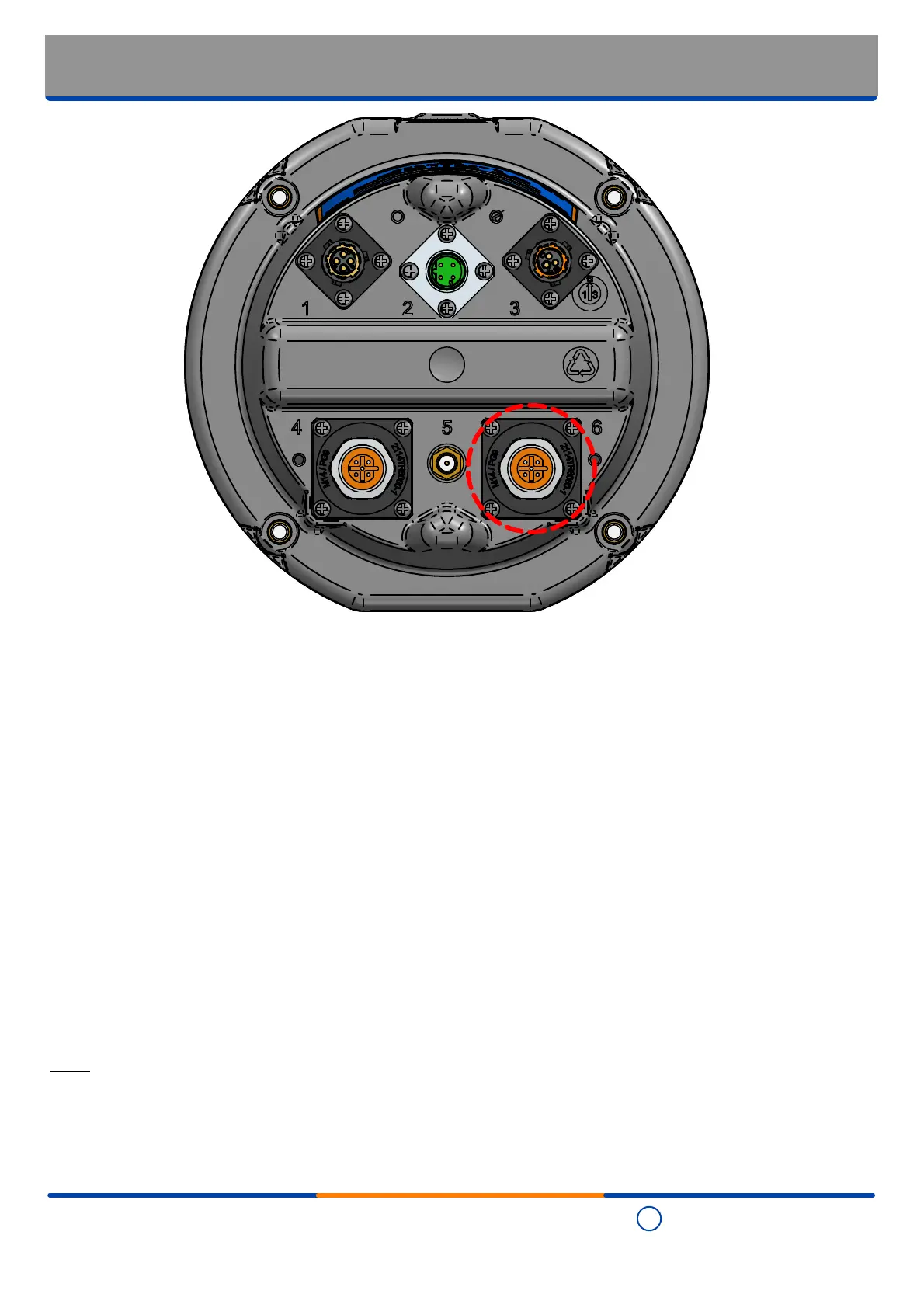
Standard connections - Port 6:
External pressure sensor connection
Pressure input 'P2' (dual pressure configurations)
OR
'P1' (in single pressure configurations in conjunction with the
"Universal eight signal" connection at Port 4) - optional open-face sealed, polarised / keyed, and colour-coded (orange),
M12 'B' coded 'external pressure' female connector is provided for the attachment of the following Technolog external
pressure sensors:
SQ619-13219: 0 - 100m H2O (or equivalent), provided with 2.5m length of cable and an integral 'quick coupling' plug
(dn 5mm) pressure fitting for attachment to a mating pressure fitting.
SQ619-13220: 0 - 200m H2O (or equivalent), provided with 2.5m length of cable and an integral 'quick coupling' plug
(dn 5mm) pressure fitting for attachment to a mating pressure fitting.
The above sensors are suitable for the pressure measurement of dry or wet media compatible with stainless steel and
provide programmable resolutions of ±0.5% or ±0.1%. By convention, in dual pressure applications, this is
usually
allocated as the "outlet" / "down stream" pressure and not subject to statistical analysis (although statistical analysis is
optionally available on this input if required)
Warning - Care is to be taken when connecting the sensor to a pressure supply to ensure that it is within the range
stated on the label affixed to the sensor - exceeding the stated pressure range may cause catastrophic damage to the
pressure sen
sor.
It is also possible monitor, and record, the temperature of the applied media to an accuracy of ±1°C although this will
use one of the available input channels.
Notes
Available options are dependent on configuration file.
Where fitted in conjunction with the "Universal eight signal connection" at Port 4, then one of the "General Purpose
inputs (GPis)', usually GPi1, is no longer available as it is used for this pressure channel.
Refer also to the "Standard connections: Channel mapping & channel shadowing" section of this document.
o
o
•
•
•


 To Next Page