13
User manual TDT +
ENGLISH
5. - INSTALLATION
Before starting
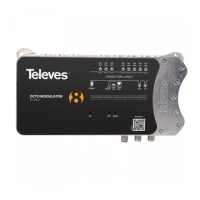
The equipment will be mounted by placing
the different modules that make up the
system in the support ref. 5301, which will
be mounted in a subrack (see section 3.1,
3.2).
It is connected to the mains via a plug that
can be found on the left-hand side of the
equipment.
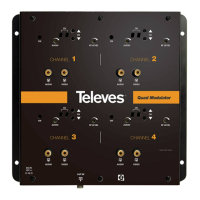
The way of connecting all the modules is
described in the figures in section 3.
The “F” bridges will be usd for the IF and RF
connections. The unused RF input should
be charged with 75 ohm ref. 4061, as should
the IF output, as can be seen in the figures
of section 3.
Carrying out the installation
To carry out the configuration of each TDT+
module, it is necessary to use the
programmer and follow these steps:
5.1 - Normal menu
When the programmer is inserted into the
front connector RJ45 (“PRGM”) of the TDT+.
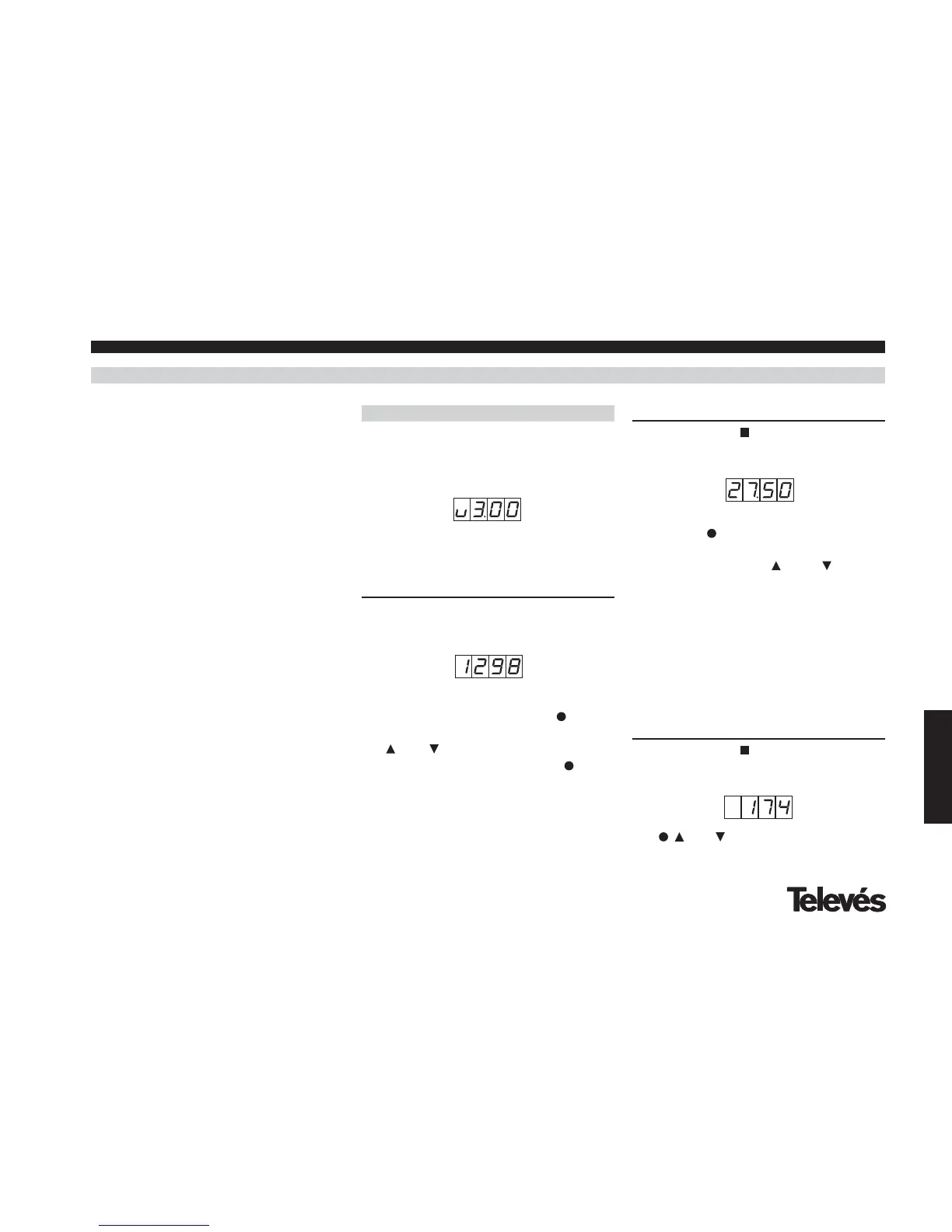
For example, version 3.00:
a.- Central frequency of the input channel
After a few seconds, the first menu will
appear. This is the Central frequency of
the input channel, for example 1.298:
To change the value, press the button.
The digit will begin to flash on and off. Using
the and buttons, you can change the
value of the digit. By pressing the again,
the following digit is selected, which can be
changed in the same way, and so on until
the desired value is obtained. The range of
permitted values is from 950 to 2150 MHz.
b.-Symbol rate
By pressing the button, the following
menu appears on the display. This is the
symbol rate, for example 27.50 Mbaud:
This is done in the same way as the input
channel; the button allows you to choose
between the different individual digits of the
symbol rate and the and buttons
modify the selected digit. The range of
values permitted for the symbol rate varies
between 1.5 and 35 Mbaud.
This menu does not appear if the SCAN
function is activated in the extended
menu. (SCAN = ON)
c.- Output channel
By pressing the button, the following
menu appears. This is the output channel,
for example 174 MHz:
The and buttons let the user change
the output channel, which has a range of
values from 46 to 862 MHz.



 To Next Page