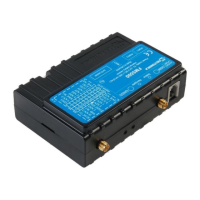
Need help?
Do you have a question about the Teltonika FM5500 and is the answer not in the manual?
Safety warnings and device handling precautions.
Guidelines for safe operation to avoid dangerous situations.
Copyright, reproduction, and trademark information.
Manual's purpose, scope, and definition of terms.
List of items included in the FM5500 device package.
Technical specifications covering GSM, GPS, and GNSS capabilities.
Physical dimensions, interfaces, and operation environment details.
Identifies stickers for GPS/GLONASS and GPS-only modifications.
Details on the internal backup battery and operating time.
Detailed electrical parameters including voltage and current ratings.
Electrical limits beyond which device damage may occur.
Visual guide on how to insert SIM cards into the device.
Step-by-step guide for installing necessary device drivers on a PC.
Explanation of Navigate and Status LED operational behaviors.
Detailed pinout description for the 2x10 connector.
USB port functionality and information on optional accessories.
Guidance on connecting fuel sensors and alarm inputs.
Step-by-step process to update the device firmware via USB.
How the FM5500 acquires records and sends them to a server.
Explanation of device modes and accelerometer usage.
Virtual odometer functionality and voice call features.
Understanding device profiles and available features like scenarios.
Launching the configurator and understanding its layout.
Configuring device parameters, including global settings.
Configuring system and GSM/GPRS parameters.
Configuring device features like mode, scenarios, and trip.
Setting up geofencing zones and managing iButton IDs.
Configuring I/O elements and their detailed properties.
Settings for the CAN interface, including baud rate and message filtering.
Tables detailing configurable and global parameters.
How to read and manage saved device records.
How profile switching is affected by GSM operator and I/O events.
Configuration for home network and SIM roaming profiles.
Handling unknown operators and the dual SIM connection logic.
Methods for acquiring GPS data: time, distance, and angle.
Acquiring I/O data and configuring event generation.
Eco Driving functionality and device mounting guidelines.
Configuration for Overspeeding and Immobilizer scenarios.
Authorized driving scenario and COM port working modes.
Configuring LLS mode and polynomial values for sensor accuracy.
Configuring RFID modes and integrating with Garmin devices.
SMS commands for getting device status, time, and operator info.
SMS commands for GPS, profile loading, and resets.
SMS commands for getting version, I/O, and general device information.
SMS commands for deleting records and setting digital outputs.
SMS commands for flushing data and getting GNSS information.
SMS commands for banlist and crash logs.
SMS commands for SIM info and LV-CAN programming.
Configuring CAN data using Auto CAN or Manual CAN tabs.
Monitoring CAN bus data and configuring offline.
List of AutoCAN IDs and their corresponding parameters.
Information related to driver states and tachograph events.
Temperature readings for engine coolant and ambient air.
Selecting program number and connecting the adapter.
Steps to configure FM5500 with the LV-CAN200 adapter.
List of parameters and their IDs for CAN bus data.
Pinout diagram for the RS485 interface.
Garmin integration, supported protocols, and client application features.
Connection details and pinout for Garmin PND.
Steps for calibrating LLS sensors and calculating polynomials.
 General
| Operating Temperature | -40°C to +85°C |
|---|---|
| GPRS | Class 12 |
| Tracking Sensitivity | -162 dBm |
| Digital Outputs | 2 |
| Analog Inputs | 2 |
| GNSS Update Rate | 1 Hz |
| IP Rating | IP54 |
| GPS Accuracy | 2.5 m |
| Communication Interfaces | RS232, RS485, CAN |
| Connectivity | GSM |
| GSM | Quad-band |
| GPS Chipset | u-blox |
| Start Time | Hot: 1s |
| GNSS | GPS, GLONASS |
| Power Supply | 10 - 30 V DC |
| SMS | SMS (text, data) |

 To Next Page