Need help?
Do you have a question about the THORLABS PDA10CF and is the answer not in the manual?
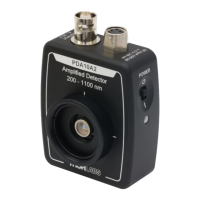
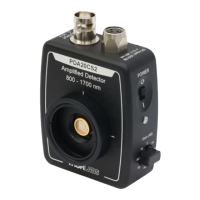
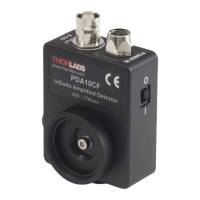
The Thorlabs PDA10CF(-EC) is an amplified InGaAs detector designed for the detection of light signals within the 800 to 1700 nm wavelength range. It features a buffered output that can drive 50 Ω load impedances up to 5 V. The detector's housing includes a removable threaded coupler (SM1T1) and a retainer ring (SM1RR), making it compatible with Thorlabs' 1" threaded accessories. This design facilitates the convenient mounting of external optics, light filters, apertures, and provides an easy mounting mechanism for Thorlabs' cage assembly accessories.
The PDA10CF(-EC) is designed for versatility in setup. It can be mounted using a Thorlabs TR-series 1½" diameter post into one of the #8-32 (M4 on -EC version) tapped holes on the bottom and side of the head, and then secured in a PH-series post holder. Power is supplied via a 3-pin plug connected to the power receptacle on the unit, and the power supply is plugged into a standard 50 to 60 Hz, 100 to 120 VAC outlet (220 to 240 VAC for -EC version).
For optimal performance, a 50 Ω coax cable (e.g., RG-58U) should be attached to the PDA's output. For cable lengths exceeding 12", terminating the opposite end of the coax with a 50 Ω resistor (Thorlabs p/n T4119) is recommended. However, caution is advised: if using high-speed oscilloscopes with 50 Ω input impedances, a separate 50 Ω terminator should not be used, as this could result in a combined load of 25 Ω, potentially damaging the output driver. The device is powered on using a slide switch located on the top side.
The detector's front surface is flush with the housing to maximize accessibility to the photodetector. When using fiber adapters, it is crucial to ensure the fiber ferrule does not crash into the detector, which could cause damage. Installing the included SM1RR retaining ring inside the 1" threaded coupler before installing the fiber adapter can prevent this. Users can install filters, optics, adapters, or fiber adapters to the input aperture as needed. During alignment, it is important to take precautions such as using reduced radiation power and appropriate eye/skin protection as recommended by the radiation source manufacturer. The gain can be adjusted to the desired setting once a light source is applied.
The PDA10CF(-EC) incorporates a reverse-biased PIN photodiode mated to a fixed gain transimpedance amplifier, all housed in a rugged enclosure. The transimpedance amplifier is designed to hold point A to a "Virtual Ground," minimizing the effects of dark current. The responsivity of the photodiode is defined as the ratio of generated photocurrent (IPD) to the incident light power (P) at a given wavelength: R(λ) = IPD / P.
Dark current is the leakage current that flows when a bias voltage is applied to a photodiode. The PDA's transimpedance amplifier helps control this. The dark current is influenced by the photodiode material and active area size. Silicon devices generally exhibit low dark current, while germanium devices have high dark currents. InGaAs photodiodes, like those in the PDA10CF(-EC), typically have low dark current and high speed, making them suitable for the specified wavelength range.
The bandwidth is limited by the load resistor interacting with the photodetector junction capacitance. For best frequency response, a 50 Ω terminator with a 50 Ω coaxial cable should be used. The bandwidth (f(-3dB)) can be calculated using the formula: f(-3dB) = GBP / (4πRF × CD), where GBP is the amplifier gain bandwidth product, RF is the feedback element, and CD is the sum of the photodiode junction capacitance and the amplifier capacitance.
A load resistance converts the generated photocurrent into a voltage (VOUT) for oscilloscope viewing. The response speed is affected by the type of photodiode and load resistance. A 50 Ω coaxial cable with a 50 Ω terminating resistor at the opposite end is recommended for maximum bandwidth, ensuring the cable is matched to its characteristic impedance. Increasing the load resistance can increase the amount of voltage for a given light level, but an unmatched termination can negatively impact the response. The maximum output of the PDA10CF(-EC) is 10 volts for high impedance loads (i.e., RLoad > 5 kΩ) and 5 V for 50 Ω loads. Adjusting the gain to ensure the measured signal level is below 10 volts (5 volts with a 50 Ω load) is important to avoid saturation. For low terminating resistors (<5 kΩ or 1% error), an additional factor needs to be considered, as the output includes a 50Ω series resistor (RS). The output load creates a voltage divider, with the 50Ω series resistor as follows: Scale Factor = RLoad / (RLoad + RS). The output voltage is then VOUT = R(λ) * Transimpedance Gain * Scale Factor * Input Power (W).
Thorlabs adheres to the WEEE (Waste Electrical and Electronic Equipment Directive) of the European Community and national laws. For "end of life" units, Thorlabs offers a return service without disposal charges, provided the equipment:
This service applies to self-contained operational electrical and electronic products, not to OEM products, components, mechanics, optics, or disassembled parts. If returning a unit for waste recovery, contact Thorlabs or your nearest dealer.
If an "end of life" unit is not returned to Thorlabs, it must be handed to a company specialized in waste recovery. It should not be disposed of in a litter bin or at a public waste disposal site.
The WEEE directive aims to reduce environmental pollution from toxic products released during decomposition by enforcing the recycling of WEEE. This controlled recycling prevents negative environmental impacts.
The internal components of the PDA10CF(-EC) are sensitive to electrostatic discharge (ESD). Users must take all appropriate precautions to discharge personnel and equipment before making any electrical connections to the unit to prevent damage.
 General
| Brand | THORLABS |
|---|---|
| Model | PDA10CF |
| Category | Security Sensors |
| Language | English |

 To Next Page