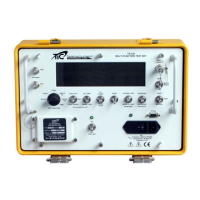
SDR-OMNI Avionics Test Set User Manual
Revision B 6 June 2023 Page 9
2.2.2 AC Power Adapter/DC Charger
The AC Power Adapter/DC Charger (24 Vdc) (Figure 2-2) charges the battery and supplies power to the unit for
operation. See Table 8-2 for power specifications.
Figure 2-2. AC Power Adapter/DC Charger (24 Vdc)
2.2.3 Telescopic Antenna
Most HF/VHU/UHF radio checks will be performed over-the-air using the supplied Telescopic Antenna
(Figure 2-3). The length of the antenna should be adjusted for the wavelength of the frequency band being tested
(refer to Table 2-2 and Table 2-3).
Many basic functional tests (such as Very High Frequency (VHF) Omnidirectional Radio (VOR), Instrument
Landing System (ILS) Localizer (LOC), Glideslope (GS), and Marker Beacon (MB)), Emergency Locator
Transmitter (ELT), Selective Calling (SELCAL), and Communication (COMM) tests) can be performed by a single
operator from the cockpit. The Telescopic Antenna can be extended out of the passenger door or the pilot’s
window. Otherwise, the SDR-OMNI should be placed 10 to 30 feet (3 to 9 meters) from the unit under test (UUT)
antenna with an unobstructed line-of-sight.
Hangars, ramp equipment, and other aircraft may interfere with test signals. If unexpected test results are
observed, first attempt to move the SDR-OMNI to a location that could minimize multi-path interference and
retest.


 To Next Page
 Loading...