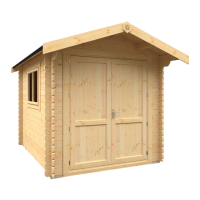
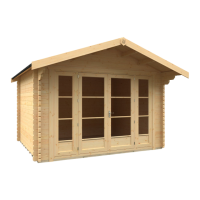
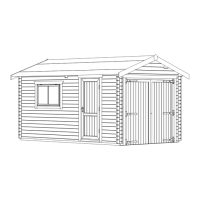
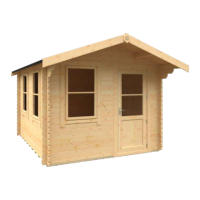
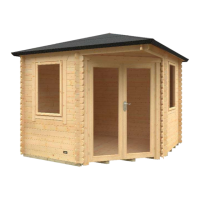
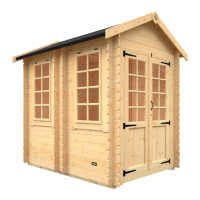
The provided document is a general assembly instruction manual for a "TIGER DELTA LOG CABIN." It outlines the steps for constructing the log cabin, from unpacking components to fitting the roof and internal elements.
Function Description:
The Tiger Delta Log Cabin is a garden building designed for outdoor use, likely serving as a shed, workshop, or additional living space. The manual guides users through the self-assembly process, emphasizing proper construction techniques and material handling to ensure the longevity and structural integrity of the cabin. It highlights the importance of a suitable base, correct log placement, and appropriate treatment for the timber.
Important Technical Specifications (Derived from the manual):
- Timber Material: Natural timber logs. The manual notes that timber can be affected by weather conditions (swelling, warping) and advises mitigation strategies like spraying with water during warm sunshine and sheltering during rain/snow.
- Base Requirements:
- Must be firm and level, built on firm ground to prevent distortion.
- Should be at least the size of the tanalised floor bearers.
- Recommended to be at least 25mm above surrounding ground level to avoid flooding.
- Types of Base:
- Durable plastic grid (Fastfit EcoBase recommended).
- Concrete: 75mm laid on top of 75mm hard-core.
- Slabs: Laid on 50mm of sharp sand.
- Timber base: Self-constructed or pre-made.
- Fixing Kit Contents:
- C20: Clout Nails (20mm Galvanised - QTY 300)
- S40: Screws (40mm - QTY 30)
- N40: Nails (40mm Galvanised - QTY 30)
- S60: Screws (60mm - QTY 8)
- N65: Nails (65mm Galvanised - QTY 300)
- S80: Screws (80mm - QTY 16)
- BA40: Nails (40mm Bright Annular - QTY 400)
- CB40: M6 Coach Bolts (40mm - QTY 8)
- Door/Window Framing: Holes for framing are pre-drilled in the factory.
- Floorboard Gap: A 2.5mm gap is required between the edge of the floorboards and the outer logs for expansion and contraction.
- Roof Felt Overhang: 75mm overhang at each end of the roof felt.
- Roof Felt Overlap: Overlap felt by 75mm when working from low to high side of the roof.
- Roof Fascia Boards (Bargeboards): No bargeboards are supplied for the low side of the roof to prevent effective water drainage.
- Storm Braces: Secured with 2x CB40, with the bottom CB40 left slack to allow for cabin expansion and contraction.
Usage Features:
- Self-Assembly: The cabin is designed for self-assembly, with step-by-step instructions provided. Two competent adults are recommended for erection.
- Interlocking Log Design: Each log interlocks in a staggered pattern, with some logs featuring additional full and half notches for specific placements.
- Tongue and Groove Fit: Logs are fitted using tongue and grooves, requiring gentle tapping with a mallet for a snug fit.
- Door and Window Installation: Doors and windows are installed as the log layers build up, with specific instructions for positioning and securing. 14ft cabins may come with single-piece header fascias for doors and windows.
- Roof Construction: Involves installing gable tops, purlins, tongue and groove roof boards, roof battens, skirting, and felt.
- Internal Elements: Instructions for fitting internal roof battens, a shelf, and internal skirting are included.
- Storm Braces: The cabin incorporates storm braces to enhance structural stability, designed to accommodate timber expansion and contraction.
Maintenance Features:
- Pre-Treatment Advisory: It is ESSENTIAL that the building is treated with an appropriate high-quality oil or solvent-based preservative AFTER assembly, both internally and externally, then annually thereafter. Painting or treating timbers before assembly is explicitly advised against to ensure a snug tongue and groove fit.
- Access for Maintenance: The base location should allow access to all sides of the building for maintenance work and annual treatment.
- Timber Movement Awareness: The manual explicitly states that timber is a natural product and will expand and contract. Slight gapping in the log cabin may occur and can be rectified by un-screwing and re-screwing fascia boards over time. Storm braces are designed to accommodate this movement.
- Checking Squareness: Users are instructed to check the cabin's squareness at various stages (floor, roof boards, doors, windows) to ensure proper assembly and prevent twisting or going out of square.
- Pre-Drilling: Screw holes should be pre-drilled to avoid splitting the timber (these are not pre-drilled from the factory).
- Regular Checks: The manual implies regular checks for levelness (spirit level) and proper alignment throughout the build process.

 Need help?
 General

 To Next Page