Need help?
Do you have a question about the Topfield TBF-200HD and is the answer not in the manual?
Lists the key capabilities and functions of the digital receiver, including storage, editing, and programme information access.
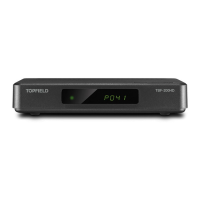
Details the buttons, lights, and display on the receiver's front panel used for basic control and status indication.
Describes the functions of each button on the remote control for operating the digital receiver.
Lists the items included in the digital receiver package for initial setup.
Provides essential safety guidelines to follow before and during the use of the receiver to prevent hazards.
Identifies and explains the purpose of each connection port on the back of the receiver for connectivity.
Details how to connect the antenna cable to the receiver to receive digital television broadcasts.
Explains how to connect the receiver to a TV using HDMI or composite video cables for display.
Guides on powering on the receiver and inserting batteries into the remote for initial use.
Instructions on how to scan for and find available TV and radio services using the receiver.
Explains how to restore the receiver to its original factory default configuration.
Allows selection of menu, audio, and subtitle languages for the receiver's interface and content.
Sets the display language for the receiver's menus and on-screen interface.
Selects preferred audio tracks for programmes, supporting multiple languages.
Configures video resolution, aspect ratio, and audio output for optimal viewing experience.
Adjusts the picture resolution to match TV capabilities for clear and sharp images.
Sets the screen aspect ratio (e.g., 16:9, 4:3) for correct image display on the TV.
Selects the audio output mode, such as stereo or mono, for sound playback.
Configures the receiver's clock using GMT and daylight saving options for accurate time display.
Enables blocking of programmes based on content ratings and age restrictions to manage viewing.
Customizes the display time and transparency of on-screen information (OSD).
Adjusts audio volume and mutes sound using the remote control's volume buttons.
Guides on changing channels, viewing programme info, and selecting audio/subtitle tracks.
Displays a list of available TV and radio channels for selection and navigation.
Shows details about the current programme, including signal quality, broadcast time, and summary.
Chooses preferred audio language or sound mode for programmes with multiple audio options.
Selects available subtitle tracks for programmes in different languages.
Accesses the EPG to see scheduled programmes and summaries for various channels.
Explains how to pause, rewind, and replay live TV broadcasts for a delayed viewing experience.
Allows users to sort, lock, move, or rename channels in the services list for organization.
Details how to record TV programmes using the receiver and external storage devices.
Records the currently viewed programme immediately with a single button press.
Schedules recordings for future programmes at specific times and dates.
Sets timer recordings directly from the electronic programme guide interface.
Manages recorded programmes, including playing, deleting, locking, and renaming files.
Removes unwanted recorded programmes from storage.
Prevents unauthorized playback or deletion of recorded content.
Changes the name of a recorded file for better organization and identification.
Instructions on how to select and play recorded programmes from the file archive.
Plays back recordings at reduced speeds (1/2, 1/4, 1/8) for detailed viewing.
Plays back recordings at increased speeds (2x, 4x, etc.) for quick review.
Plays multiple recorded programmes consecutively in a selected order.
Plays various media file formats (video, image, music) stored on the device.
Erases all data from the connected hard drive for a fresh start or to resolve issues.
Guides on updating the receiver's firmware using a USB memory stick.
Provides critical information regarding battery replacement for the remote control to avoid data loss.
Offers advice on maintaining and cleaning the universal remote control for longevity.
Details the process of inserting batteries and basic setup for the universal remote control.
Explains how to configure the remote to control the TV and receiver via code entry or search.
Manually enters a TV code to program the remote for controlling the television.
Searches for the correct TV code based on the television brand.
Automatically searches for compatible TV codes for the remote control.
Enables controlling media playback functions of the STB from TV mode.
Allows powering on/off the TV and STB simultaneously using the POWER button.
Resets the universal remote control to its default factory settings.
 General
| Brand | Topfield |
|---|---|
| Model | TBF-200HD |
| Category | TV Receiver |
| Language | English |

 To Next Page