18
Operating the Parking Brake
Always set the parking brake when you stop the machine or
leave it unattended.
Important Do not park the machine on slopes unless
the wheels are chocked or blocked.
Setting the Parking Brake
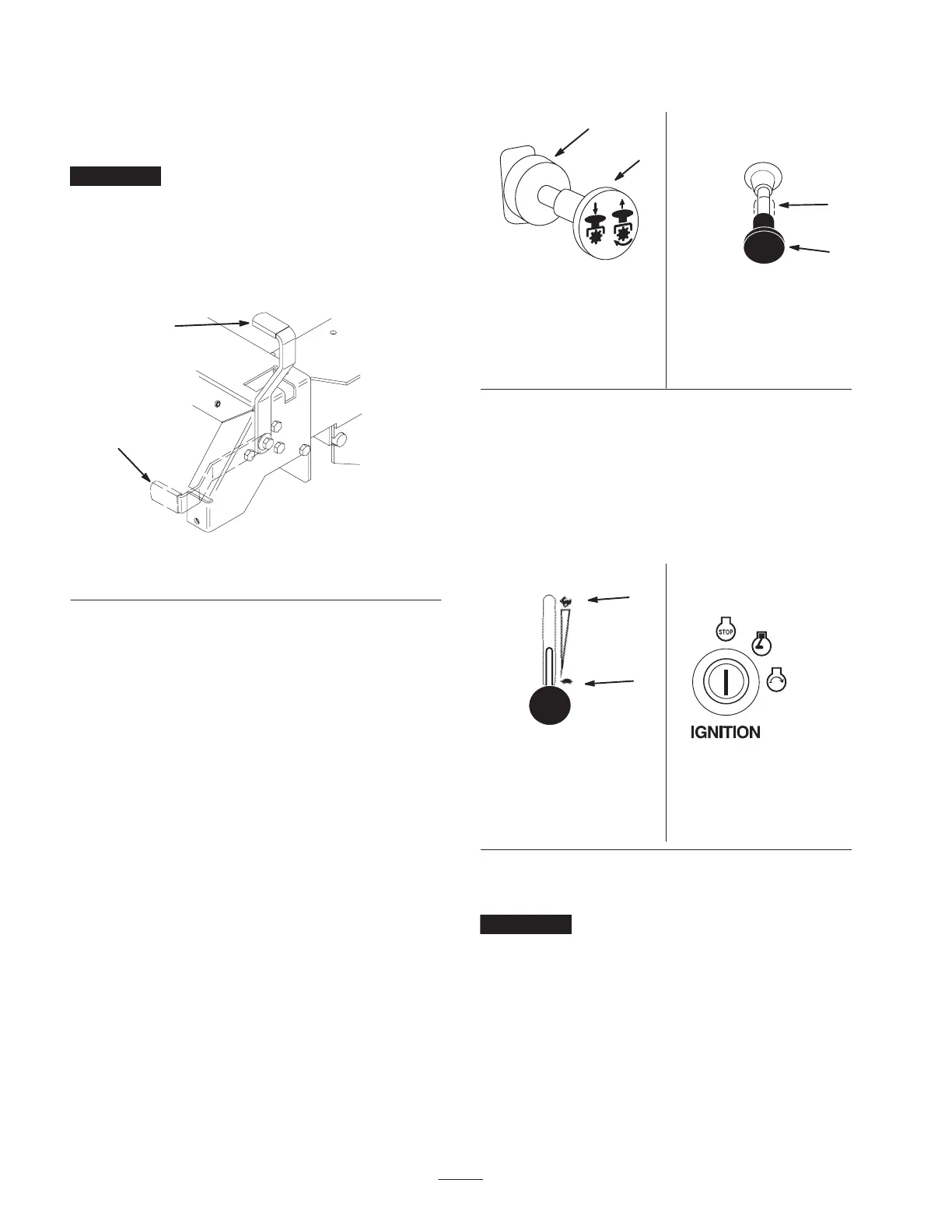
1. Move the motion control levers (Fig. 10) to the neutral
lock position.
1
2
m–4121
Figure 10
1. Parking brake—On 2. Parking brake—Off
2. Pull back and up on the parking brake lever to set the
parking brake (Fig. 10).
Note: The parking brake lever should stay firmly in the
Engaged position.
Releasing the Parking Brake
Push forward and down on the parking brake lever to
release the parking brake (Fig. 10).
Starting and Stopping the
Engine
Starting the Engine
1. Sit on the seat and move the motion controls to the
neutral locked position.
2. Set the parking brake; refer to Setting the Parking Brake
on page 18.
3. Move the PTO (power takeoff) to Off (Fig. 11).
Figure 11
1. PTO—On
2. PTO—Off
Figure 12
1. Choke—On
2. Choke—Off
1
m–2719
2
1
m–4201
2
4. Move the choke control to On before starting a cold
engine (Fig. 12).
Note: A warm or hot engine may require choking. After
the engine starts, move the choke control to the Off
position.
5. Move the throttle control to Fast before starting a cold
engine (Fig. 13).
Figure 13
1. Fast
2. Slow
Figure 14
1. Off
2. Run
3. Start
2
1
m–2720a
1
2
3
m-4268
6. Turn the ignition key to Start to energize the starter.
When the engine starts, release the key (Fig. 14).
Important Do not engage the starter for more than
10 seconds at a time. If the engine fails to start, allow a
30 second cool down period between attempts. Failure to
follow these instructions can burn out the starter motor.
7. After the engine starts, move the choke to Off (Fig. 12).
If the engine stalls or hesitates, move the choke back to
On for a few seconds. Then move the throttle lever to
the desired setting. Repeat this step as necessary.



 To Next Page