EasyManua.ls Logo

Toshiba HWS-1103H8-E - User Manual

Toshiba HWS-1103H8-E
212 pages
Print Icon
To Next Page IconTo Next Page
Loading...
Model name:
Outdoor Unit
HWS-803H-E(TR)
HWS-1103H-E(TR)
HWS-1403H-E(TR)
HWS-1103H8-E
HWS-1103H8R-E
HWS-1403H8-E
HWS-1403H8R-E
HWS-1603H8-E
HWS-1603H8R-E
AIR TO WATER HEAT PUMP
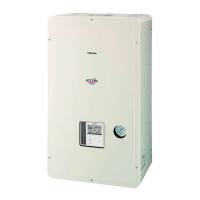
Hydro Unit
HWS-803XWHM3-E(TR)
HWS-803XWHT6-E(TR)
HWS-803XWHD6-E
HWS-803XWHT9-E
HWS-1403XWHM3-E(TR)
HWS-1403XWHT6-E(TR)
HWS-1403XWHD6-E
HWS-1403XWHT9-E(TR)
Hot Water Cylinder
HWS-1501CSHM3-E(-UK)
HWS-2101CSHM3-E(-UK)
HWS-3001CSHM3-E(-UK)
SERVICE MANUAL
A10-006

Table of Contents

Other manuals for Toshiba HWS-1103H8-E

Questions and Answers

  • M
    Mario MoraAug 4, 2025
    Why is my Toshiba Heat Pump not heating or cooling properly?
    • A
      Adam BairdAug 4, 2025
      There are several reasons why your Toshiba Heat Pump might not be heating or cooling correctly. It could be due to an incorrect remote controller setting, so check the operation and temperature settings. Alternatively, the function code setting might be incorrect, so refer to the function code table. Other potential causes include a disconnected backup heater (check the heater and bimetal thermostat), insufficient capacity (check the equipment selection), or a sensor defect (ensure the temperature sensor is installed correctly).
  • J
    James KentAug 8, 2025
    How to fix a Toshiba Heat Pump remote controller when nothing is displayed?
    • M
      Marcus MitchellAug 8, 2025
      If nothing is displayed on your Toshiba Heat Pump remote controller, there are a couple of things to check. First, ensure that power is being supplied to the remote controller by checking the power supply wiring. Also, verify the DIP switch setting on the Hydro Unit board and compare it with the function code table to ensure it is set correctly.
  • J
    Jennifer BrownAug 12, 2025
    How to troubleshoot regular communication errors between the hydro unit and remote controller of my Toshiba HWS-1103H8-E Heat Pump?
    • J
      John MurphyAug 12, 2025
      To troubleshoot communication errors between the hydro unit and the remote controller, check the remote control connection. Also, there may be a defect in the remote control.
  • S
    Sandra MarksAug 16, 2025
    What causes regular communication errors between the hydro unit and outdoor unit of a Toshiba Heat Pump?
    • M
      Mrs. Julie GardnerAug 16, 2025
      To address communication errors between the hydro unit and outdoor unit, check the serial circuit. Also, look for miswiring of the crossover between the water heat exchanger and the outdoor unit.
  • K
    Kelly MasonAug 21, 2025
    What to do if the flow rate switch is activated on my Toshiba HWS-1103H8-E Heat Pump and error code A01 appears?
    • T
      Tracey WatsonAug 21, 2025
      If the flow rate switch is activated and error code A01 is displayed on your Toshiba Heat Pump, it could be due to several reasons: * Air in the pump: Release the air completely following the correct procedure. * Low hydraulic pressure: Adjust the hydraulic pressure considering the pipe height and add water until the manometer displays the set hydraulic pressure or higher. * Clogged strainer: Clean the strainer. * Large resistance on the hydro side: Widen the water path to the hydro unit or install a bypass valve. * Malfunction of motorized 3-way valve: Check the wiring and parts of the valve.
  • M
    Mary CallahanAug 26, 2025
    Why is hot water leaking from the pressure relief valve of my Toshiba HWS-1103H8-E Heat Pump?
    • M
      Matthew KimAug 26, 2025
      Hot water leaking from the pressure relief valve of your Toshiba Heat Pump could be caused by a few issues. First, there might be excessive hydraulic pressure; set the hydraulic pressure considering the pipe height, and replenish water until the manometer shows a value of set hydraulic pressure or more. Second, the expansion tank capacity might be insufficient compared to the total water amount; in this case, install another expansion tank. Finally, the expansion tank itself could be failing; check the air pressure.
  • J
    Joseph WhiteAug 29, 2025
    What to do if my Toshiba Heat Pump detects a gas leak?
    • B
      brennanbillyAug 29, 2025
      If your Toshiba Heat Pump detects a gas leak, check the refrigeration cycle for leaks. Also, ensure that the service valve is fully open and inspect the piping for any kinks. Check the pulse motor valve for defects and verify the resistance value of the discharge temperature sensor (TD) and the suction temperature sensor (TS).

Summary

1 SAFETY PRECAUTIONS

General Safety Indications

Defines safety indications and symbols used in the manual.

Electrical Safety Warnings

Details hazards and precautions for high voltage and electrical shock.

Fire and Refrigerant Safety

Covers fire prevention and safe handling of refrigerants.

General Operational Safety

Includes precautions for wiring, water leaks, insulation, and ventilation.

2 NEW REFRIGERANT (R410 A)

Safety During Installation and Service

Outlines essential safety measures for R410A refrigerant handling.

2-2. Installing refrigerant pipe

Steel Pipe and Joint Requirements

Specifies standards and requirements for steel piping and joints.

Copper Pipe Specifications

Details specifications for copper piping material.

Pipe Joint Methods

Explains flared and socket joint procedures.

2-3. Tools

Necessary Tools for R410 A Installation

Lists essential tools for R410A systems and their interchangeability.

2-4. Recharging of refrigerant

Refrigerant Recharging Procedure

Step-by-step guide for recharging refrigerant into the system.

2-5. Brazing of pipes

Brazing Materials and Flux

Covers brazing metals, flux types, and their usage.

Brazing Procedure and Oxidation Prevention

Details the brazing process and methods to prevent oxidation.

3 Specifications

Unit Specifications Overview

Provides general technical specifications for the units.

4 Outside Drawing

Hydro Unit Dimensions and Layout

Presents dimensional drawings and layout of the hydro unit.

Outdoor Unit Dimensions and Layout

Provides dimensional drawings for various outdoor unit models.

5 Wiring Diagram

Hydro Unit Wiring Diagram

Illustrates the electrical connections for the hydro unit.

Outdoor Unit Wiring Diagrams

Shows wiring for single-phase and 3-phase outdoor units.

Hot Water Cylinder Unit Wiring Diagram

Details the wiring for the hot water cylinder unit.

6 Key Electric Component Rating

Hydro Unit Component Ratings

Lists electrical ratings for hydro unit components.

Outdoor Unit Component Ratings

Lists electrical ratings for outdoor unit components.

Hot Water Cylinder Unit Components

Lists components for the hot water cylinder.

Control Boards and Associated Components

Details control boards and related electrical parts.

7 Refrigeration Cycle; Water System Diagram

Water System Diagrams

Illustrates the water circuits and flow paths.

Refrigeration Cycle System Diagrams

Illustrates the refrigerant circuits and components.

8 Operational Description

Basic Operation Modes

Explains fundamental operation controls like heating and hot water supply.

Operation Modes and Control Methods

Details various operating modes and control logic.

Hydro Unit Control Logic

Explains the control functions of the hydro unit.

Outdoor Unit Control Logic

Explains the control functions of the outdoor unit.

9 Method of Defect Diagnosis

Initial Confirmation and Checks

Covers preliminary checks before diagnosing defects.

Non-Defective Operation Identification

Describes normal operations that might be mistaken for defects.

Defect Determination Flowcharts

Provides systematic troubleshooting guides for error codes.

PC Board and Component Checks

Outlines methods for checking PC boards and key components.

10 Hydro unit and Outdoor Unit Settings

Hydro Unit Switch Settings

Explains configuration via DIP switches on the hydro unit.

Hydro Unit Function Code Settings

Details setting parameters using remote controller function codes.

11 Replacement of the Service P.C. Board

PC Board Model and Switch Configuration

Guides on setting jumper wires and DIP switches for different models.

12 How to Exchange Main Parts

Hydro Unit Parts Replacement Procedures

Step-by-step instructions for replacing hydro unit parts.

Outdoor Unit Parts Replacement Procedures

Step-by-step instructions for replacing outdoor unit parts.

13 Periodic Inspection Items

Hydro Unit Inspection Schedule

Lists annual inspection items for the hydro unit.

Outdoor Unit Inspection Schedule

Lists annual inspection items for the outdoor unit.

Hot Water Cylinder Inspection Schedule

Lists annual inspection items for the hot water cylinder.

14 Part Exploded View, Part List

Hydro Unit Parts List

Provides an exploded view and list of hydro unit parts.

Outdoor Unit Parts List (HWS-803 H-E)

Lists components for HWS-803H-E.

Outdoor Unit Parts List (HWS-1103 H-E, 1403 H-E)

Lists components for HWS-1103H-E and 1403H-E.

Outdoor Unit Parts List (HWS-1103 H8(R)-E, etc.)

Lists components for 3-phase outdoor units.

15 Outdoor Unit Setting

Refrigerant Recovery Control

Procedure for environment-friendly refrigerant recovery.

Outdoor Unit DIP Switch and Jumper Settings

Explains settings using dip switches and jumpers.

Service Support Functions (LEDs and Switches)

Describes LED indicators and special operation switches.

Toshiba HWS-1103H8-E Specifications

General IconGeneral
TypeHeat Pump
Heating Capacity (kW)3.6
SEER6.1
SCOP4.0
Power Supply220-240 V, 50 Hz
Energy Efficiency Ratio (Heating)4.0
Energy Efficiency Ratio (Cooling)6.1

Related product manuals