ISC - ISC Valv
e
Bypass air passag
e
A'
OHP 7
2
From To air intake
air cleaner
chambe
r
~
L
~
;~
Bypass po
rt
O
~
Valve
u
p
✓
alv
e
Cross-section A-A'
OHP 7
2
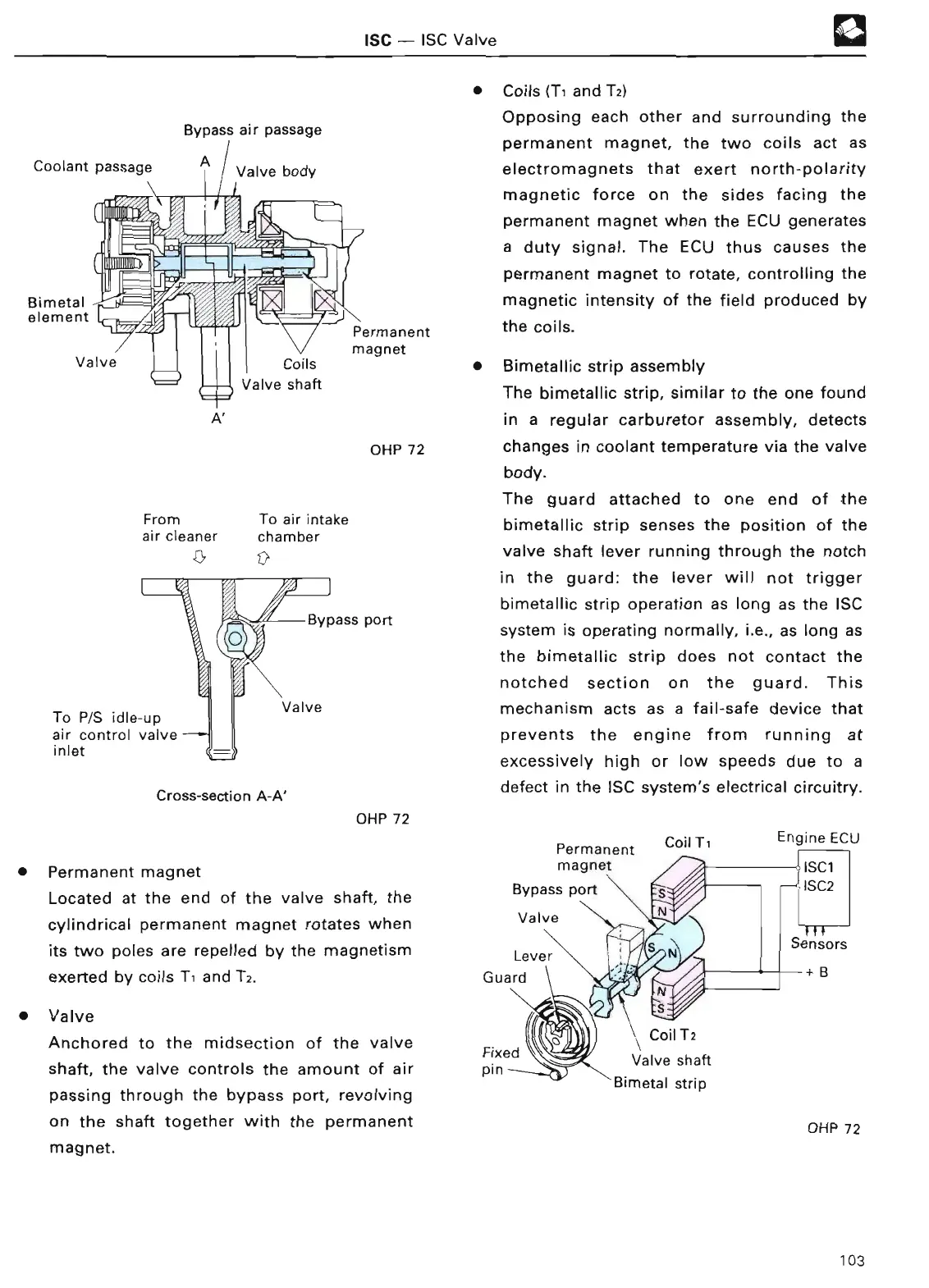
• Permanent magne
t
Located at the end of the valve shaft, the
cylindrical permanent magnet rotates when
its two poles are repelled by the magnetism
exe rt
ed by
coils Ti and T2
.
• Valv
e
Anchored to the midsection of the valve
shaft, the valve controls the amount of air
passing through the bypass port, revolving
on the shaft together with the permanent
magnet
.
®
• Coils
(Ti
and T2
)
Opposing each other and surrounding the
permanent magnet, the two coils act as
electromagnets that exert north-polarity
magnetic force on the sides facing the
permanent magnet when the ECU generates
a duty signal
. The ECU thus causes the
permanent magnet to rotate, controlling the
magnetic intensity of the field produced by
the coils
.
• Bimetallic strip assembl
y
The bimetallic strip, similar to the one found
in a regular carburetor assembly, detects
changes in coolant temperature via the valve
body
.
The guard attached to one end of the
bimetallic strip senses the position of the
valve shaft lever running through the notch
in the guard
: the lever will not trigger
bimetallic strip operation as long as the ISC
system is operating normally, i
.e
., as long as
the bimetallic strip does not contact the
notched section on the guard
. This
mechanism acts as a fail-safe device that
prevents the engine from running at
excessively high or low speeds due to a
defect in the ISC system's electrical circuitry
.
Coil T2
Valve shaf
t
'
Bimetal strip
OHP 7
2
103





 To Next Page