EasyManua.ls Logo

TP-Link AC600 - User Manual

TP-Link AC600
36 pages
Print Icon
To Next Page IconTo Next Page
Loading...
1
AC600 Wireless LAN
Dual Band Selectable
Travel Router
(2.4GHz: 150Mbps, 5GHz: 433Mbps)
Users Manual
Version: 1.0
(January, 2014)

Other manuals for TP-Link AC600

Questions and Answers

  • J
    Jacob SanchezJul 27, 2025
    Why TP-Link Network Router is not responding when I try to access it via web browser?
    • G
      gregory95Jul 27, 2025
      First, ensure the power cord and network cable are correctly and firmly inserted into your TP-Link Network Router. If all the LEDs are off, check the A/C power adapter to make sure it's properly powered. Also, ensure you're using the same IP address section as the router. If these steps don't work, try connecting with another computer to rule out MAC or IP address filter issues. You can also set your computer to obtain an IP address automatically (DHCP). If a firmware upgrade caused this, or if none of these solutions work, contact your dealer for assistance.
  • R
    Rebecca WardAug 2, 2025
    What to do if my TP-Link Network Router can’t get connected to Internet?
    • J
      Jordan LeonAug 2, 2025
      First, check the Internet connection status in the ‘Status’ -> ‘Internet Connection’ menu. If you were able to connect a computer directly to the Internet before, try doing that again to verify the connection. Double-check your PPPoE / L2TP / PPTP user ID and password. If you still have problems, try resetting your TP-Link Network Router and the device provided by your Internet service provider. If you can't connect to specific websites but other internet services work, check the URL/Keyword filter. As a last resort, try using an IP address instead of a hostname to rule out DNS issues. Sometimes, the Internet might just be slow, so be patient.
  • R
    Robert MeadowsAug 6, 2025
    Why file download is very slow or breaks frequently on TP-Link Network Router?
    • J
      John JohnsonAug 6, 2025
      If file downloads are slow or frequently interrupted, first check if the QoS function is enabled and try disabling it. Internet speed can vary, so some patience may be needed. Try resetting your TP-Link Network Router to see if performance improves. Also, consider other devices on your network that might be consuming bandwidth with large file transfers. If the issue is new, contact your Internet service provider to check for network problems.
  • D
    Diana RiosAug 11, 2025
    How to fix wrong password error on TP-Link Network Router web management interface?
    • J
      Jennifer SmithAug 11, 2025
      Ensure you're connecting to the correct IP address of your TP-Link Network Router. Passwords are case-sensitive, so check that the 'Caps Lock' light is off. If you've forgotten the password, perform a hard reset.
  • C
    Catherine RodriguezAug 16, 2025
    What to do if I can’t locate my TP-Link Network Router by my wireless client?
    • J
      Justin JohnsonAug 16, 2025
      If you can't find your TP-Link Network Router with your wireless client, check if 'Broadcast ESSID' is turned off. Ensure both antennas are properly secured. Make sure you are not too far from the router; try moving closer. If ESSID broadcast is disabled, remember to manually input the ESSID on your wireless client.
  • C
    Chelsea FriedmanAug 21, 2025
    Why TP-Link Network Router become hot?
    • J
      Jim WoodwardAug 21, 2025
      It's normal for your TP-Link Network Router to become warm during operation. If you can keep your hand on the router's case, it is not a malfunction. However, if you smell something burning or see smoke, immediately disconnect the router and A/C power adapter from the power outlet (ensure it's safe to do so) and contact your dealer for help.

Summary

Chapter I: Product Information

Introduction and Safety Information

Introduces the AC600 router and provides initial safety guidelines for safe operation.

Safety Information

Details crucial safety instructions for users to prevent hazards and damage during use.

System Requirements

Lists the necessary hardware and software for the router's operation and setup.

Package Contents

Itemizes all components included in the router package for user verification upon receipt.

Router Features and Indicators

Explains LED indicators and the function panel for basic device identification and status.

Chapter II: System and Network Setup

Build Network Connection

Guides on physically connecting the travel router to modems and network devices.

Network Setup

Details the initial wireless configuration via web browser, including network scanning.

Chapter III: WEB GUI Configuration

Setup Wizard

Guides the user through the initial router configuration process step-by-step.

Travel Router Mode

Configures the router to convert a wired connection to wireless for multiple clients.

Wireless ISP Mode

Configures the router to connect to an existing wireless network for internet access.

Advanced Setup

Covers advanced settings like LAN IP, password, and firmware upgrades.

WPS Setup

Configures Wi-Fi Protected Setup for easy wireless client connections.

Status

Displays the router's current operating status, hardware, and firmware information.

Chapter IV: Appendix

Hardware Specification

Lists detailed technical specifications of the router's hardware components.

Troubleshooting

Offers solutions for common problems encountered with the router.

Glossary

Defines technical terms and acronyms used throughout the manual.

TP-Link AC600 Specifications

General IconGeneral
InterfaceUSB 2.0
AntennaInternal
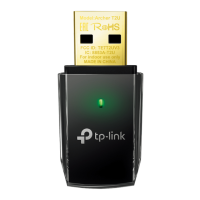
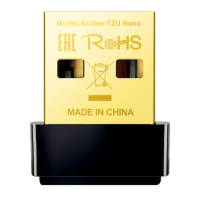
ModelArcher T2U
Wireless StandardIEEE 802.11ac
Frequency2.4GHz, 5GHz
SecurityWEP, WPA, WPA2
Data Rate5 GHz: Up to 433 Mbps, 2.4 GHz: Up to 150 Mbps
Operating Systems SupportedWindows 11/10/8.1/8/7/XP, Mac OS X 10.9-10.13

Related product manuals