EasyManua.ls Logo

Trane 2TWZ9 - User Manual

Trane 2TWZ9
8 pages
Print Icon
To Next Page IconTo Next Page
Loading...
ALL phases of this installation must comply with NATIONAL, STATE AND LOCAL CODES
IMPORTANT This Document is customer property and is to remain with this unit. Please return to service information
pack upon completion of work.
Installer’s Guide
3. Avoid locating the unit where condensation and freezing
of defrost vapor may annoy the customer. For instance,
installing the unit under a bedroom, kitchen, or picture
window may be annoying to the customer since conden-
sate and fog will occur during the defrost cycle.
4. Avoid locating the unit under the eaves or other over-
head structures as sizeable icicles may form and the unit
may be damaged by these falling icicles.
B. LOCATION AND PREPARATION
OF THE UNIT
1. When removing unit from the pallet, notice the tabs on
the basepan. Remove tabs by cutting with a sharp tool as
shown on page 2, Figure 2, and slide unit off of pallet.
2. The unit should be set on a level support pad at least as
large as the unit base pan, such as a concrete slab. If this
is not the application used please refer to application
bulletin “Trane XL19i-APG**-EN”. (*denotes latest
revision)
Heat Pumps
2TWZ9
These instructions do not cover all variations in
systems nor provide for every possible contingency to
be met in connection with installation. All phases of
this installation must comply with NATIONAL, STATE
AND LOCAL CODES. Should further information be
desired or should particular problems arise which are not
covered sufficiently for the purchaser’s purposes, the matter
should be referred to your installing dealer or local distributor.
A. GENERAL
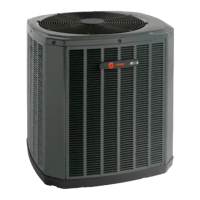
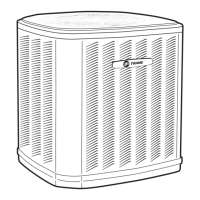
The following instructions cover 2TWZ9 Heat Pump Units.
NOTE:
These outdoor units must be used with indoor units
equipped with Thermostatic Expansion Valve only.
Check for transportation damage after unit is uncrated.
Report promptly, to the carrier, any damage found to the unit.
To determine the electrical power requirements of the unit,
refer to the nameplate of the unit. The electrical power
available must agree with that listed on the nameplate.
The Weathertron
®
Heat Pump has been designed and
manufactured to withstand and operate in severe winter
conditions. However, there are precautionary steps which
should be taken at the time of installation which will help
assure the efficient operation of the unit. It is recom-
mended that these precautions be taken for units
being installed in areas where snow accumulation and
prolonged below freezing temperatures occur.
1. Units should be elevated 3 to 12 inches above the pad or
rooftop, depending on local weather. This additional
height will allow better drainage of snow and ice (melted
during defrost cycle) prior to its refreezing. This should
prevent a build-up of ice around the unit which occurs
when unit is not elevated. Insure that drain holes in
unit base pan are not obstructed preventing
draining of defrost water.
2. If possible, avoid locations that are likely to accumulate
snow drifts. If not possible, a snow drift barrier should be
installed around the unit to prevent a build-up of snow
on the sides of the unit and should be of sufficient
distance from the unit to prevent restriction of airflow to
and from the unit. Also allow for proper maintenance
space. The barrier should be constructed of materials
which will blend in with the building design.
1
18-BC53D1-2
Question and Answer IconNeed help?

Do you have a question about the Trane 2TWZ9 and is the answer not in the manual?

Summary

General Unit Information and Precautions

General Instructions

Provides general instructions for 2TWZ9 Heat Pump Units, including notes on indoor units and unit care.

Unit Location and Preparation

Details guidelines for selecting unit location and preparing the installation site, including elevation and clearance.

Refrigerant Line Installation and Service

Installing Refrigerant Lines

Covers the process of installing refrigerant lines, including brazing and insulation requirements.

Service Valve Operation

Explains the operation of brass liquid line and gas line service valves, including warnings.

System Evacuation

Details the process of evacuating refrigerant lines and the indoor coil using a vacuum pump.

Electrical and Operational Setup

Electrical Connections

Covers power wiring, grounding, disconnect switches, and low voltage wiring requirements.

Defrost Control

Explains the demand defrost control, its sensors, and fault identification.

Compressor Start Up

Outlines the procedure for starting the compressor, including initial power application.

Additional Installation and System Components

Operational and Checkout Procedures

Refers to final operational and checkout procedures found on page 8.

Electric Heaters

Briefly mentions the installation of electric heaters according to separate instructions.

Start Control

Notes that models have factory-installed quick start components.

Outdoor Thermostat

Mentions field installation of an outdoor thermostat and refers to separate data.

Seacoast Salt Shield

Discusses the Seacoast Shield and its impact on the outdoor coil and warranty.

2 TWZ9 Outline Drawing

Mounting Hole Location

Checkout Procedure

Overview

This document describes the installation and maintenance of Trane 2TWZ9 Heat Pump Units, providing comprehensive instructions for installers to ensure proper setup, operation, and longevity of the system. The guide emphasizes compliance with national, state, and local codes, and highlights specific precautions for installations in areas prone to snow accumulation and prolonged freezing temperatures.

Function Description:

The Trane 2TWZ9 Heat Pump is designed to provide both heating and cooling for residential and commercial applications. It functions by transferring heat between the indoor and outdoor environments, offering an energy-efficient alternative to traditional heating and cooling systems. The unit is specifically designed to operate effectively in severe winter conditions, making it suitable for a wide range of climates. These outdoor units are intended for use with indoor units equipped with a Thermostatic Expansion Valve (TXV).

Usage Features:

Installation and Placement:

  • Elevation: For installations in areas with snow and freezing temperatures, the unit should be elevated 3 to 12 inches above the pad or rooftop. This elevation facilitates better drainage of snow and ice during defrost cycles, preventing ice buildup around the unit. It is crucial to ensure that drain holes in the unit's base pan are not obstructed.
  • Snow Drift Avoidance: Installers should avoid locations prone to snow drifts. If unavoidable, a snow drift barrier should be installed around the unit. This barrier must be sufficiently distant from the unit to prevent airflow restriction and allow for proper maintenance access. The barrier should also be constructed from materials that blend with the building design.
  • Condensation and Fog: To prevent customer annoyance, avoid locating the unit under bedroom, kitchen, or picture windows, as condensation and fog may occur during defrost cycles.
  • Overhead Structures: Do not install the unit under eaves or other overhead structures, as falling icicles could damage the unit.
  • Clearance: The support pad for the unit must not be in direct contact with any structure. A minimum of 12 inches of clearance from walls or surrounding shrubbery is required to ensure adequate airflow. Sufficient clearance must also be provided in front of the control box and any other side requiring service access, in compliance with National Electrical Code. The unit should also be far enough from any structure to prevent excess roof run-off water from pouring directly on it.
  • Top Discharge Area: The top discharge area must remain unrestricted for at least five feet above the unit.
  • Roof Mounting: If mounted on a roof, ensure the roof can support the unit's weight. Properly selected isolation is recommended to prevent vibration transmission to the building structure.
  • Refrigerant Line Length: The maximum length of refrigerant lines from the outdoor to indoor unit should not exceed eighty feet.
  • Lift Limitations: If the outdoor unit is mounted above the air handler, the maximum suction line lift should not exceed twenty-five feet. If the air handler is mounted above the condensing unit, the maximum liquid line lift should not exceed twenty-five feet.
  • Indoor Coil/Air Handler: Install the indoor coil or air handler according to its specific instructions.

Refrigerant Line Installation:

  • Existing Lines: If using existing refrigerant lines, ensure all joints are brazed, not soldered.
  • Brazing Connections: The condensing units are equipped with provisions for braze connections. Pressure taps are provided on the service valves for compressor suction and liquid pressures.
  • Line Set Configuration: The indoor end of the recommended refrigerant line sets may be straight or have a 90-degree bend, depending on site requirements. This should be verified before ordering.
  • Insulation: The gas line must always be insulated. Avoid direct contact between uninsulated liquid lines and bare gas lines.
  • Routing: Determine the most practical routing for refrigerant tubing (inside or outside the structure). Provide a sufficiently sized pull-through hole for both liquid and gas lines. Ensure tubing is of adequate length, uncoil it without kinking or denting, and properly secure it before making connections.
  • Vibration Isolation: To prevent noise from vibration transmission, use isolation-type hangers when fastening refrigerant lines to floor joists or other framing. Isolation hangers should also be used when lines run in stud spaces or enclosed ceilings. Insulate and isolate lines running through walls or sills, and isolate them from all ductwork.

Service Valve Operation:

  • Brass Liquid Line Service Valve: This valve is factory-shipped in the seated position, holding the factory charge. The pressure tap service port opens only to the field brazing side when the valve is seated. This valve is not a back-seating valve. Extreme caution is required when opening this valve; turn the stem counterclockwise only until it contacts the rolled edge (no torque required).
  • Brass Gas Line Ball Service Valve: This valve is shipped in the closed position, holding the factory refrigerant charge. The pressure tap service port opens only to the field brazing side when the valve is closed. This valve is full open with a 1/4 turn.

Brazing Refrigerant Lines:

  • Preparation: Remove the lower access cover to access service valves. Before brazing, remove plugs from external copper stub tubes and clean internal and external surfaces.
  • Tubing Fit: Cut and fit tubing, minimizing sharp 90-degree bends.
  • Heat Damage Prevention: Take precautions to avoid heat damage to the pressure tap valve core during brazing. It is recommended to remove the valve core and wrap a wet rag around the valve body. Also, keep the flame directly off the basepan to prevent damage.
  • Brazing Procedure: Use a dry nitrogen purge and brazing alloy without flux. Flow dry nitrogen into either valve pressure tap port, through the tubing, and out the other port while brazing. Use accepted good brazing techniques.

Leak Check and Evacuation:

  • Leak Check: After brazing, check all field brazed connections for leaks. Pressurize the indoor unit and field refrigerant lines with dry nitrogen to 350-400 psi. Use soap bubbles or other methods to confirm leak-free joints. If leaks are found, release pressure and repair.
  • Evacuation: Evacuate the refrigerant lines and indoor coil before opening the gas and liquid line valves. Attach manifold gauge hoses to gas and liquid line pressure taps and the vacuum pump. Evacuate until the micron gauge reads no higher than 350 microns. Close the valve to the vacuum pump and observe the micron gauge; if the pressure rises above 500 microns in one minute, evacuation is incomplete or there is a leak. If the vacuum gauge does not rise above 500 microns in one minute, evacuation is complete.
  • Charging: With the vacuum pump and micron gauge blanked off, open the valve on the HCFC-22 cylinder and charge the refrigerant lines and indoor coil with vapor to the tank pressure of HCFC-22 supply. Do not vent refrigerant into the atmosphere.
  • Valve Opening: Close the valve on the HCFC-22 supply cylinder and manifold gauge set, then remove charging hoses. Open the liquid line shut-off valve by removing the cap, fully inserting a hex wrench into the stem, and backing out counterclockwise until the stem just touches the rolled edge (approximately five turns). Open the gas valve by removing the cap and turning the stem 1/4 turn counterclockwise using an open-end or adjustable wrench.
  • Cap Replacement: Replace all valve stem and pressure tap caps finger tight, then tighten an additional 1/6 turn to prevent leaks.

Electrical Connections:

  • Code Compliance: Power wiring and grounding must comply with local codes.
  • Power Supply: The power supply must match the equipment nameplate.
  • Disconnect Switch: Install a separate disconnect switch at the outdoor unit.
  • Grounding: Ground the outdoor unit per local code requirements.
  • Conduit: Provide flexible electrical conduit to prevent noise problems from vibration transmission.
  • Low Voltage Wiring: Use color-coded low voltage wire to simplify connections between the outdoor unit, thermostat, and indoor unit.
  • Wire Length: Refer to the NEC Class II Control Wiring table for maximum total length of low voltage wiring based on wire size (e.g., 18 AWG for 150 ft, 16 AWG for 225 ft, 14 AWG for 300 ft).
  • Thermostat Installation: Mount the indoor thermostat according to its instructions and wire it per the appropriate hook-up diagram.

Defrost Control:

  • Demand Defrost: The unit features a demand defrost control that measures outdoor ambient temperature with a sensor outside the outdoor coil and coil temperature with a second sensor on the coil. The difference (delta-T) between these temperatures indicates the operating state and capacity, determining the need for defrost. The coil sensor also terminates the defrost cycle.
  • Fault Identification: A flashing light on the defrost control inside the heat pump control box indicates a fault condition. In normal operation, the light flashes once per second. If it flashes more frequently or not at all, refer to the service manual.
  • Checkout: Normal operation requires the LED on the board to flash once per second, 24V AC between R & B, and 24V AC between Y & B when the unit is operating. Defrost initiation should occur when the test wire is moved to the "Forced Defrost" pin, then returned to "Normal Pin". If defrost control issues are suspected, refer to the service information in the control box.
  • Safety Warning: Do not connect 24 VAC to the T1 (ODS-A) terminal, as this will damage the ODS-A thermistor.

Compressor Start-Up:

  • Initial Power-Up: After all electrical wiring is complete, set the thermostat system switch to the OFF position to prevent the compressor from running. Apply power by closing the system main disconnect switch. This activates the compressor sump heat (if used). Do not change the thermostat system switch until power has been applied for one hour to prevent potential compressor overload trips at initial start-up.

Outdoor Thermostat:

  • An optional outdoor thermostat (TAYSTAT250B) can be field-installed. Refer to the wiring diagram and instruction sheet for details.

Seacoast Salt Shield:

  • Units are shipped with a black Seacoast Shield clipped to the top of the outdoor coil. Removing this shield may shorten the life of the coil joints and affect the limited warranty.

Maintenance Features:

  • Operational and Checkout Procedures: After installation, a series of checks must be performed to ensure proper performance. These include verifying refrigerant lines for leaks, proper insulation, and secure mounting; checking for sealed masonry passages; confirming electrical connection tightness; observing outdoor fan operation; and ensuring the indoor coil drain line drains freely.
  • Thermostat Accuracy: The thermostat thermometer should be checked for accuracy against a reliable thermometer and adjusted as needed.
  • Blower Motor Speed: Verify that the correct speed tap is being used for the indoor blower motor.
  • System Operation: Operate the complete system in each mode to ensure safe operation.
  • Filter Maintenance: Ensure supply registers and return grilles are open and unobstructed, and that the return air filter is installed.
  • Refrigerant Charge Adjustment: If refrigerant lines are longer than 15 feet or a different size than recommended, the system refrigerant charge must be adjusted upon completion of installation, as detailed in the unit Service Facts.
  • Fault Identification: The flashing light on the defrost control provides a quick visual indicator of system status. If the light flashes abnormally, it signals a fault condition, prompting the installer to consult the service manual for troubleshooting.
  • Troubleshooting Chart: The manual includes a detailed troubleshooting chart to diagnose system faults, categorizing them by refrigerant circuit, electrical issues, and defrost problems. It identifies primary and secondary causes for various symptoms like head pressure issues, compressor start failures, and defrost malfunctions. This chart guides technicians in systematically identifying and resolving issues, improving diagnostic efficiency.

Trane 2TWZ9 Specifications

General IconGeneral
TypeHeat Pump
Model2TWZ9
RefrigerantR-410A
Compressor TypeVariable Speed
Warranty10-Year Limited Warranty on Compressor
StagesVariable

Related product manuals