32
A951X-SVX001-1D-EN
Vent Terminations
For DIRECT VENT APPLICATION: The Furnaces must be vented to
the exterior of the house and combustion air MUST come through the
inlet air pipe from OUTSIDE AIR.
Note: BAYVENT* accessories can be used for inlet and outlet
terminals when the pipes do not exit the structure together. For
Canadian applications, venting systems must meet ULC-S636
requirements.
For NONDIRECT VENT APPLICATION: The Furnace shall be vented
to the exterior of the house, but combustion air may enter from the
surrounding area as long as combustion air requirements are met.
(See AIR FOR COMBUSTION AND VENTILATION)
Vent terminations
• BAYVENT200B
• BAYAIR30AVENTA
Vent terminations — Canadian applications. Meets ULC-S636
requirements.
• BAYVENTCN200B
• BAYAIR30CNVENT
FURNACE VENT / INLET PIPE INSTALLATION IN TWO PRESSURE ZONE CONFIGURATIONS ARE NOT ALLOWED
Note: For single pressure zone applications, see the Horizontal Venting section.
The following are EXAMPLES ONLY.
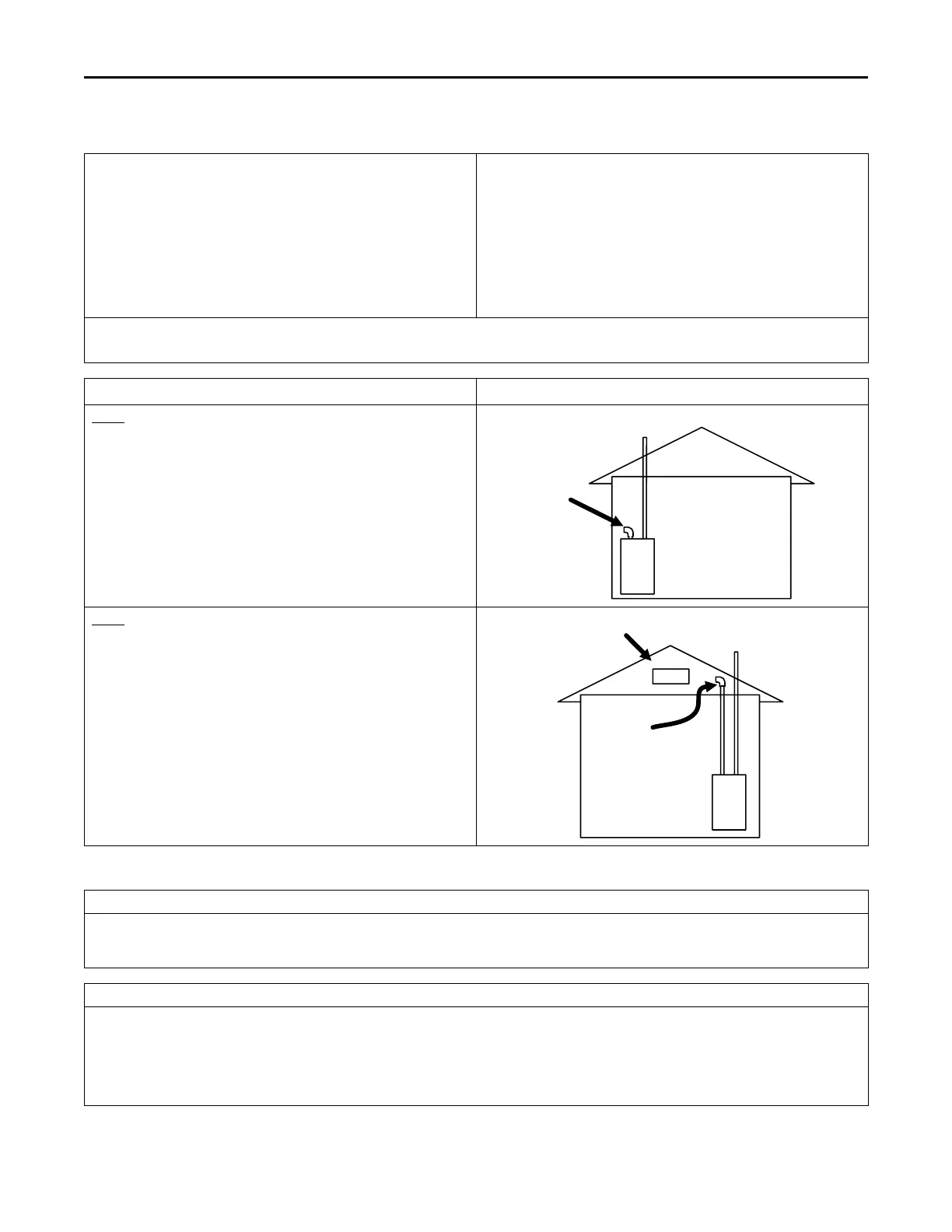
EX. 1 —
Example 1 shows the vent pipe exhausting through the roof and the
inlet air coming from the interior of the house. The inlet air coming
from the interior of the house must meet combustion requirements for
area, etc., as shown in the section AIR FOR COMBUSTION AND
VENTILATION in this document.
Note: If only the flue gas pipe is to the outside of the structure, a
straight section of pipe (long enough to exit the Furnace
cabinet) must be attached to the inlet air side with an elbow
(which is 5 to 10 equiv. ft.) installed on the end to prevent dust
and debris from falling directly into the Furnace.
EX. 2 —
The inlet air does not have to come from outside the structure.
Example 2 shows the inlet air, may come from the attic if the
requirements for combustion air are met as shown in the section AIR
FOR COMBUSTION AND VENTILATION.
Note: If only the flue gas pipe is to the outside of the structure, a
straight section of pipe (long enough to exit the Furnace
cabinet) must be attached to the inlet air side with an elbow
(which is 5 to 10 equiv. ft.) installed on the end to prevent dust
and debris from falling directly into the Furnace.
Furnace
Air
Inlet
Vent
Attic
Vent
(See Note)
Attaching Vent Piping
VENT FITTING MATERIAL – PLASTIC
Gas and liquid tight single wall vent fittings, designed for resistance to corrosive flue condensate, MUST be used throughout.
Listed in the Approved Vent Pipe Materials table are designations for different types of 2" and 3" size pipe and fittings that meet these
requirements. The materials listed are various grades of PVC, CPVC, ABS, PolyPro® by DuraVent , Z-Dens by Novaflex Group, Innoflue® by
Centrotherm, ECCO™ polypropylene venting system, and PolyFlue™ polypropylene venting systems.
ATTACHING VENT PIPING
Important: Products installed in Canada must use vent systems that are certified to the Standard for Type BH Gas Venting Systems (ULC S636)
for Class II-A venting systems (up to 65°C). Components of the vent system must not be interchanged with other vent systems or
unlisted pipe or fittings. Plastic components, specified primers, and glues must be from a single system manufacturer and not
intermixed with other system manufacturer's vent system parts. In addition, the first three feet of the vent pipe must be visible for
inspection.
PIPE JOINTS: All joints must be fastened and sealed per manufacturer instructions and local and national codes to prevent escape of combustion
products into the building.
FFuurrnnaaccee GGeenneerraall IInnssttaallllaattiioonn


 To Next Page