SECTION
4:
OPERATING INSTRUCTIONS
A DANGER
CONTACT
WITH ROTATING
CUTTING
BLADES
INSIDE DISCHARGE OPENING WILL CAUSE
SERIOUS PERSONAL INJURY!
READ
THE
COMPLETE OWNER/OPERATOR
MANUAL,
INCLUDING
THESE
OPERATING
INSTRUCTIONS,
BEFORE
USING
YOUR
EQUIPMENT.
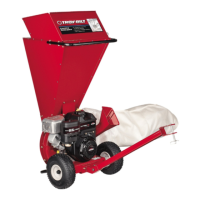
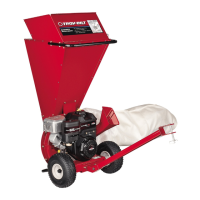
This Section provides you with detailed information
on the use of
your
Chipper/Shredder, lots of helpful tips
to make jobs
go
faster and smoother, and
an
important
Checklist
of
Pre-Starting Steps and Engine Starting
Steps that you should always
use.
Please read
all
of
the
information
in
this
Section before
you
start
the engine.
IMPORTANT - Do not allow processed material
to
build
up
beneath the machine or
in
the Discharge Area. If
material can not freely exit
via
the discharge opening,
it
will
continue
to
circulate within the processing chamber
leading
to
clogs and the possibility
of
having some
of
the
material being "blown" back
up
through the
feed
hopper.
To
remove discharged material or blockages,
push
Engine Shut-Off Tab (on top
of
engine) against spark
plug and hold there until
all
moving parts
have
come
to
a
complete stop. Disconnect the spark plug wire. Then,
use
a long-handled
shovel
or stick
to
move
material from
beneath and around discharge area. With machine
still
turned
off,
check that the holes
in
the screen are not
clogged.
To
do
this,
just
open the Service Door and
inspect the screen
as
shown
in
Photo 3-6. Clean out any
clogged holes with a
small
stick.
Use
The
Shredder For Most Materials;
Use
The
Chipper For Big Tough Jobs
To get the greatest benefits from
your
equipment, it's
important
to
know
which
materials are best fed into the
Shredder
hopper
and which ones are best fed into the
Chipper
chute. Under no circumstances should you
feed metal, glass, bottles, plastic, cans, rocks or other
such foreign objects into your equipment. Please see
examples
of
appropriate materials for chipping and
shredding listed below.
IMPORTANT - Do not shred materials thicker than
112"
in
diameter - engine damage could result.
Materials Best Suited For Shredding:
Due
to
the
wide
variety
of
materials that can be
shredded, and
theirvery
different physical characteris-
tics,
we suggest that you feed limited quantities
of
any
material to begin with.
Bulk
and lengths can be
increased if
you
find the material is being processed
without
any
difficulty. Your judgement
is
important -
be sure
not
to overload the Shredder. Overloading will
cause engine speed to decrease significantly. Always
feed material slowly into the shredder.
• Twigs and branches -
up
to W' in diameter in the
Shredder hopper. Several small branches can be fed
into the Shredder
hopper
at once providing their
com-
bined diameter
is
less than W'. Long branches (more
than 2-to-3 feet)
should
be
cut
to
make them more
manageable. Green materials should be allowed to dry,
or
processed in small batches with
dry
materials,
to
avoid winding
up
and binding the cylinder.
• Leaves, grass clippings, and all
other
light, loose
materials. These process most easily.
• Organic waste materials and
organic
garbage (be
sure
to
first remove all metal, bottles, cans, rocks, and
plastic).
• Sections
of
vines less than W' in diameter. Long vines
should be
cut
to
manageable lengths - 2-to-3 feet.
• Wood chips processed
by
the
Chipper
if even finer
particles are required.
• All paper trash.
• Partially finished compost.
• Stalks and most brush material.
• A mixture
of
any
of
the materials listed above.
Materials Best Suited For Chipping:
•
Thicker
branches - from W' to
2"
in diameter,
depending upon the hardness
of
wood. Extremely hard
knots will
not
process very well. Short,
thick
branches
(up to
2"
in diameter) that are left over after an original
longer branch was fed
through
the
chipper
may also be
chipped - move these shorter stubs
through
the
chipper with the next long branch you'll be chipping.
• Tough
W'
to
2"
diameterstalks and vines.
Cut
them to
manageable lengths -
no
more
than five
or
six feet
long - before chipping them.
A DANGER
CONTACTWITH ROTATING
CUTTING
BLADES
INSIDE
THE
UNIT
AND
INSIDE
THE
DIS-
CHARGE
OPENING
WILL CAUSE SERIOUS
PERSONAL
INJURY.
THE
CHIPPER
AND
SHREDDER BLADES ROTATE
AT
EXTREMELY
HIGH
SPEED.
NEVER
PUT
YOUR HANDS, FEET OR ANY
OTHER PART OF YOUR
BODY
INTO
THE
CHIPPER
CHUTE
INLET OR SHREDDER
HOP-
PER INLET. KEEP
HANDS
AND
FEET
OUT
OF
DISCHARGE OPENING WHEN
MACHINE
IS
RUNNING.
BEFORE SERVICING OR
UNCLOG-
GING
JAMMED
MATERIAL, PUSH
SHUT-OFF
TAB
(On Top Of Engine)
AGAINST
SPARK
PLUG
AND
HOLD
THERE
UNTIL
ALL
MOVING
PARTS HAVE
COME
TO
A COMPLETE STOP.
DISCONNECT
THE
SPARK PLUG WIRE.
11



 To Next Page