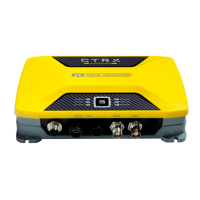
AIS-CTRX Class B AIS Transponder Manual
Please see the ‘Data Interface’ section of this manual for more details of the
data port messages.
When in operation an AIS unit:
• Uses one of two VHF channels within the international marine band allocation (channel 87B;
161.975MHz, or channel 88B; 162.025MHz) to regularly transmit information such as the
vessel position, Maritime Mobile Service Identity (MMSI), name, speed, course, etc.
• Receives similar information from other AIS equipped vessels within VHF range and outputs
that information for use by an external display medium (AIS enabled chart plotter, PC using
AIS enabled chart plotter software etc.)
Information Transmitted and Received
A Class A unit will transmit its IMO number (if known), MMSI, Call sign and Name, length and beam,
ship type, time, course over ground (COG), speed over ground (SOG), heading, navigational status,
rate of turn, draught, cargo type, destination and safety related messages via a short message service
(SMS) facility. Message lengths are variable with static and voyage related information being
transmitted less often.
A Class B unit will transmit its MMSI, Call Sign and Name, length and beam, ship type, time, course
over ground (COG), speed over ground (SOG) and heading.
Built in Test
The AIS-CTRX unit is equipped with Built In Integrity Testing (BIIT). BIIT tests run continuously or at
appropriate intervals simultaneously with the standard functions of the equipment. The BIIT detects
any failure or malfunction that will significantly reduce integrity or stop operation of the AIS-CTRX unit.
The tests include:
• AIS TX malfunction (synthesiser not locked and TX time-out not exceeded)
• Antenna VSWR exceeds limit
• Rx channel 1 malfunction (synthesiser not locked)
• Rx channel 2 malfunction (synthesiser not locked)
• Internal GNSS not in use
• No valid SOG information
• No valid COG information
• Background noise > -77dBm
• GPS failure
• VSWR exceeding the maximum allowed level
• The input voltage is out of the specified range
LED Indicators
Power
This is a green LED which indicates, when lit, that power has been connected correctly to the
transponder, that the transponder hardware has been configured, that the operating software is
present, that the CPU has booted up, the application software is running.
1.1E 23 LD2103


 To Next Page