Need help?
Do you have a question about the Two-Rock Burnside and is the answer not in the manual?
Input jack for instrument connection and Volume for loudness/compression.
Treble, Bass, and Presence controls for tone shaping.
Bright switch, Standby switch, and Indicator Lamp functions.
Connects to A/C power and the main power switch.
Connects speakers (4/8/16 ohm) and external effects units.
Details fuse types and ratings for different voltage models.
Record serial number for service or in case of loss.
Lists preamp, phase inverter, power, and rectifier tubes used.
Step-by-step guide for setting the amplifier's bias.
Factory bias setting and warnings about adjustments.
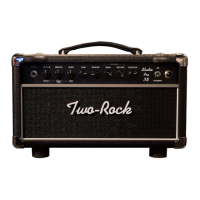
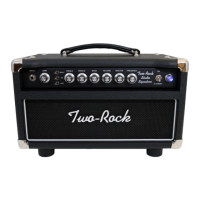
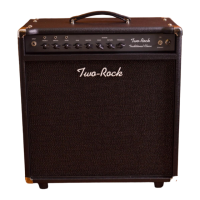
The Two-Rock Burnside is a high-quality audio power amplifier designed for discerning guitarists, emphasizing great tone through carefully selected components and a hand-built approach. This amplifier offers a versatile and responsive playing experience, with features designed to enhance both clean and overdriven guitar tones.
The Burnside amplifier serves as a core component of a guitarist's rig, taking the instrument's signal and amplifying it to drive speakers. Its design focuses on providing natural tube compression and a wide range of tonal possibilities, from sparkling cleans to rich, natural tube sustain and breakup. The amplifier is built around a tube complement that includes a 12AY7 preamp tube (with an option for a 12AX7 for added gain), a 12AX7 phase inverter, 6L6GC power tubes (or 6V6GT for models built prior to 2020), and a 5AR4 rectifier. This tube configuration is crucial to its characteristic sound.
The front panel controls allow for precise shaping of the guitar's tone. The "INPUT JACK" is a high impedance input where the instrument is connected. The "BRIGHT Switch" boosts high-frequency response, particularly effective at lower volume settings, adding sparkle to clean tones. The "VOLUME" control is highly responsive, offering natural tube compression across all settings. As it's turned up, it pushes the amp into natural tube sustain and breakup, which can be controlled by the guitar's volume or pick attack. The "TREBLE" control adjusts the high-frequency response, interacting significantly with the "BASS" control. In its full counter-clockwise position, high frequencies are bypassed, while in the full clockwise position, they pass to the next gain stage. Similarly, the "BASS" control adjusts the low-frequency response, cutting lows in the counter-clockwise position and allowing them to pass in the clockwise position. This control also affects the treble response. The "PRESENCE" control fine-tunes the contour of the high-frequency response, gradually increasing the intensity of upper frequencies to emphasize sparkle and brightness, or smoothing out the overall tone when turned down.
The amplifier also features a "STANDBY" switch and an "ON" power switch. The "STANDBY" switch is used to mute the amplifier's output and prolong power tube life when taking a break from playing, while keeping the amp "powered up." The "INDICATOR LAMP" illuminates when the power switch is in the "up" position, indicating that the unit is receiving A/C power.
On the rear panel, the "A/C Input" connects the amplifier to the main power supply. The "FUSE" provides protection for the unit. "Speaker Output Jacks" are provided for 4, 8, and 16 ohms, emphasizing the critical need to connect a proper speaker load matching the cabinet's impedance to prevent damage. The "Effects Loop" is a passive loop, featuring "SEND" and "RETURN" jacks. The "SEND" jack transmits the amplifier's signal to external effects, and the "RETURN" jack brings the processed signal back into the amplifier. The "S/N" (Serial Number) is also located on the rear panel, important for service and identification.
The Burnside amplifier is designed for ease of use while offering deep tonal control. To power up, the "STANDBY" switch should be in the down/STANDBY position before the "Power" switch is moved to the up/ON position. After 20 seconds or more, the "Standby" switch can be moved to the "up" position to play. This sequence helps protect the tubes and circuitry.
The interactive nature of the "TREBLE" and "BASS" controls allows for nuanced tonal sculpting. Experimenting with these controls, along with the "PRESENCE" knob, enables guitarists to dial in a wide array of sounds suitable for various musical styles. The "BRIGHT Switch" offers an immediate way to add clarity and cut, especially useful for clean passages or when using darker-sounding guitars.
The "VOLUME" control is central to the amplifier's character, providing natural tube compression and overdrive as it's increased. Players can leverage this by adjusting their guitar's volume knob or their picking dynamics to transition between clean and overdriven sounds without touching the amp's controls.
The passive effects loop is a key feature for integrating external time-based or modulation effects. Users can connect their pedals or rack units to the "SEND" and "RETURN" jacks to incorporate them into the amplifier's signal path, maintaining the core tone of the Burnside while adding desired effects.
The manual provides important safety instructions that must be followed to ensure safe operation and longevity of the amplifier. These include reading and keeping all instructions, heeding warnings, following all instructions, not using the apparatus near water, cleaning only with a dry cloth, and not blocking ventilation openings. It also advises against installing near heat sources, protecting the power cord, using only manufacturer-specified attachments, unplugging during lightning storms or long periods of disuse, and referring all servicing to qualified personnel. A crucial safety note is that turning the power switch off does not completely disconnect the unit from the MAINS; the unit must be unplugged for complete disconnection.
Regarding tube maintenance, the manual emphasizes the importance of using high-quality, matched sets of power tubes when replacement is necessary. It also details a "BIAS PROCEDURE" for resetting the bias after installing new power tubes. This procedure involves connecting a speaker, powering up the amplifier (without applying any signal), inserting a voltmeter's positive probe into the bias test point socket and the negative probe to chassis ground, switching the amp out of standby, allowing stabilization, setting the voltmeter to millivolt scale, and observing the current bias setting. The factory bias setting for 6L6GC tubes is .030V, and for older models with 6V6GT tubes, it's .020V. A warning is included against setting the bias higher than recommended levels to prevent tube failure and damage to other components.
The manual explicitly states, "WARNING! No user serviceable parts inside! Refer to qualified service person only." This highlights that internal repairs or modifications should only be performed by trained professionals. For safety, the "LINE CORD" should always be connected to a grounded A/C receptacle.
The inclusion of a "Fuse Chart" on the rear panel provides information on the correct fuse types and ratings for different power configurations (Export 100 Volt, Domestic, and Export 220, 230, 240), ensuring that users can replace fuses correctly if needed, which is a common maintenance task. All fuses are specified as 3AG Type 250 Volt, SLO-BLO.
Overall, the Two-Rock Burnside is designed as a robust and reliable amplifier, with clear guidelines for both operation and essential maintenance, ensuring a long and satisfying experience for the musician.
 General
| Type | Tube Amplifier |
|---|---|
| Speaker Configuration | 1x12" |
| Reverb Type | Spring Reverb |
| Preamp Tubes | 12AX7 |
| Controls | Treble, Middle, Bass, Reverb |
| Effects Loop | Yes |
| Speaker Output | 8 Ohms |


 To Next Page