Need help?
Do you have a question about the TYAN TIGER 230 and is the answer not in the manual?
Details the high-performance features of the Tiger 230 motherboard, including CPU and chipset support.
Lists key hardware components, expansion slots, memory, I/O, form factor, and regulatory compliance.
Outlines the supported operating systems for the motherboard.
Provides guidance on seeking technical assistance and lists support resources.
Explains the process for returning products for warranty service and required documentation.
Lists the components included in the retail motherboard package for initial setup.
General instructions for installing the motherboard into a computer chassis, noting ATX compatibility.
Emphasizes the importance of reading the user manual before beginning the installation process.
Explains jumper terminology (on/off, closed/open) and provides visual examples.
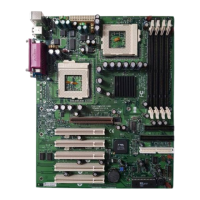
Illustrates the physical locations of various jumpers on the Tyan Tiger 230 S2507 motherboard.
Details the function and configuration of various motherboard jumpers.
Pinout diagram and description for the front panel connector (J1).
Step-by-step instructions for resetting the CMOS using the JP11 jumper.
Information regarding the additional USB connector (USB1) for extra ports.
Guidance on connecting CPU and chassis fans to the motherboard headers.
Identifies the JWOL connector for the Wake on LAN feature.
Identifies the JWOM connector for the Wake on Modem feature.
Describes the JP3 connector for chassis intrusion detection feature.
Details settings for CPU frequency based on ratio and bus speed, for specific CPU samples.
Notes the reserved connector (IR) for infrared functions.
Explains how the soft power connector controls system power management via the power button.
Instructions for connecting the chassis hardware reset switch.
Provides information on upgrading the motherboard BIOS using the Flash Utility.
Illustrates methods for mounting the motherboard into a computer chassis using various hardware.
Step-by-step guide for installing DIMM modules into the motherboard's memory sockets.
Detailed procedure for installing Intel Pentium III FC-PGA CPUs and their associated cooling fans.
Instructions for connecting hard disk drives (HDDs) and floppy drives using IDE and floppy cables.
Guidelines and precautions for installing expansion cards into PCI or ISA slots.
Explains how to connect peripheral devices like keyboards, mice, USB, and serial devices.
Instructions for correctly connecting the ATX power supply connector to the motherboard.
Addresses common user questions regarding system stability, memory, accessories, and BIOS updates.
Provides an overview of the BIOS, its function, and the configuration process.
Explains how to access and initiate the BIOS setup utility during system startup.
Lists keyboard shortcuts for navigating and interacting with the BIOS setup menu.
Describes how to access context-sensitive help within the BIOS setup interface.
Outlines recovery procedures for issues arising from BIOS setup changes.
Notes that BIOS setup screens may differ between systems and designers.
Information on loading default BIOS settings for troubleshooting.
Describes the primary menu of the BIOS setup utility and navigation.
Covers basic system configuration settings like date, time, and IDE devices.
Instructions for setting the system's date and time within the BIOS.
Configuration options for IDE devices like hard drives and CD-ROMs.
Detailed table explaining various IDE device configuration parameters.
Displays information about the system's installed memory configuration.
Settings for optimizing boot process, CPU cache, and other advanced system features.
Technical settings for the motherboard chipset, intended for advanced users.
Configuration options for onboard hardware components like IDE, FDD, and serial ports.
Settings related to system power saving modes and ACPI features.
Options for managing Plug-and-Play and PCI bus configurations.
Displays real-time hardware monitoring data such as CPU temperature and voltages.
Procedures for setting BIOS passwords to restrict access and configuration.
Information and instructions for updating or flashing the motherboard's BIOS.
Explains diagnostic beep codes that indicate system errors during boot.
Lists common error messages displayed during system startup and their meanings.
 General
| Brand | TYAN |
|---|---|
| Model | TIGER 230 |
| Category | Motherboard |
| Language | English |

 To Next Page