seconds and the yellow LED continues to blink until the batteries are replaced. Pressing the
hush button silences the chirps for 12 hours, if no other trouble conditions exist. The batteries
should be replaced with new batteries when the chirps begin.
At low battery, the test button is disabled. An alternative test method is to use an aerosol test
gas such as ‘Solo A10 smoke detector tester’. Shake the can well, aim it at the smoke detector
and spray a short burst (no more than 1 sec) at the detector. If the alarm does not sound,
repeat every 10 seconds until alarm sounds or for a maximum of 1 minute.
NOTE: If the alarm does not sound, contact the installer or dealer for service.
Battery Installation and Replacement
CAUTION: Risk of explosion if battery is replaced by an incorrect type. Dispose of used
battery according to the manufacturer's instructions.
To replace batteries, complete the following steps:
1. Remove the detector from its mounting base by twisting the detector counterclockwise.
Carefully remove batteries by lifting from the “+” end using a flathead screwdriver and
dispose of them according to local regulations.
2. To ensure a proper power-down sequence, wait a minimum of 30 seconds before
installing new batteries.
3. Install 3 new AAA batteries in the battery compartment. Install the batteries by inserting
the “-” end first, then pushing the “+” end down. If the batteries are incorrectly inserted,
please remove them carefully by lifting them out from the “+” end and correctly re-
inserting them.
4. Re-install the detector on its mounting base by turning the detector clockwise until the
mating marks align.
5. After the power-up sequence, the green LED should blink once every 60 seconds to
indicate normal operation. If the batteries are not installed correctly, the detector will not
operate and the batteries may be damaged. If the detector does not power up, check that
the batteries are installed correctly and fully charged.
6. Test the detector as described later.
CONSTANT EXPOSURES TO HIGH OR LOW TEMPERATURES OR HIGH HUMIDITY MAY
REDUCE BATTERY LIFE.
Installation Instructions
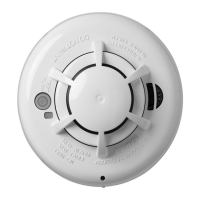
The PG9936/PG8936/PG4936 Series wireless smoke detector shall be installed and used
within an environment that provides the pollution degree max 2 and over voltages category II in
non-hazardous locations, indoor only. The equipment is designed to be installed by SERVICE
PERSONS only; (SERVICE PERSON is defined as a person having the appropriate technical
training and experience necessary to be aware of hazards to which that person may be
exposed in performing a task and of measures to minimize the risks to that person or other
persons).
1. Smoke Detector Placement
Research has shown that all hostile fires in homes generate smoke to a greater or lesser extent.
Experiments with typical fires in homes indicate that detectable quantities of smoke precede
detectable levels of heat in most cases. For these reasons, smoke alarms should be installed
outside of each sleeping area and on each storey of the home.
The following information is for general guidance only and it is recommended that local fire
codes and regulations be consulted when locating and installing smoke alarms. It is
recommended that additional smoke alarms beyond those required for minimum protection be
installed. Additional areas that should be protected include: the basement; bedrooms, especially
where smokers sleep; dining rooms; furnace and utility rooms; and any hallways not protected
by the required units. On smooth ceilings, detectors may be spaced 9.1 m (30 ft) apart as a
guide. Other spacing may be required depending on ceiling height, air movement, the presence
of joists, uninsulated ceilings, etc. Consult National Fire Alarm Code NFPA 72, CAN/ULC-S553
or other appropriate national standards for installation recommendations.
l Do not locate smoke detectors at the top of peaked or gabled ceilings; the dead air space
in these locations may prevent the unit from detecting smoke.
l Avoid areas with turbulent air flow, such as near doors, fans or windows. Rapid air
movement around the detector may prevent smoke from entering the unit.
l Do not locate detectors in areas of high humidity.
l Do not locate detectors in areas where the temperature rises above 38 ºC (100 ºF) or falls
below 5 ºC (41 ºF).
3


 To Next Page