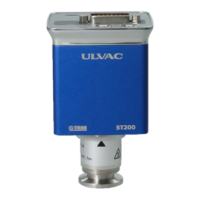
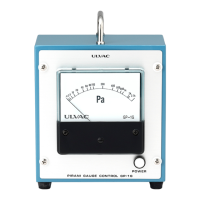
INSTALLING THE PIRANI GAUGE
- 8 -
2.2.2. Installing the sensor head
Do not connect the sensor head to a test
object of which pressure is in excess of
atmospheric pressure. If the pressure in the sensor head exceeds atmospheric
pressure, the sensor head will be damaged or it will pop out from the connector,
causing injury to the surrounding, including human body.
If the pressure
exceeds atmospheric pressure, provide an isolation valve so that the pressure in
the sensor head does not exceed atmospheric pressure.
Do not give an impact to the sensor head.
Install the sensor head to the gauge port of a vacuum system.
(1) Measuring position
• This gauge measures the static pressure in the position where the sensor head is connected.
If there is gas flow or an outgas source or an intense electron or ion generating source, the
measurement value will be affected. So select the measuring position carefully.
Note that if the sensor head is subjected to vibration, heat radiation, high intensity magnetic
field or intense radiation, correct pressure measurement may not be made.
• Because of its principles of operation, the Pirani vacuum gauge indication is affected by the
ambient temperature of the sensor head. Be careful that the ambient temperature deviates
considerably from the calibrating temperature (about 25°C).
(2) Installing the sensor head
• Install the gauge in such a manner that the sensor head mounting opening plane is parallel
with gas flow. See to it that gas does not enter the sensor head in the form of beam.
• The vacuum gauge filament is as thin as 25 microns in diameter. Avoid use in a place
where vibration is at a high level, if possible. Be careful in selecting the installation place
and handling the sensor because major cause of filament burnout is mechanical impact.
• To install the sensor head, use an O-ring that releases little outgas.
Use of a materiel that releases much outgas like rubber pipe or grease can be a cause of error.
2.2.3. Electrical connection
Check connection.
Before turning on power, make sure all cables are connected correctly. If cable
connection is incorrect, damage or fire can result.
The operating voltage of this gauge is 100 to 240 VAC. Check the line voltage
before connection. If incorrect power is applied, damage or fire can result.
• Make electrical connection after installing components.
• Fix the cable by taking care not to exert undue force to the connection between the sensor head and
sensor head cable and the connection between the controller and sensor head cable.
• Lay the sensor head cable away from power lines, if possible. Noise may occur.
• Securely fasten the connector fixing screw.


 To Next Page