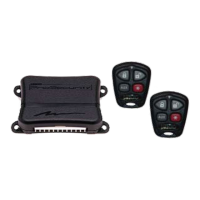
Ungo ProSecurity
will show between 1V and 6V AC. In multi-coil
systems, the system can learn individual coil wires.
Individual coil wires in a multi-coil system will register
lower amounts of AC voltage. Also, if necessary, the
system can use a fuel injector control wire for engine
speed sensing. Common locations for a tachometer
wire are at the ignition coil, back of the gauge cluster,
engine computers, and automatic transmission
computers.
How to Find a Tachometer Wire with a Multimeter
1. Set the multimeter to ACV or AC voltage (12V or
20V is fine)
2. Attach the (-) probe of the meter to chassis ground.
3. Start the vehicle and allow it to reach its normal idle
speed.
4. Probe the wire you suspect of being the tachometer
wire with the red probe of the meter.
5. If it’s the correct wire the meter will read between
1V and 6V.
Multi-Coil Systems
1. Examine the individual coils and determine which
wires are common on each coil. (Example: 2002
Chevy Pick-up: Each coil has 4 wires, three common
wires on each coil and the 4th wire changes.)
2. The “different” colored wire can be used for the
tachometer reference signal for the remote start
module. (Only one coil wire is necessary.)
3. Teach the tachometer reference signal to the
remote start module.
It is highly recommended to solder this connection,
due to the heat generated inside the engine bay.
Using t-taps or scotch-locks are likely to fail due to
heat.
Fuel Injection Wire
1. Examine the individual fuel injectors and determine
which wire(s) are common on each fuel injector.
2. The “different” colored wire can be used for the
tachometer reference signal for the remote start
module. (Only one fuel injector wire is necessary.)
3. Teach the tachometer reference signal to the
remote start module.
It is highly recommended to solder this connection,
due to the heat generated inside the engine bay.
Using t-taps or scotch-locks are likely to fail due to
heat.
Tachometer Reference Options
Tachless
If programmed to the voltage sense setting, the unit will
crank the starter for a preset timed duration. Once the
starter has been engaged, the system will check the
voltage level to verify the engine is running.
When using tachless operation, it is essential to deter-
mine the correct crank time to prevent damage to the
starter. It may take several remote start activations to
determine the crank time.
Some vehicles have many accessories, which are turned
on during remote start activation. In these vehicles, the
variations of voltage between the engine off and the
vehicle running is very slight and the remote start module
may “think” the vehicle has not started. This can cause
the remote start module to shut down after the vehicle
has been started. If this is the case, the Voltage Check
Level must be set to the LOW position.
Voltage sensing is not recommended in areas that
experience extreme cold temperatures. The resistance in
the vehicle’s wiring increases which can cause intermit-
tent remote start reliability.
Passive Anti-Theft Systems
Immobilizer (a.k.a. Transponder)
The Immobilizer uses an antenna ring around the ignition
cylinder to energize a small transponder chip hidden in
the ignition key. When the ignition is turned on, the chip
is energized and the antenna ring sends the code to the
Immobilizer control unit. The vehicle will only start if the
code matches the one programmed into the vehicle.
Passkey/VATS
The Passkey/VATS system consists of four parts: the
Passkey cylinder, the ignition switch, the instrument
cluster panel (ICP), and the power train control module
(PCM). The system requires that the key cylinder be
mechanically turned using a key. When the key cylinder
is properly turned, it generates a resistance code
(R-code), which is sent to the IPC. The vehicle will only
start if the R-code matches the key and ignition cylinder.
Passlock 2
The Passlock 2 system must see the correct resistance
code at the correct time. When the ignition system is
turned to the crank position, the “Bulb Check” wire is
switched to ground. This starts a time window during
which the instrument cluster panel (IPC) analyzes the
resistance code (R-code). If the R-code is valid and is
received in the proper window of time, the IPC sends a
code via data bus to the PCM to enable the fuel injection
128


 To Next Page
 Loading...