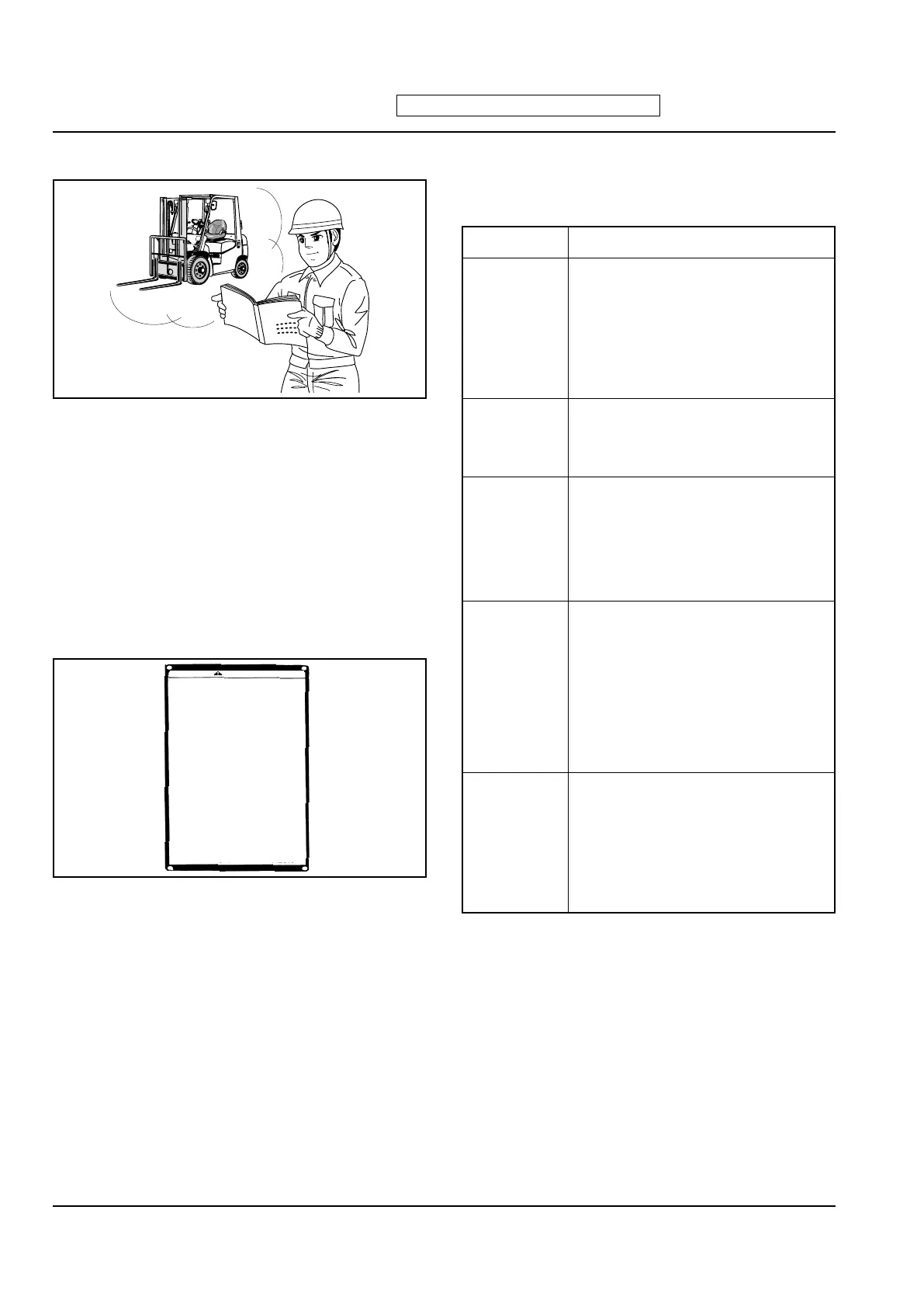
READ MANUAL AND DECALS
■
Read the Operation & Maintenance manual
and caution plates on the truck, and become
familiar with your truck and operating procedures.
Remember that individual lift trucks might be
different in design and construction from one
another. Observe the caution decals on the truck.
Keep this Operation and Maintenance manual on
the truck as a ready reference for anyone who may
drive or service it.
KEEP DECALS LEGIBLE
■
YOU MUST FOLLOW THESE RULES TO AVOID SEVERE INJURY OR
DEATH TO YOURSELF AND OTHERS.
1. Operate truck only if trained and authorized by your employer. Know
Operation & Maintenance Manual and all work rules.
2. Safety check truck every day. Do not start if damaged or faulty; stop if
problems start.
Repair allowed only by trained, authorized mechanics.
3. Turn, start, stop, and handle loads smoothly and slowly.
Carry loads low and tilted back; stack only on level using minimum tilt.
4. Look where you are going. Watch out for people, hazards on oors
and overhead, drop-offs and tail swing clearance.
5. Truck overturn can kill you. Slow for turns even when empty. Never
turn on inclines.
6. Do not lift overweight or loose loads.
Move slowly with wide, high, or long loads.
Keep forks wide and fully under loads.
Travel in reverse if loads block view.
Attachments require special training, ask your employer.
7. Keep loads upgrade on all inclines. Stay clear of ramp and dock
edges. Make sure dockboards and trailers are secure before going on
them.
8. Overhead guard and load backrest must be on truck.
Always keep yourself completely inside guard.
9. Stop engine when refueling. Follow Operation & Maintenance Manual
and employer’s work rules about fuel, battery and tire maintenance
hazards.
10. Forks can fall rapidly even with light loads.
Do not raise people or allow them under forks.
No passengers allowed on truck.
11. Park only in authorized areas, never on inclines.
Lower forks to bottom, put direction control in neutral, turn off key and
make sure parking brake is set.
12. Fasten the seat belt, when operating the lift truck.
WARNING
The decals on the truck describe safety precautions
and operating instructions. Replace any damaged
or missing decals. Check that the decals are legible
during regular inspections.
USE THE RIGHT TRUCK FOR THE JOB
■
Be sure the type and capacity of the lift truck is
suitable for the work environment.
Check Point Choice
Capacity Load capacities range from 0.5 to 42
tons. Pay particular attention to the load
center.
(UniCarriers Lift Truck Capacities: 0.5,
0.7, 0.9, 1, 1.35, 1.5, 2, 2.25, 2.5, 2.75, 3,
3.5, 4, 4.5, 5, 6, 7, 8, 10, 10.5, 11.5, 12,
13.5, 15, 18, 20, 22, 23, 24, 25, 30, 37,
or 42 tons.)
Power Source Gasoline, natural gas, diesel, and
battery- powered models are available.
Fuel costs and exhaust composition will
vary.
Balance On co u nte rb al anc ed mo de ls , th e
counterweight at the rear makes the
vehicle longer than reach trucks. A reach
truck performs loading and unloading
by extending the front part of the mast
outward, which gives it the advantage of
compactness.
Tires For indoor use, there are models with
solid tires (best for reach trucks) and
cushion tires (engine type or battery
type). Both are compact.
For outdoor use, pneumatic tires work
well. Solid cushion tires, with the same
dimensions as pneumatic tires, may be
the best choice in cases where the load
materials or surface conditions could
puncture pneumatic tires.
Flammable
Materials
For handling flammable materials
such as petrochemicals, a combustion
engine is too dangerous. An electric
vehicle with explosion-proof or safety-
reinforced construction is required. (A
battery power source always offers
better protection against fire than a
combustion engine.)
1-8
FOR SUPERVISORS
TYPES OF VEHICLES AND LOADS



 To Next Page