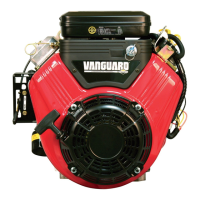
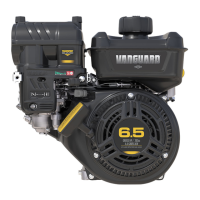
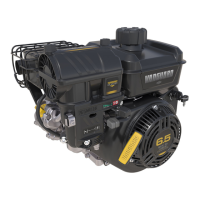
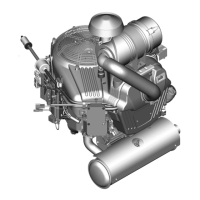
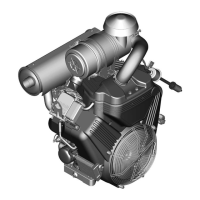
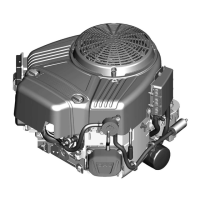
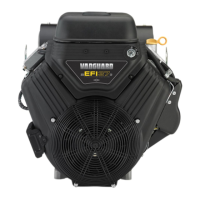
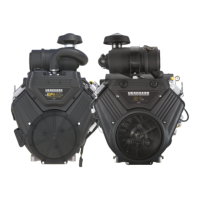
This document serves as an operator's manual for Vanguard® engines, specifically models 290000, 300000, 350000, and 380000. It provides essential safety information, operational guidelines, and maintenance instructions to ensure safe and efficient use.
Function Description
The Vanguard® engine is a gasoline-powered internal combustion engine designed for various outdoor power equipment. It features different starting systems, including Electronic Fuel Injection (EFI), Electronic Fuel Management System, and Choke System, catering to diverse operational needs and environmental conditions. The engine's controls include throttle, choke, starter switch, and fuel shut-off valve, allowing for precise management of engine operation.
Important Technical Specifications
The manual details specifications for three engine models: 290000/300000, 350000, and 380000.
For models 290000/300000:
- Displacement: 29.23 ci (479 cm³)
- Bore: 2.677 in (68 mm)
- Stroke: 2.598 in (66 mm)
- Oil Capacity: 46 - 48 oz (1.36 - 1.42 L)
- Spark Plug Gap: .030 in (.76 mm)
- Spark Plug Torque: 180 lb-in (20 Nm)
- Armature Air Gap (Carburetor Models): .008 - .012 in (.20 - .30 mm)
- Intake Valve Clearance: .004 - .006 in (.10 - .15 mm)
- Exhaust Valve Clearance: .004 - .006 in (.10 - .15 mm)
For model 350000:
- Displacement: 34.78 ci (570 cm³)
- Bore: 2.835 in (72 mm)
- Stroke: 2.756 in (70 mm)
- Oil Capacity: 46 - 48 oz (1.36 - 1.42 L)
- Spark Plug Gap: .030 in (.76 mm)
- Spark Plug Torque: 180 lb-in (20 Nm)
- Armature Air Gap (Carburetor Models): .008 - .012 in (.20 - .30 mm)
- Intake Valve Clearance: .004 - .006 in (.10 - .15 mm)
- Exhaust Valve Clearance: .004 - .006 in (.10 - .15 mm)
For model 380000:
- Displacement: 38.26 ci (627 cm³)
- Bore: 2.972 in (75.5 mm)
- Stroke: 2.756 in (70 mm)
- Oil Capacity: 46 - 48 oz (1.36 - 1.42 L)
- Spark Plug Gap: .030 in (.76 mm)
- Spark Plug Torque: 180 lb-in (20 Nm)
- Armature Air Gap (Carburetor Models): .008 - .012 in (.20 - .30 mm)
- Intake Valve Clearance: .004 - .006 in (.10 - .15 mm)
- Exhaust Valve Clearance: .004 - .006 in (.10 - .15 mm)
Engine power decreases with altitude and temperature: 3.5% per 1,000 feet (300 meters) above sea level and 1% per 10°F (5.6°C) above 77°F (25°C). The engine operates satisfactorily at angles up to 15°.
Usage Features
The manual provides detailed instructions for adding fuel, starting the engine, and operating the equipment.
- Fuel Recommendations: Use clean, fresh, unleaded gasoline with a minimum of 87 octane/87 AKI (91 RON). Gasoline with up to 10% ethanol (gasohol) is permitted. High altitude adjustments may be required for carbureted engines (above 5,000 feet / 1524 meters). EFI engines do not require high altitude adjustment.
- Adding Fuel: Always stop the engine and allow it to cool for at least two minutes before removing the fuel cap. Fill the tank outdoors or in a well-ventilated area, avoiding overfilling to allow for fuel expansion. Keep fuel away from ignition sources.
- Starting the Engine: Ensure the spark plug, muffler, fuel cap, and air cleaner are correctly installed. Do not crank the engine with the spark plug removed. For flooded engines, set the choke to OPEN or RUN and throttle to FAST. Avoid starting if there is gas leakage or using pressurized starter fluids. The manual outlines specific starting procedures for EFI, Electronic Fuel Management, and Choke systems, including rewind start (manual pull) and electric start.
- Operating the Equipment: Do not tilt the engine or equipment at an angle that causes fuel to spill. Do not choke the carburetor to stop the engine. Do not operate the engine without the air cleaner or air filter.
- Stopping the Engine: Procedures vary by start system, but generally involve moving a stop switch or key switch to the OFF position and closing the fuel shut-off valve.
Maintenance Features
Regular maintenance is crucial for the engine's longevity and performance. The manual provides a maintenance schedule and detailed instructions for each task.
- Maintenance Schedule:
- Every 8 hours or Daily: Check engine oil level, clean around muffler and controls.
- Every 100 hours or Annually: Replace spark plugs, change engine oil, replace oil filter (if installed), service air filter, clean pre-cleaner (if installed), service exhaust system.
- Every 250 hours or Annually: Check valve clearance (adjust if necessary).
- Every 400 hours or Annually: Replace air filter, replace fuel filter, service air cooling system, clean oil cooler fins.
- Oil Recommendations: Use Briggs & Stratton® Warranty Certified oils (SF, SG, SH, SJ or higher). The manual includes a viscosity chart to select the appropriate oil based on ambient temperature (e.g., SAE 30 for temperatures below 40°F, 5W-30 Synthetic for most outdoor power equipment, Vanguard® 15W-50 Synthetic for hot temperatures).
- Checking and Adding Oil: Ensure the engine is level, clean the oil fill area, and refer to specifications for capacity. Instructions include removing, cleaning, and reinserting the dipstick to check the oil level.
- Low Oil Protection System (if installed): If the oil level is low, the sensor will activate a warning light or stop the engine. Users are instructed to check and add oil if necessary.
- Servicing the Spark Plug: Check and adjust the spark plug gap using a wire gauge. Install and tighten to the correct torque.
- Servicing the Exhaust System: Remove debris from the muffler and cylinder area. Inspect for cracks, corrosion, or damage. Replace damaged parts.
- Changing Engine Oil: Drain warm oil into an approved container. Replace the oil filter if installed, lubricating the new filter's gasket with clean oil.
- Servicing the Air Filter: Instructions vary for models with and without a fuel tank. Tasks include opening fasteners, removing covers, nuts, and retainers, removing the air filter and pre-cleaner (if installed), tapping to loosen debris, washing the pre-cleaner, and reassembling. Do not use pressurized air or solvents to clean the filter.
- Servicing the Fuel System: Replace the fuel filter by draining the fuel tank or closing the fuel shut-off valve, squeezing clamps, and twisting fuel lines. Inspect fuel lines for cracks or leaks.
- Servicing the Cooling System: Clean debris from the air intake grille, linkages, springs, controls, and oil cooler fins (if equipped). For internal debris, professional service is recommended.
- Storage: Empty the fuel tank or ensure the fuel shut-off valve is closed. Store fuel and equipment away from ignition sources. Use an alcohol-free fuel stabilizer and ethanol treatment for fuel stored longer than 30 days.

 Need help?

 To Next Page
 General