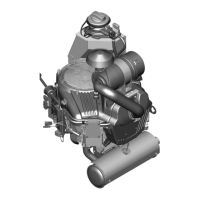
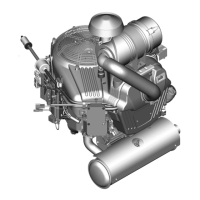
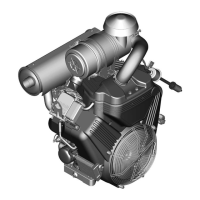
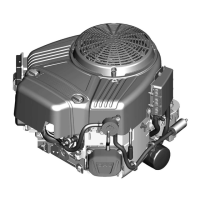
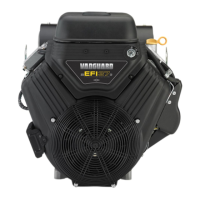
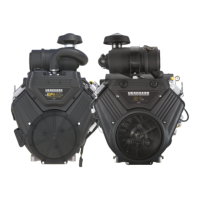
8. Rewind Start, if equipped: Tightly hold the starter cord handle (E, Figures 7, 8).
Pull the starter cord handle (E) slowly until resistance is felt, then pull it quickly.
WARNING
Fast retraction of the starter cord (kickback) will pull your hand and arm to the engine
faster than you can let go. Broken bones, fractures, bruises or sprains could result. To
prevent kickback when you start the engine, pull the starter cord slowly until resistance
is felt and then pull quickly.
9. Electric Start, if equipped:Turn the key switch (D, Figures 7, 8) to the ON or
START position.
NOTICE
To extend the life of the starter, use short start cycles (five seconds maximum). Wait one
minute between start cycles.
10. As the engine warms, move the choke control (C, Figures 9, 10) to the OPEN
position.
NOTE:If the engine does not start after 2-3 attempts, contact your local dealer or go to
vanguardpower.com or call 1-800-999-9333.
Stop the Engine
WARNING
Fuel and its vapors are flammable and explosive. Fire or explosion could result in
burns or death.
• Do not choke the carburetor (if equipped) to stop the engine.
1. Stop Switch, if equipped: Move the stop switch (F, Figure 11) to the OFF position.
2. Key Switch, if equipped: With the throttle control, if equipped, in the SLOW
position, turn the key switch (D, Figure 11) to the OFF position. Remove the key
and it in a safe location out of reach of children.
3. After the engine stops, move the fuel shut-off (A, Figure 11), if equipped, to the
CLOSED position.
Maintenance
Maintenance Information
WARNING
Fuel and its vapors are flammable and explosive. Fire or explosion could result in
burns or death.
Duringmaintenanceif it is necessary to tilt the unit, make sure that the fuel tank, if
mounted on the engine, is empty and that the spark plug side is up. If the fuel tank is not
empty, leakage can occur and could result in a fire or an explosion. If the engine is tilted
in a different direction, it will not easily start because of oil or fuel contamination of the air
filter or the spark plug.
WARNING
Accidental engine spark can cause an electric shock, fire or explosion and could
result in entanglement, traumatic amputation or laceration.
Before you make adjustments or repairs:
• Disconnect all spark plug wires and keep them away from the spark plugs.
• Disconnect the battery wire from the negative battery terminal (only engines with
electric start).
• Use only the correct tools.
When you check for spark:
• Use an approved spark plug tester.
• Do not check for spark with the spark plug removed.
WARNING
All the components used to assemble this engine must stay in the initial position
for correct operation. Damage or injury can occur if you use incorrect parts or you
do not replace all parts on the engine.
• Replacement parts must be of the same design and installed in the same
position as initial parts.
• If installed, do not change the governor spring, links, or other parts to increase
the engine speed.
See a Briggs & Stratton Authorized Service Dealer for all maintenance and servicing of
the engine and engine parts.
Emissions Control Service
For maintenance, replacement, or repair of emissions control devices and
systems, contact a qualified off-road engine repair establishment or service
technician. However, for "no charge" emissions control service, the work must be done
by a factory authorized dealer. Refer to the Emissions Control Statements.
Maintenance Schedule
Intervals of 8 Hours or Daily
• Check the engine oil level.
• Clean the area around the muffler and controls.
Intervals of 100 Hours or Annually
• Replace the spark plugs.
• Change the engine oil.
• Replace the oil filter (ifinstalled).
•
Service the air filter
1
.
•
Clean the pre-cleaner (if installed)
1
.
• Service the exhaust system.
Intervals of 250 Hours or Annually
• Check the valve clearance. Adjust if necessary.
Intervals of 400 Hours or Annually
• Replacethe air filter.
• Replace the fuel filter.
•
Service the air cooling system
1
.
•
Clean the oil cooler fins
1
.
1
Clean more frequently in dusty conditions or when many particles are in the air.
Electronic Fuel Injection (EFI) System
The EFI System monitors engine temperature, engine speed, and battery voltage for
engine start-up and warm-up. There are no adjustments on the system. If start-up or
operation problems occur, contact a Briggs & Stratton Authorized Service Dealer.
NOTICEMake sure to obey the steps that follow or damage to the EFI system could
occur.
• DO NOT start the engine if the battery cables are loose.
• Turn the key to the OFF position before you disconnect, remove, and / or install
the battery.
• DO NOT use a battery charger to start the engine.
• DO NOT disconnect the battery cables during engine operation.
• When you disconnect the battery cables, first connect the positive (+) cable, and
then connect the negative (-) cable to the battery.
• When you charge the battery, turn the ignition switch to the OFF position,and
disconnect the negative (-) battery cable from the battery.
• DO NOT spray water directly on the Electronic Control Module.
Electronic Fuel Management System
The Electronic Fuel Management System monitors engine temperature, engine speed,
and battery voltage to adjust the choke during engine start-up and warm-up. There
are no adjustments on the system. If start-up or operation problems occur,speak to
aBriggs & StrattonAuthorized Service Dealer.
NOTICEMake sure that you follow these rules or the Electronic Fuel Management
System could be damaged.
• DO NOT start the engine if the battery cables are loose.
• Before you connect the jump start cables, or disconnect or reconnect the battery
cables, turn the ignition switch to the OFF position. When you charge the
battery, turn the ignition switch to the OFF position.
• When you disconnect the battery cables from the battery, disconnect the
negative (- ) cable, and then disconnect the positive (+) cable to the battery.
When you connect the battery cables to the battery, connect the positive (+)
cable, and then the negative (-) cable to the battery.
• DO NOT use a battery charger to start the engine.
• DO NOT disconnect the battery cables during engine operation.
• DO NOT spray water directly on the Electronic Control Unit.
Carburetor and Engine Speed
Do not make adjustments to the carburetor, governor spring, linkages, or other parts
to adjust the engine speed. If adjustments arenecessary,contact a Briggs & Stratton
Authorized Service Dealer forservicing.
9


 To Next Page