_______________________________________________________________________________________________________________________________________________________
4
1. Assembly (Skipping this can lead to troubles ! )
Ok, so we have your attention. These hints will help you to make this project successful.
Read them carefully.
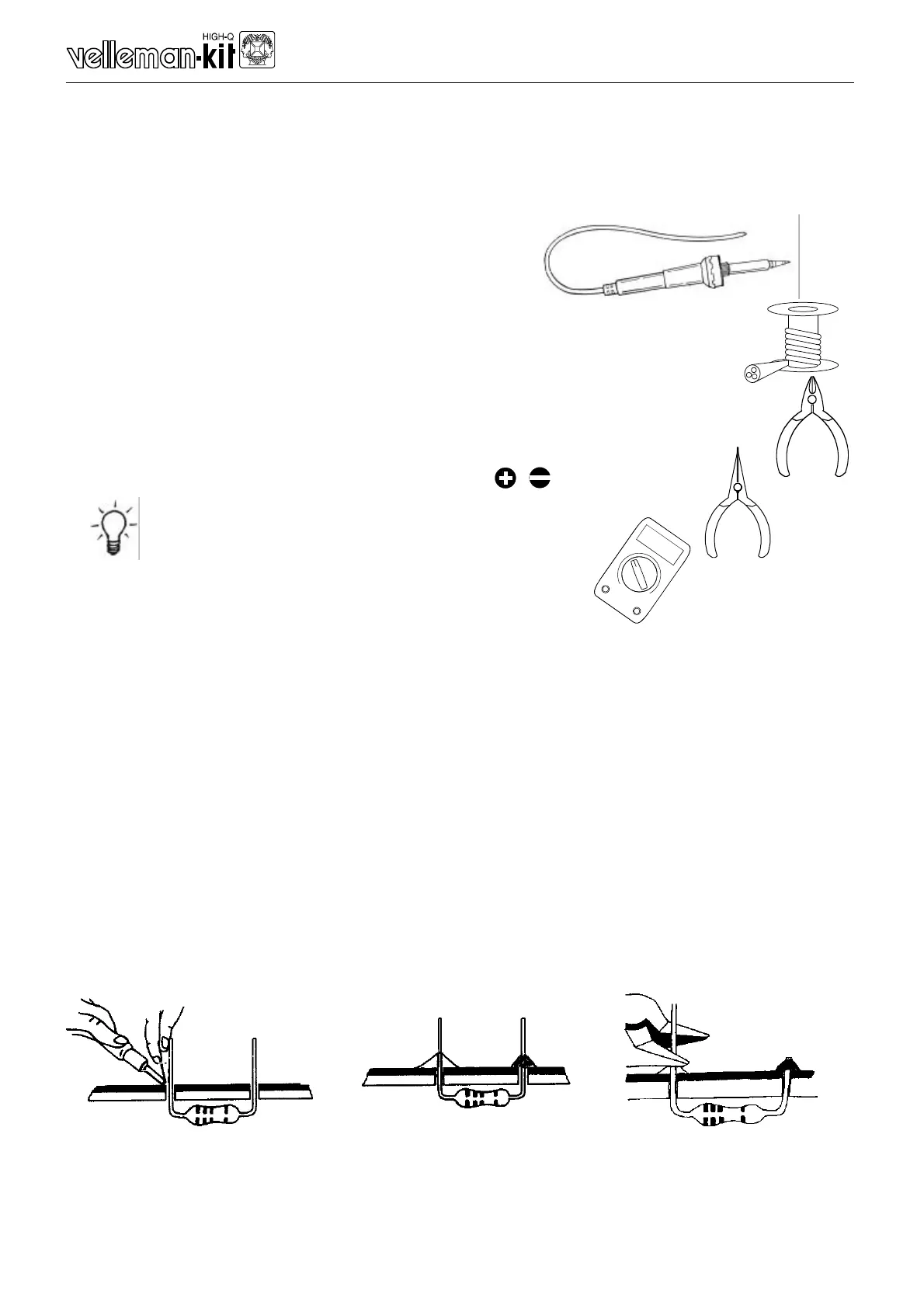
1.1 Make sure you have the right tools:
• A good quality soldering iron (25-40W) with a small tip.
• Wipe it often on a wet sponge or cloth, to keep it clean;
then apply solder to the tip, to give it a wet look. This is
called ‘thinning’ and will protect the tip, and enables you
to make good connections. When solder rolls off the tip, it needs cleaning.
• Thin raisin-core solder. Do not use any flux or grease.
• A diagonal cutter to trim excess wires. To avoid injury when cutting excess leads,
hold the lead so they cannot fly towards the eyes.
• Needle nose pliers, for bending leads, or to hold components in place.
• Small blade and phillips screwdrivers. A basic range is fine.
For this projects, a basic multi-meter is required
1.2 Assembly Hints :
þ Make sure the skill level matches your experience, to avoid disappointments.
þ Follow the instructions carefully. Read and understand the entire step before you perform each op-
eration.
þ Perform the assembly in the correct order as stated in this manual
þ Position all parts on the PCB (Printed Circuit Board) as shown on the drawings.
þ Values on the circuit diagram are subject to changes.
þ Values in this assembly guide are correct*
þ Use the check-boxes to mark your progress.
þ Please read the included information on safety and customer service
* Typographical inaccuracies excluded. Always look for possible last minute manual updates, indicated
as ‘NOTE’ on a separate leaflet.
1.3 Soldering Hints :
Mount the component against
the PCB surface and carefully
solder the leads
Make sure the solder joints are
cone-shaped and shiny
Trim excess leads as close as
possible to the solder joint
0.000


 To Next Page