3.2.2 Fuel connections
The following, but not limited to the following, additional fuel connection related points, applying to all engines unless
otherwise stated, must be considered.
• Fuel pickup should be at least 25 mm (1 in.) from the bottom of fuel tank, to prevent picking up impurities.
• The fuel lines (both supply- and return line) should be copper, tubing 8 mm (5/16 in.) outer diameter. The fuel lines can
be plumbed to the exible hoses mounted at the bed of the generator set.
• If the generator set is positioned at a higher level than the tank it is recommended to run the fuel return line to approx.
1 cm (3/8”) from the bottom of the tank so to prevent possible syphoning when the generator set is not running.
• A exible fuel line must be used to connect fuel supply line to fuel inlet tting on the generator set to absorb deec-
tion when engine is running. Injection pump fuel return line must also have a exible rubber hose segment.
• On Multi-Engine Diesel Installations: Use a separate tube for the fuel supply line and fuel return line, for each engine.
• Larger diameter (than previously specied) lines and ttings must be used on installations requiring long lines or
numerous ttings.
• Fuel line(s) should be installed free of stress and rmly secured to prevent vibration and/or chang.
• Sharp bends in fuel lines should be avoided.
3.2.3 Shut o valve
The generator set is equipped with a electrically operated shut o valve. But in the supply line, as close as possible to the
tank, a shut o valve must be installed too.
Make sure the boat owners know the location and how to operate it.
3.2.4 Diesel fuel Pre-lter and fuel additives.
There is the possibility that contamination of diesel fuel and algae growth in the diesel fuel could block the lift pump
resulting in poor performance.
IMPORTANT
The engine is provided with an element type fuel lter, but to help eliminate water and
dirty it is recommended to use an additional 10 micron lter that has a water separator.
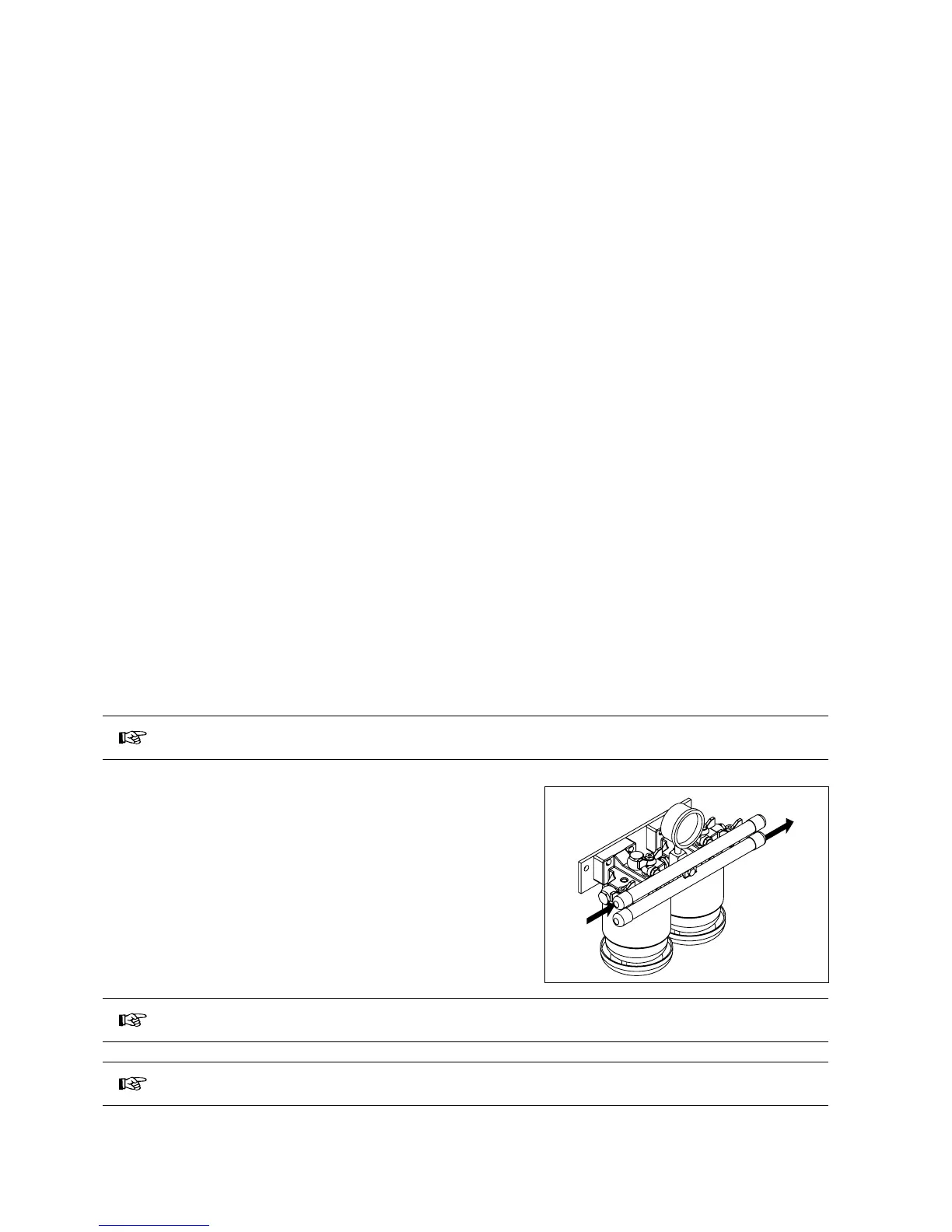
It is recommended to install an additional fuel lter equipped with a
water separator before the fuel lift pump. We recommend a 10 micron,
190 l/h (42 Imp. gph, 50US gph) per hour rated lter Vetus type 330
VTEB. This will help to lter out contaminants in diesel fuel.
Select a suitable position in the fuel system between the fuel supply
pump and the fuel tank for the additional lter The position selected
must be free from vibrations, and allow for easy inspection and replace-
ment. It is also recommended that a diesel fuel additive be used to
combat algae growth, particularly in warmer climates. Additives reduce
the chances of algae growth in the diesel fuel in warmer clime.
IMPORTANT See the certication data on the lter i.e CE,ABYC or Solas
IMPORTANT For fuel hose use A1 quality tube for petrol and diesel with NBR inside.


 To Next Page