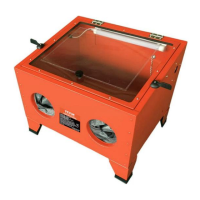
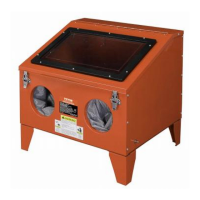
and body shop cleaning applications. The cabinet requires a standard, clean, dry,
3. OPERATING INSTRUCTIONS
WARNING! Ensure you read,understand and apply safety instructions in section 1
before using the unit.
NOTE! We strongly recommend that a suitable dust extraction system is used with
this unit.
If dust extraction is not used,media may be forced out of the joins as pressure
builds up.You can alleviate this to some extent by removing the white blanking
plug (Fig.1) situated on the upper left corner at the rear of the tank when viewed
from the front. This However will not substitute a suitable dust extraction system.
3.1. Connect the air supply to the inlet on the front of the cabinet. Ensure the gun
valve is in the "off" position before connecting the air supply.
3.2. Check all fittings to ensure that there are no air leaks.
3.3. Pour the abrasive media into the centre of the cabinet. DO NOT use more
than 10lbs (4.5kg). Excessive amounts of abrasive will impair visibility.create poor
blasting performance and could block the air exhaust.
3.4. Fit suitably sized jet(33A) and nozzle (33) into the gun bore and retain with the
set screws. The larger the abrasive particles the larger the jet and nozzle required.
3.5. Plug the transformer into a mains socket and the transformer lead into the
socket on the back of the cabinet.
3.6. Place the workpiece in the cabinet and close and latch the door(s) securely.
WARNING! Failure to securely close the doors could result in damage and/or
personal injury.
3.7. Turn on light (switch to left of viewing window) and air supply and insert hands
into cabinet gloves. Grasp gun and depress the trigger to start the blasting
process.
3.8. Move the blast media(which looks like steam) continuously over the workpiece
in an even and circular motion. To avoid undesirable peening the flow should not
be too hard or concentrated. The surface finish may vary from coarse to fine
depending on the size of the abrasive media. On delicate workpieces, to avoid
unnecessary peening or excessive abrasion, begin the blasting with a low airflow.


 To Next Page