CONTROL CABINETS - TECHNICAL MANUAL EN-UK - V.1.3 - 14/07/16
DE
29
AUDIO & VIDEO CONTROL CABINETS
There are two ways in which to mount the cabinet to the wall. This will depend on which cabinet knockouts
are being used. The rst option is to mount it directly to the solid wall. If mounting in this way then only the
cabinet knockouts along the top and bottom of the cabinet can be used. The second option is to mount the
cabinet o the wall on spacers thereby leaving a gap between the base plate of the cabinet and the wall.
Mounting in this way will allow the knockouts on the rear of the cabinets to be used.
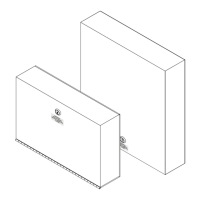
CAB1 and CAB2 Mounting
For the CAB1, using the mounting holes template shown in Fig.5A, mark out the xing hole positions on the
wall where the cabinet is to be xed.
For the CAB2, using the mounting holes template shown in Fig.5B, mark out the xing hole positions on the
wall where the cabinet is to be xed.
Option 1: Mounting directly to the wall
It is recommended that when mounting the cabinet directly to the wall the following are used: 3x at head
self-tapping countersunk masonry/concrete screws with a Ø5mm to Ø5.5mm (diameter) and between 40-
50mm length. 3x expansion type rawl plugs (for use in solid walls) with a Ø5.5mm to Ø6mm (diameter) and
between 35-40mm length. 6x M5 size at metal washers (2 washers per xing position).
After the cabinet xing positions have been marked out a Ø5.5mm to Ø6mm (diameter) masonry/concrete
drill bit should be used to drill out the holes in the wall (the diameter of the drill bit used will depend on the
size of the rawl plug used). The rawl plugs can be pushed into the holes. The cabinet can then be tted into
position placing an M5 washer on either side of the cabinet base plate where the xing hole is located and
the self-tapping screw can be securely tightened into place (refer to Fig.6A).
Option 2: Mounting o the wall
It is recommended that when mounting the cabinet o the wall the following are used: 3x at head self-
tapping countersunk masonry/concrete screws with a Ø5mm to Ø5.5mm (diameter) and between 50-60mm
length. 3x expansion type rawl plugs (for use in solid walls) with a Ø5.5mm to Ø6mm (diameter) and between
35-40mm length. 3x nylon spacers with at least an internal diameter Ø6mm and between 10-15mm length.
6x M5 size at metal washers (2 washers per xing position).
After the cabinet xing positions have been marked out a Ø5.5mm to Ø6mm (diameter) masonry/concrete
drill bit should be used to drill out the holes in the wall (the diameter of the drill bit used will depend on the
size of the rawl plug used). The rawl plugs can be pushed into the holes. The cabinet can then be tted into
position placing an M5 washer on either side of the cabinet base plate where the xing hole is located. The
nylon spacer should be placed between the washer and the rawl plug in the wall. The self-tapping screw can
be passed through the xing assembly and then securely tightened into place (refer to Fig.6B).
Once the cabinets have been mounted to the wall the various incoming cables can be routed through the
knockouts. In order to secure the cables and keep them tidy within the cabinet cable ties can be used. PVC/
rubber cable grommets or nylon snap cable bushings can be used to keep the incoming cables secure to the
cabinet knockout positions. For the circular knockouts a Ø20mm (diameter) grommet can be used and for
the 13.5mm x 25mm knockouts PVC or nylon rectangular grommets can be used.
Securing Cabinet Cables
IMPORTANT NOTE: Any of the cabinet xings mentioned above (mounting screws, rawl plugs, grommets,
cable ties, cable bushings and spacers etc.) can be sourced from any high street hardware store/specialist e.g.
Wickes, B&Q, Screwx etc. or from similiar online websites. Videx do not provide these xings.


 To Next Page