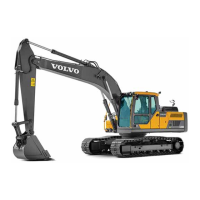
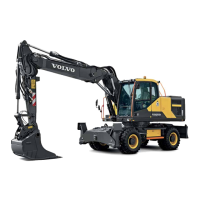
Check also that no water has entered the travel
gearbox.
NOTICE
Risk of machine damage.
When operating the machine in water, the water
can damage the machine parts.
When operating in water, do not exceed the
maximum permissible water depth.
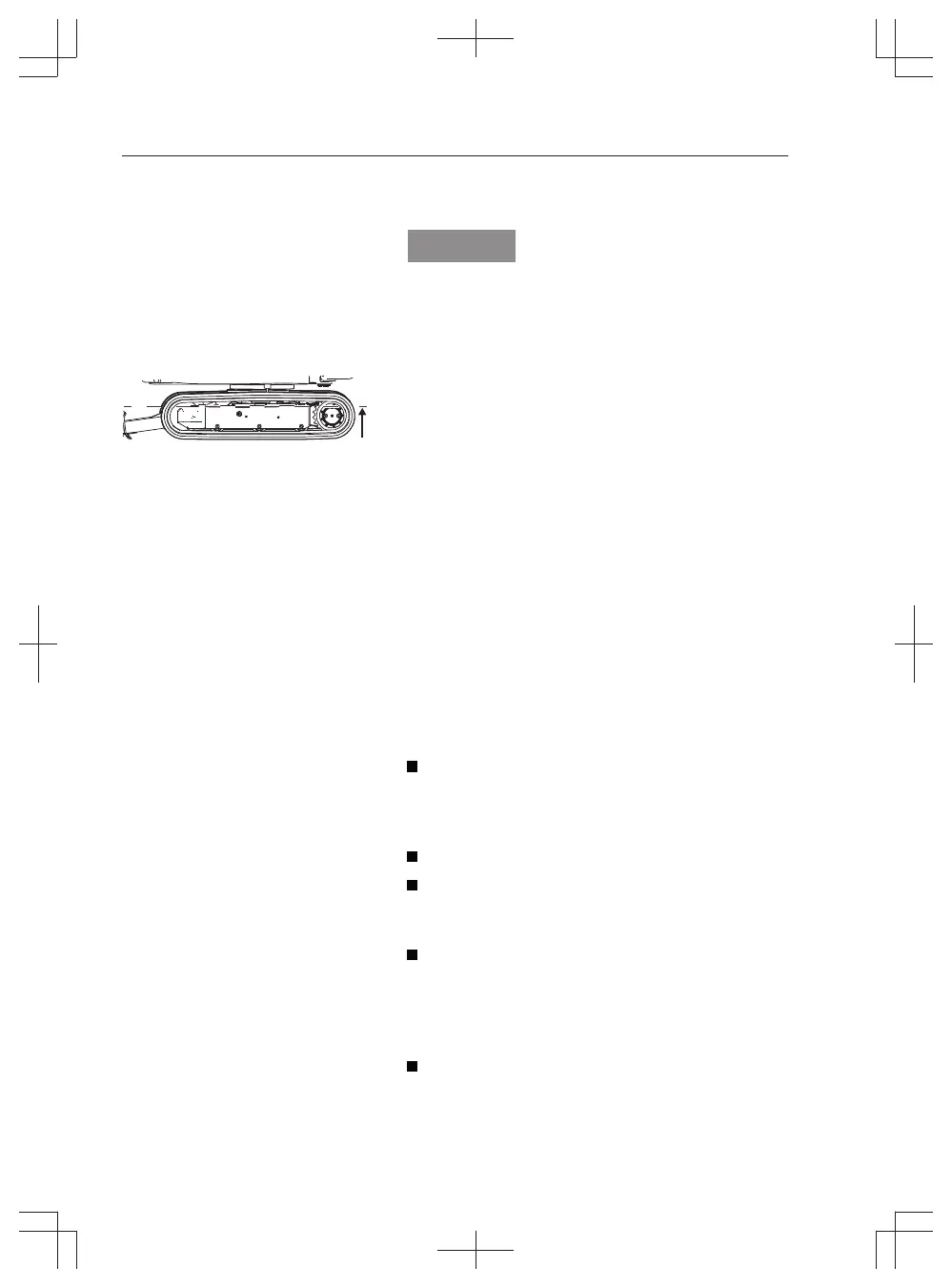
NOTE!
The water must not reach higher than the
designated level on undercarriage (see illustration
left).
Heavy timber mats can be used to support the
machine when working on boggy ground. The mats
should be kept as flat and clean as possible.
Working where there is risk of landslip
Always check ground conditions before beginning
to work. If the ground is soft, great care must be
taken when positioning the machine. Thawing of
frozen ground, rain, traffic, piling and blasting are
factors which increase the risk of landslip. The risk
also increases on sloping ground. If it is not possible
to dig with sufficiently slanting trench sides, they
must be shored up.
Do not place excavated material too close to the
edge as its weight may cause a landslip. Loose
clay should be placed at least 5 m (16 ft) away
from the edge.
Do not dig under the machine.
Do not operate too close to the edge of a steep
slope or road bank. Take care when working in a
place where the machine may tip.
Take care when working on river banks or in other
similar places where the ground is soft. There is
a risk that the machine, because of its own weight
and own vibrations, may sink and this could lead
to accidents.
Keep in mind that the ground conditions may
have changed after heavy rain. Therefore, be
careful when restarting work. This is particularly
important when working near the edge of ditches,



 To Next Page