1.3
RANDOM
ACCESS DATA STORAGE
The disk drive provides
a
high
volume
of
random
access program
and data
storage from
which
data emd
progreuns
may be
rapidly
accessed. Each storage
location on the disk has a
unique identification
tag
or
address which
can be
directly accessed by
the system. Thus, unlike
sequential-access storage
devices (such as
magnetic
tape
drives, punched
tape, and card
readers)
,
the
disk does not
have
to
read sequentially through
a file in order
to locate
a
desired
item of information. Instead, the disk can skip
over all
intervening
records
and directly access a specified location for
data storage or
retrieval.
Hence, random-access devices are also referred
to as direct-access
devices
.
Random access
capability is very valuable
when interrogating
or updating
a
large
file, since
in many
cases, the records
are not
accessed
in
sequential
order. Even
in sequential-processing operations,
however, the
disk is
usually
as
fast or
faster than most other external
storage devices.
1.4 THE DISK PLATTER
The storage medium of all disk units is
the disk
platter. A disk
platter
is
a
thin, flat,
rigid
circular
plate. It is
coated on one or
both
sides
with
a
magnetic material,
usually iron onide,
and
except that it
has no
apparent
grooves,
closely resembles
a
phonograph
record. The
magnetic
iron
oxide
on each recording surface is arranged
in concentric
tracks.
Information
is
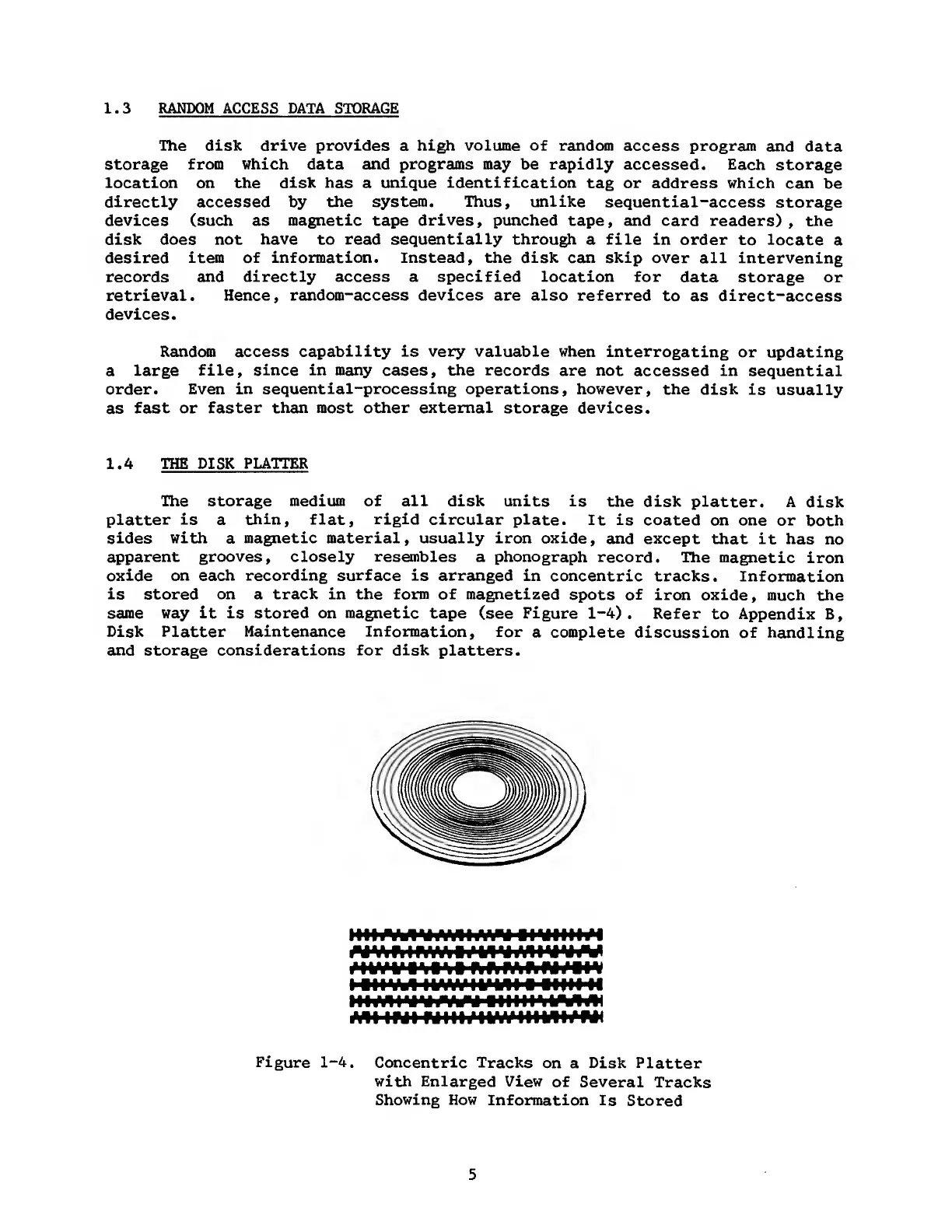
stored on a track in the form of magnetized
spots of iron oxide,
much the
same way it is stored on magnetic
tape (see
Figure
1-4)
. Refer
to Appendix B
,
Disk Platter Maintenance Information, for
a
complete
discussion of
handling
and
storage considerations for disk
platters.
II I
I^VWIM^
WWI^WM I
IMIIII^I
I IllVyi IWWIMWI l
H
II I
I
IllWi
y^^ftW
IIIII I
^IWI^I
#11 INI MIIIHIIWI
I
IWI^WI
Figure
1-4.
Concentric Tracks
on a Disk Platter
with Enlarged View
of Several
Tracks
Showing How
Information
Is Stored


 To Next Page