1.5
SECTORS
ON THE
DISK PLATTER
In
general,
it is desirable to be
able
to
store and
retrieve information
in units
smaller than an
entire track.
For this reason, each track is
divided
into
a
number
of discrete
segments
called sectors. A sector is the smallest
discrete
unit
of storage
on the
disk and has
a
fixed storage capacity of 256
bytes.
Each
sector
carries its
own
sector
address, and can be directly
accessed by
the system.
On
a
Model
2280/2280N disk platter, each track is
divided
into
64 sectors.
In addition to
the
256
bytes
in
each sector
reserved for
data
storage,
the
disk
processing unit
records
several
bytes
of control information,
including
sector
address and
an error correcting code
(ECC)
.
The
sector
address
is,
of course,
needed
to
enable the system to
uniquely identify and
access
each
sector.
The ECC is used by
the system
to
monitor the integrity of
data
stored
in the
sector
and
to
correct certain
types
of
data
recording
errors.
All system
control
information is created, interpreted and
maintained
solely
by
the
disk controller and
is completely transparent and inaccessible
to
the
user.
1.6
TRACK
AND SECTOR
NUMBERING
ON THE DISK
PLATTER
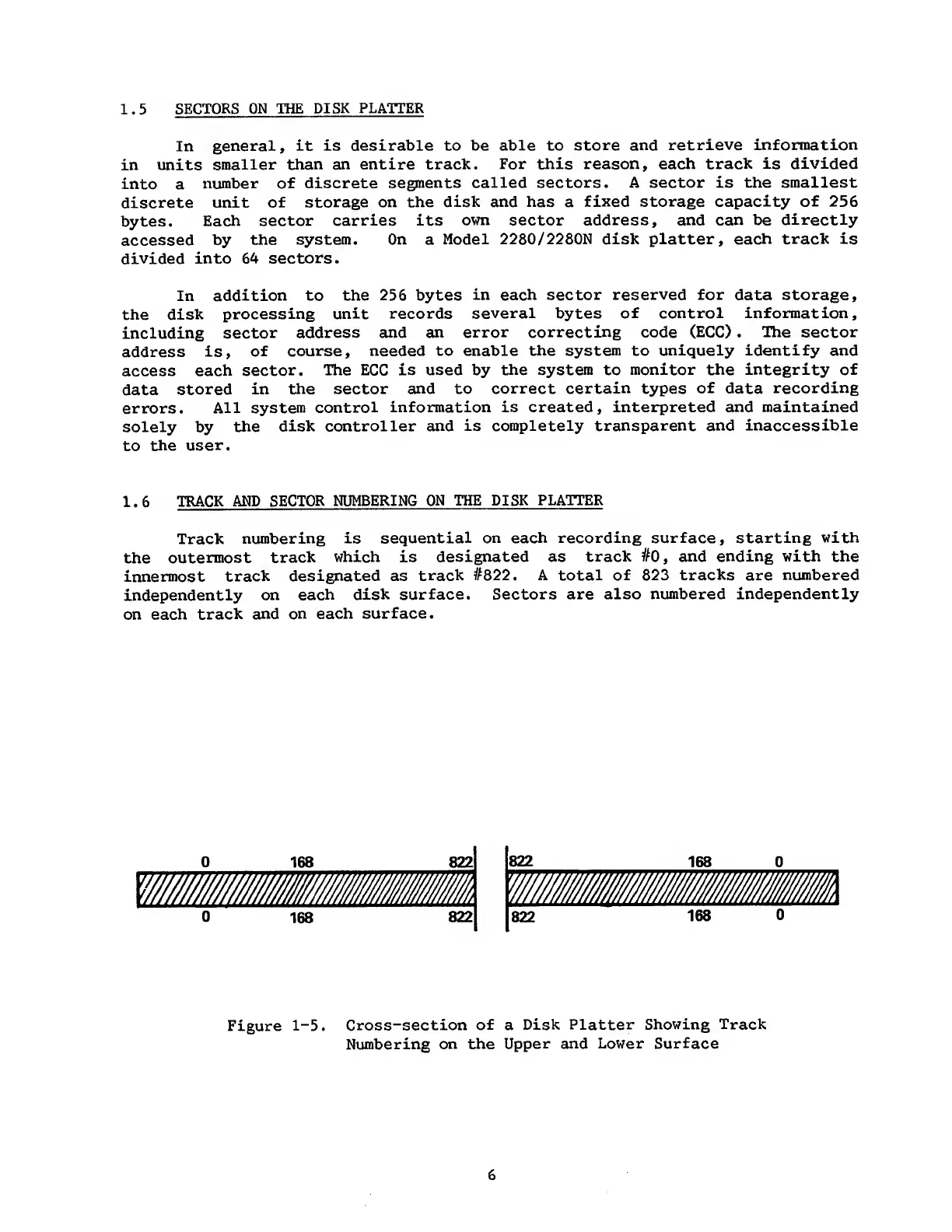
Track
numbering
is sequential
on each recording surface, starting
with
the
outermost
track
which is
designated
as
track
#0,
and ending with
the
innermost
track
designated as
track
#822. A total of 823 tracks are numbered
independently
on each
disk surface.
Sectors are also
numbered independently
on
each track
and on
each surface.
168
822I
m///mmmimmi/m/i/////A
168
822|
822
168
PW/Ji^^^^/^
822
168
Figure
1-5.
Cross-section
of
a
Disk Platter
Showing Track
Numbering
on the Upper
and Lower Surface


 To Next Page