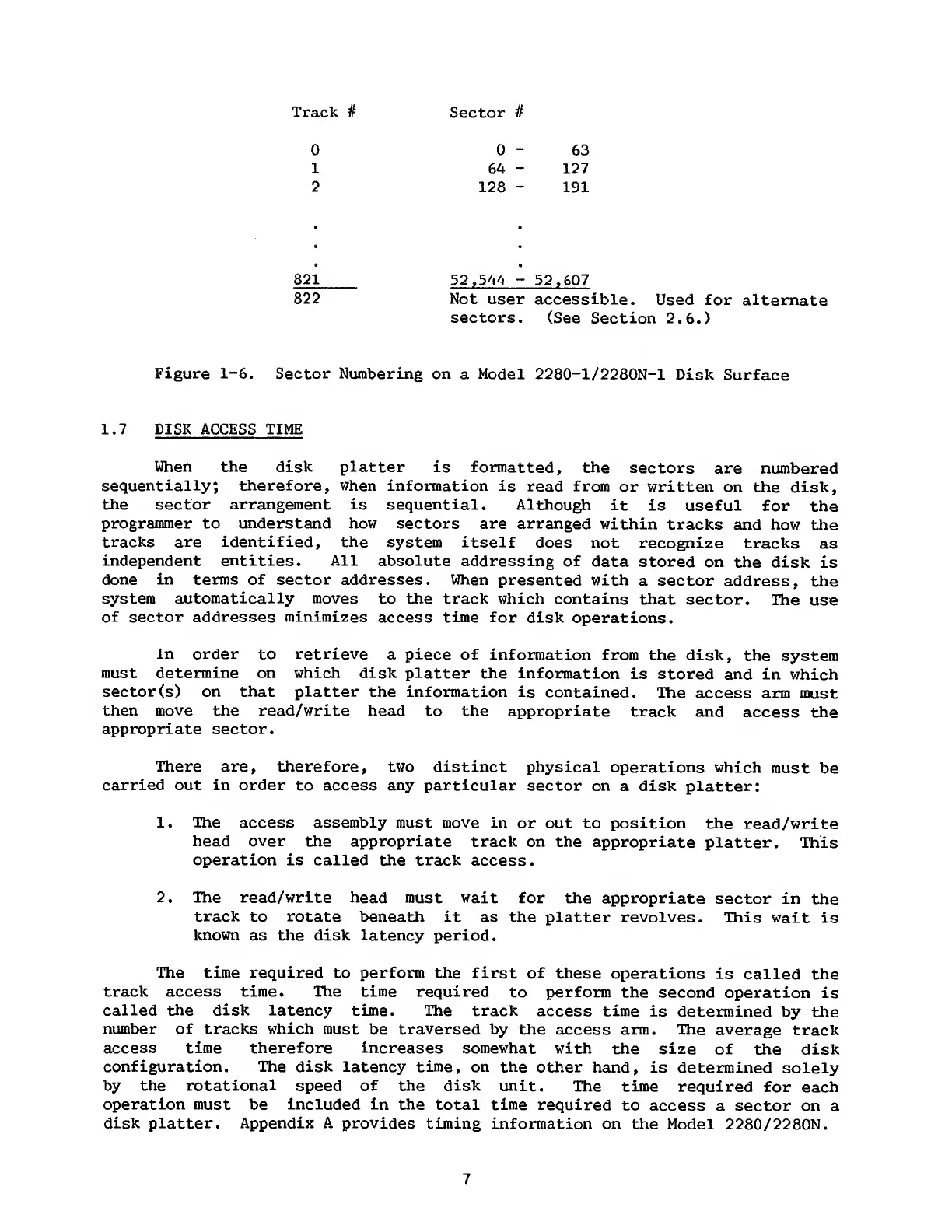
Track #
1
2
Sector #
-
63
64
-
127
128
-
191
821
52.544
-
52.607
822
Not user
accessible.
Used
for
alternate
sectors.
(See Section
2.6.)
Figure
1-6.
Sector Numbering on
a Model
2280-1/2280N-1 Disk
Surface
1.7 DISK ACCESS TIME
When the disk platter is
formatted,
the
sectors are
numbered
sequentially;
therefore,
when information
is read from
or written
on
the disk,
the sector arrangement is
sequential. Although
it
is useful
for
the
programmer
to
understand
how sectors are
arranged
within tracks
and how
the
tracks are
identified, the
system itself
does not
recognize
tracks
as
independent entities. All
absolute addressing
of data
stored on
the disk
is
done in terms of sector addresses.
When
presented with
a sector
address,
the
system automatically moves
to
the track
which contains
that
sector.
The
use
of
sector
addresses
minimizes
access
time for
disk operations.
In order
to retrieve
a piece of information
from
the disk,
the
system
must determine on which disk
platter the
information
is stored
and in
which
sector
(s)
on that platter
the information
is contained.
The
access arm
must
then move the read/write head
to the appropriate
track
and access
the
appropriate sector.
There are, therefore,
two distinct
physical
operations
which
must
be
carried out in order
to access
any
particular
sector on
a disk platter:
1. The
access
assembly
must move in
or out to
position
the read/write
head over
the appropriate
track on the
appropriate
platter. This
operation
is called the track
access.
2. The read/write
head must wait
for the
appropriate
sector
in the
track
to rotate beneath it
as
the platter
revolves.
This
wait is
known
as the disk latency period.
The
time required
to
perform
the first of
these operations
is
called the
track access time. The time required
to
perform
the
second operation
is
called the disk latency
time. The track
access time
is determined
by the
number of tracks which
must
be
traversed
by the access arm. The
average track
access time therefore increases
somewhat with
the size
of
the disk
configuration. The disk latency time, on
the other hand,
is
determined
solely
by
the rotational
speed
of the disk
unit.
The time
required
for each
operation must
be
included in
the total time
required
to access
a sector on
a
disk
platter.
Appendix A provides
timing information
on
the Model
2280/2280N.


 To Next Page