Need help?
Do you have a question about the WARPP INTIG 402 PULSE and is the answer not in the manual?
Guidelines for wearing recommended safety gear like glasses, flame-proof clothing, and gloves, and avoiding loose items.
Ensuring secure connections, qualified personnel for high voltage work, fire equipment readiness, and avoiding maintenance during operation.
Advises on ventilation and extraction to manage dangerous fumes and gases during welding.
Highlights risks of arc rays to eyes and skin, recommending protective screens, filter lenses, and clothing.
Warns about sparks (spatter) causing fire and emphasizes keeping flammable materials away.
Advises on protecting ears from excessive noise and warning bystanders of the risk.
Specifies requirements for the welding machine's location, considering sunlight, rain, dust, humidity, and wind.
Details required input voltage (380-440V, 50Hz) and acceptable 3-phase voltage unbalance.
Ensures personal safety, proper operation, and reduced EMI through proper grounding and 4-wire service.
Explains how to select welding modes (ARC, TIG, PULSE TIG) and operation modes (2T, 4T).
Details the function of the knob for selecting and adjusting parameters like pre-flow, current, and post-flow.
Lists parameters with their minimum and maximum adjustable ranges, such as current, frequency, and time settings.
Covers cautions for industrial use, maintenance by authorized personnel, and the impact of unauthorized repairs on the guarantee.
Guides on checking and cleaning the power source and welding torch to ensure trouble-free operation and prevent overheating.
Provides a table for diagnosing common faults like 'no arc' or 'poor welding performance' and lists specific error codes (Err 001, Err 002).
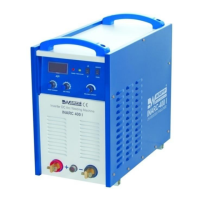
The WARPP INTIG 402 PULSE is a welding machine designed for industrial use, offering reliable welding and cutting capabilities. This manual provides detailed instructions for its safe and effective operation, emphasizing adherence to safety procedures and regular maintenance.
The INTIG 402 PULSE is a versatile welding machine capable of performing three main welding modes: ARC Welding, TIG Welding, and Pulse TIG Welding. It features a front panel with various controls for precise parameter adjustment, allowing users to tailor the welding process to specific requirements. The machine supports both 2T and 4T trigger modes, providing flexibility in how the welding arc is initiated and maintained.
The INTIG 402 PULSE offers a user-friendly interface with clear displays and intuitive controls.
The manual strongly emphasizes safety, outlining several critical precautions:
Regular maintenance is essential for safe and reliable operation.
The manual provides guidance for troubleshooting common issues:
Welding equipment, primarily composed of steel, plastic, and non-ferrous metals, must be handled and disposed of according to local environmental regulations.
This comprehensive guide ensures that users can operate and maintain the WARPP INTIG 402 PULSE welding machine safely and efficiently, maximizing its lifespan and performance.
 General
| Brand | WARPP |
|---|---|
| Model | INTIG 402 PULSE |
| Category | Welding System |
| Language | English |

 To Next Page